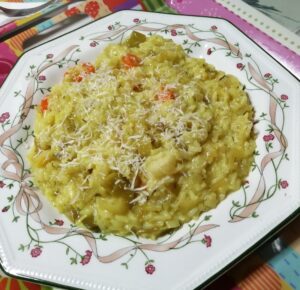
Greek leek risotto (Prasorizo)

Do you have leeks in the fridge? You can make this sweet ambrosia in no time!

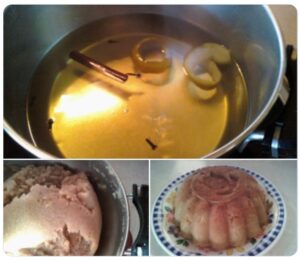
Prasorizo is a wonderful Greek risotto that’s perfect for vegetarians and vegans. The main ingredients are leeks (prasa) and rice (rizi). The aromatic dill and the tang of the fresh lemon juice really make it!

Get my recipe now, along with the similar risotto ones that use spinach (spanakorizo) and cabbage (lahanorizo)!

GRAB THE RECIPE!


OOPPAAA! SIGN UP TO MY BIMONTHLY NEWSLETTER AND GET 3 BOOKS FROM ME AS A WELCOME GIFT! SEE BELOW FOR THIS OFFER!

YOU KNOW WHAT THEY SAY… SHARING IS CARING! Tweet this to spread some love:

Fun news from a Greek author and FREE books for all! #iartg #freebies #romance Share on X


3 FREE books for you! Sign up below to receive them instantly!

NEW! Clean Christmas romance. Single mother Cathy Roussos gave up on love long ago, and veterinarian Alex Rallis doesn’t believe in it, but one magical Christmas on a Santorini farm might just change everything…
Check it out on Amazon     Read a FREE sample!


A clean romantic suspense short read with an unreliable narrator that’ll keep you guessing! Vera is losing her mind over famous actor Yannnis Ksenos, except, she isn’t just a fan… Now, she plucks up the courage to ring his doorbell… Visit Amazon


For my delicious Greek recipes, go here
 
Planning to visit Greece? Check out my  FREE guide to south Corfu!

Fun in Athens at Christmas: Monastiraki and the Stavros Niarchos Foundation (SNFCC)

Two wonderful days in Athens… 

(See the photos on my Facebook page)

During the holidays back in 2023, my husband and I headed over to Athens for two days, and we were determined to visit new places while aiming to get as much festive fun as possible. We chose a tiny hotel at the heart of Monastiraki. It was an old neoclassical building without any staff on site – which was a novelty for us and a little unnerving, but the place was clean and beautiful, with the typical neoclassical high ceilings, tall windows and wooden floors.

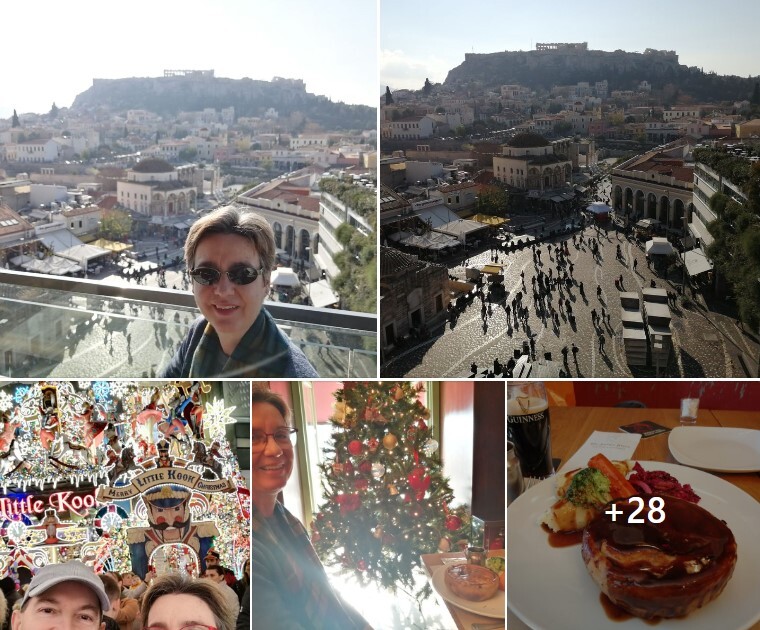
Monastiraki itself felt safe to walk around in, even late into the night, and the streets were packed, especially in Psyrri where we went to admire the Christmas lights outside the whimsical cafe, “Little Kook”. During that first day, we did quite well in our quest to try new experiences! We went to A for Athens for coffee – a café that’s part of the hotel of the same name. It’s on a terrace and overlooks Monastiraki Square with the Acropolis on the opposite hill. As you can see from the first two pictures above, the view was as spectacular as we had imagined it to be!

After visiting a few shops, we wound up at our favourite haunt – the Irish ‘James Joyce Pub’ at the heart of Monastiraki, but committed to make it a new experience, we both ordered new things on the menu. Andy had sausage with onions and I utterly enjoyed a meal I had come to miss from my days living in the UK in the 90s. It was a dish of steak and Guinness pie and it was absolutely delicious.

The evening found us  having  dinner on Athinas street,  near  the  Athens market.  We  walked  a lot  around  Monastiraki,  Plaka  and  Psirri  afterwards, enjoying  the  lights  and  taking  in  the  city  vibe.

Even though by bedtime we thought we’d had an absolutely perfect day, little did we know that the next day would impress and please us even more! For a while now we both wanted to visit the Stavros Niarchos Foundation Cultural Centre (SNFCC) but never seemed to get the chance. It is situated south of Athens by the sea, on the grounds where the old Hippodrome (race horse track) used to be. The free shuttle picked us up from Syntagma Square early in the morning. We were at our destination in just 10 minutes.

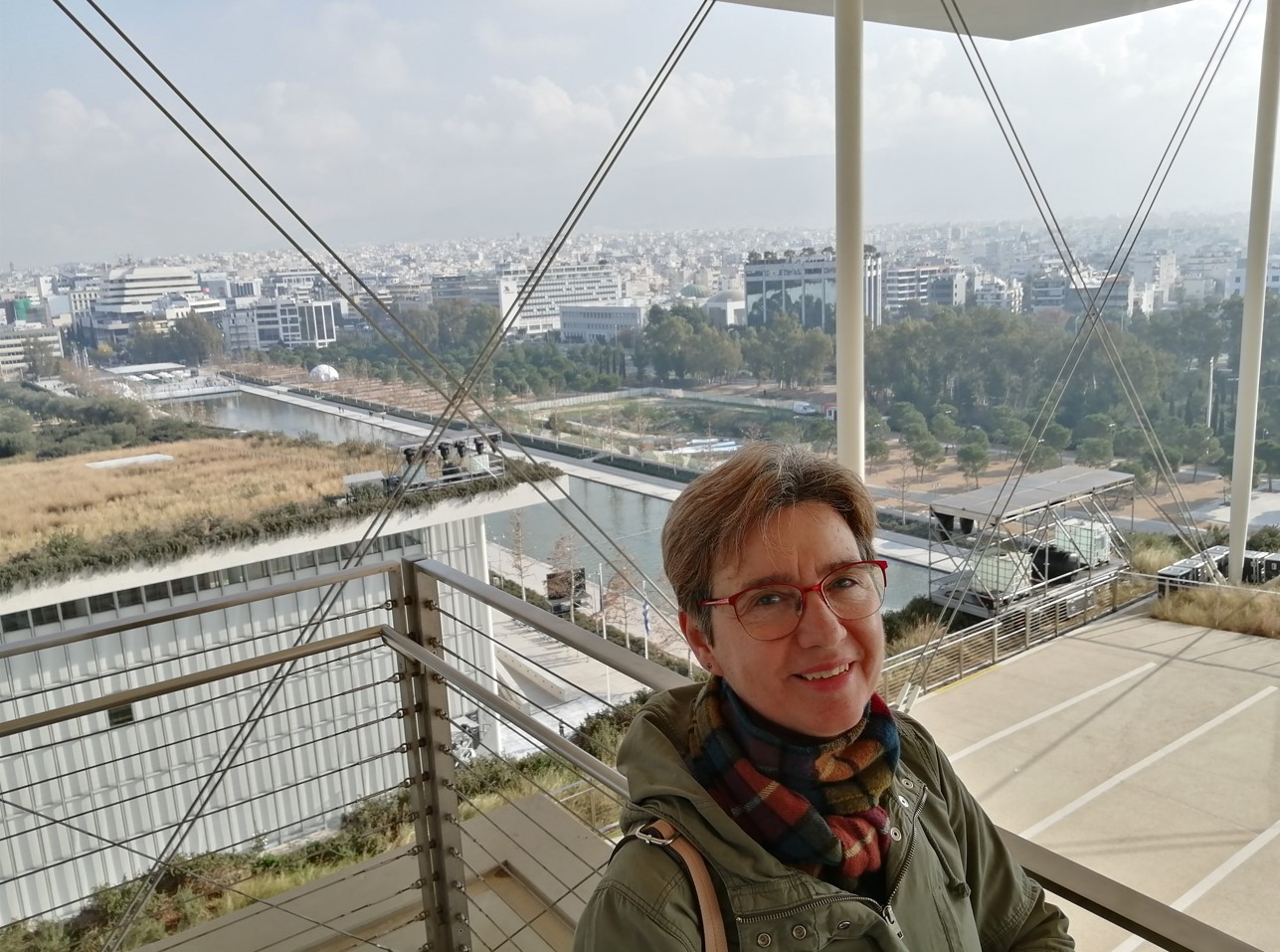
To say that our mouths were gaping open, on and off, as we discovered the place would be an understatement. It wasn’t just because of the grandeur of the National Opera and the National Library that are housed in the SNFCC. It wasn’t even the beautiful canal with the musical fountains that operate to the sound of music. It was the sheer GENIUS of the whole undertaking and the design of the place. I chose this picture above to show you the one thing that impressed me more than anything else:

In the picture, I am standing on top of an edifice called Faros (Lighthouse) at the SNFCC. From there, visitors have a generous view of Athens and the Acropolis. On the other side, people can admire the sea view. Faros stands on the highest ground of the Foundation. Behind me, you can see the edifice of the National Opera and the canal. Do you see what’s on top of the Opera? Grounds! Gardens! I could not believe, as Andy and I were making our way downhill after seeing that, now realizing that we were basically stepping along the top of the opera building. It was just too mind-blowing to wrap my head around it.

The gardens were beautiful, to say the least. There are pine trees, an olive grove, planted herbs and vegetables of many kinds, and a large clearing in the midst of it all that is perfect for family picnics and open-air cinema viewings throughout the summer. Amidst the greenery, one finds surprises as they walk around. Delightful features and fun things for the kids to do, and some also for the adults. ‘The Maze’ impressed me the most, but as the ground was soggy from an earlier rain we gave it a miss. Perhaps next time!

People can cycle in the park or jog or just sit and enjoy nature or the beautiful canal that uses sea water, being in direct connection with the sea. Events take place in the summer period in many parts of the Foundation outdoors. It’s just a fun place to be, and I’m certainly going back – probably in the spring, when I hear it’s beautiful with the flowers in bloom.

I’d also love to combine my visit next time with one at the Eugenides Foundation with its state-of-the-art planetarium – it’s literally across Syggrou avenue from the SNFCC via an underground passage (under said avenue). The educational shows there about astronomy and nature are said to be spectacular.

If you’re planning a trip to Athens, I highly recommend you visit the SNFCC. In case you intend to use the free shuttle service, please note it does not depart from Syntagma, but only comes and stops briefly at the corner bus stop, just in front of ‘Public’ superstore. Timetables for the shuttle and all sorts of information you will find at the SNFCC website.

OOPPAAA! SIGN UP TO MY BIMONTHLY NEWSLETTER AND GET 3 BOOKS FROM ME AS A WELCOME GIFT! SEE BELOW FOR THIS OFFER!

YOU KNOW WHAT THEY SAY… SHARING IS CARING! Tweet this to spread some love:

Christmas fun in #Athens #Greece, a #Greek writer reports... Share on X


3 FREE books for you! Sign up below to receive them instantly!

NEW! Clean Christmas romance. Single mother Cathy Roussos gave up on love long ago, and veterinarian Alex Rallis doesn’t believe in it, but one magical Christmas on a Santorini farm might just change everything…
Check it out on Amazon     Read a FREE sample!


A clean romantic suspense short read with an unreliable narrator that’ll keep you guessing! Vera is losing her mind over famous actor Yannnis Ksenos, except, she isn’t just a fan… Now, she plucks up the courage to ring his doorbell… Visit Amazon


For my delicious Greek recipes, go here
 
Planning to visit Greece? Check out my  FREE guide to south Corfu!

Majestic views in Lake Doxa and a secret school

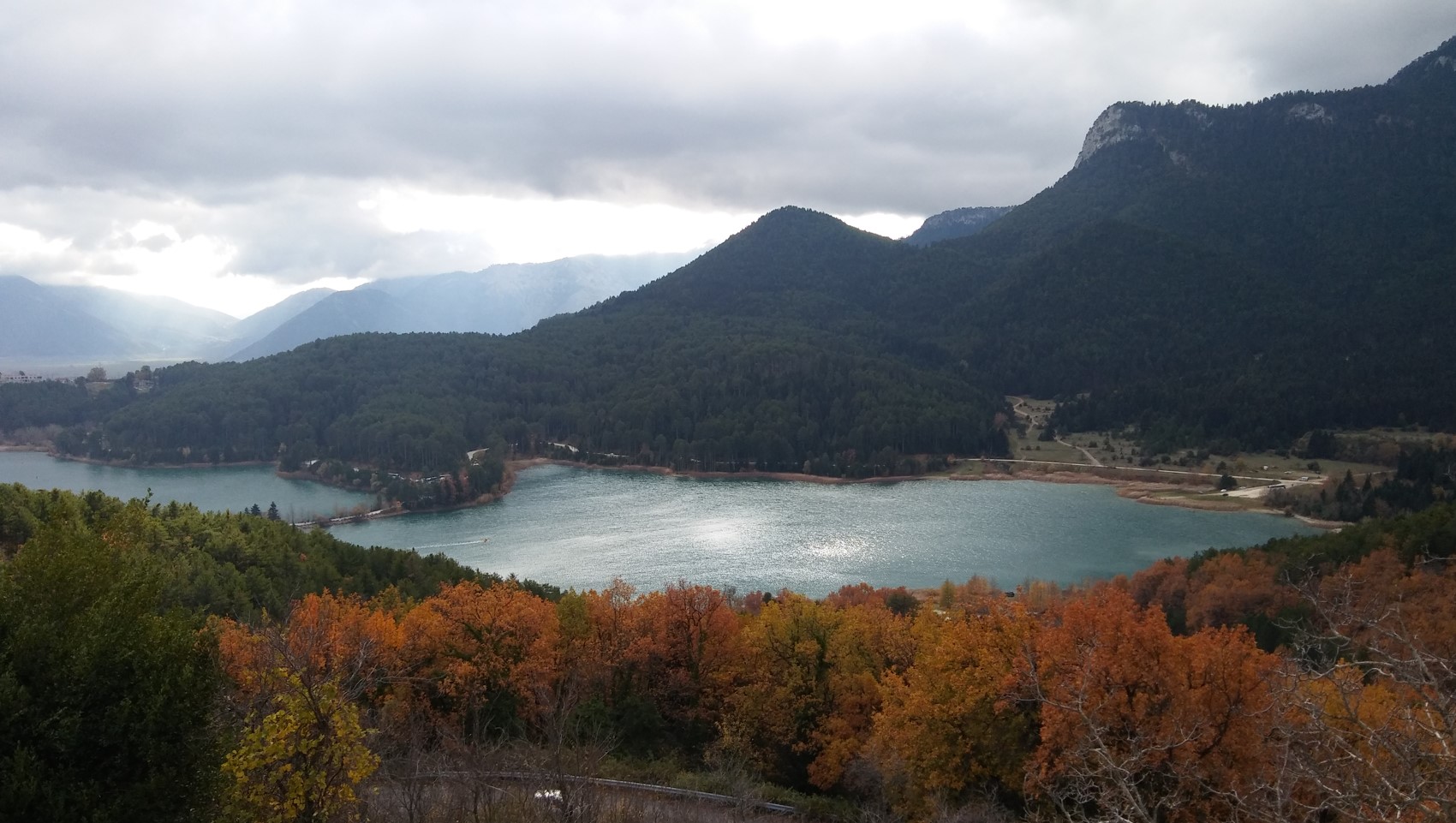
This view took my breath away…

My husband, Andy, and I spent one cold Sunday at the end of November filling our minds with images of breathtaking beauty at the mountains and plains of Feneos in Korinthia (i.e. the prefecture of ‘Korinthos’ – Corinth, in English).

I took this photo from the top level balcony of the stunning St George’s Monastery which overlooks Lake Doxa. The monastery of St George was originally built by the lake, but in 1693 the water level rose much too quickly and the monks fled, barely having time to save themselves. The ruins of that monastery are still underwater today. The same year, upon losing their home, the monks got to work building a new monastery high up on the mountain, to make sure history will not not repeated. In the monastery’s garden today, the monks grow a special variety of roses from the Peloponnese that are particularly aromatic.

Once a year, at harvesting season, they get to work using the fragrant flowers to make a syrupy sweet, which they sell at the monastery’s gift shop in jars. They also welcome the guests with a free treat of this sweet, and I can attest to the fact it is highly aromatic and delicious (albeit a little too sweet for my liking). Walking around the charming court of the monastery (that’s decked in stone everywhere you look) and around its different levels and corridors is a pleasure in itself. I was also impressed by the seemingly tireless tour given by an elderly monk. He was such a sweet soul and kept welcoming coachfuls of guests inside the tiny church, sharing about the history of the place in a low soft-spoken voice that rang with kindness and humility.
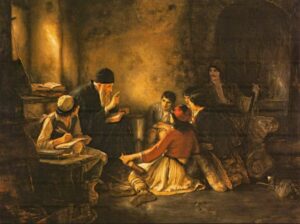
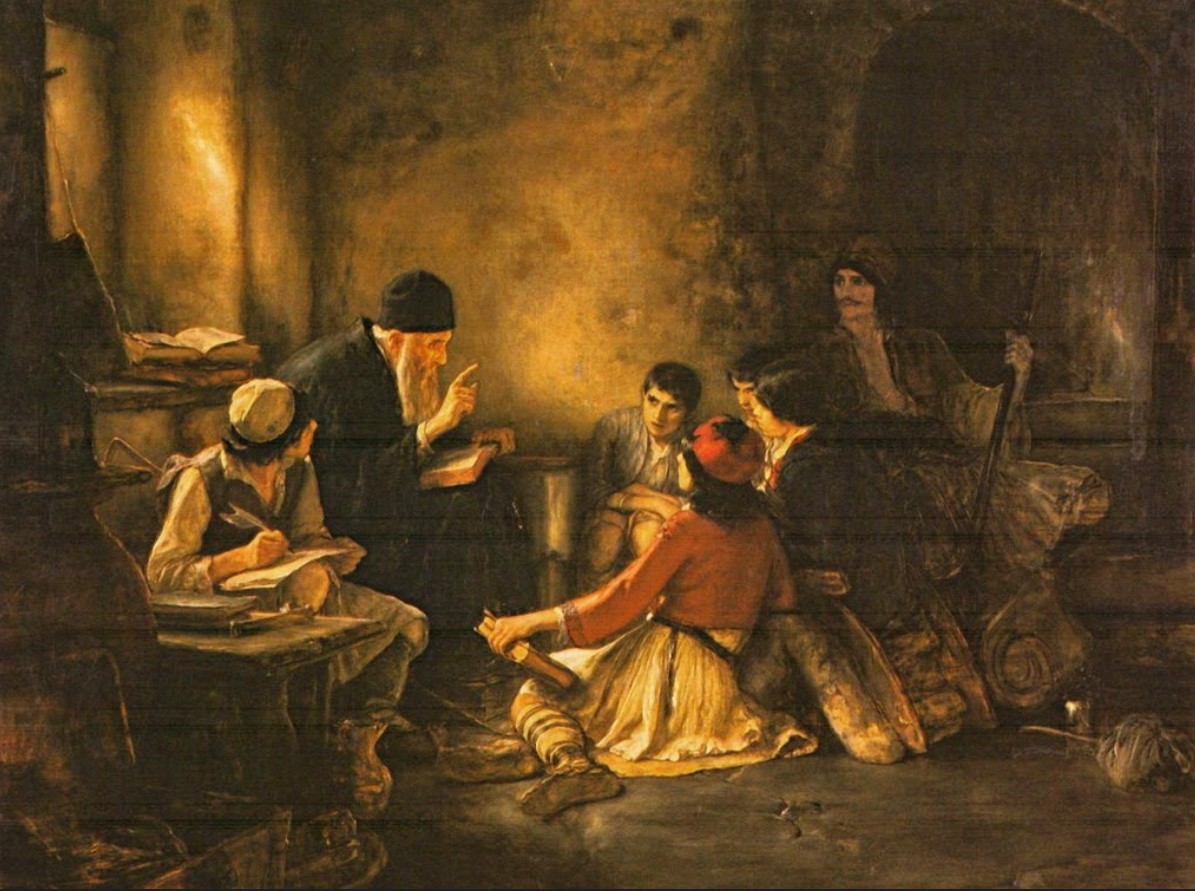
A depiction of krifo skolio by painter, Nikolaos Gyzis

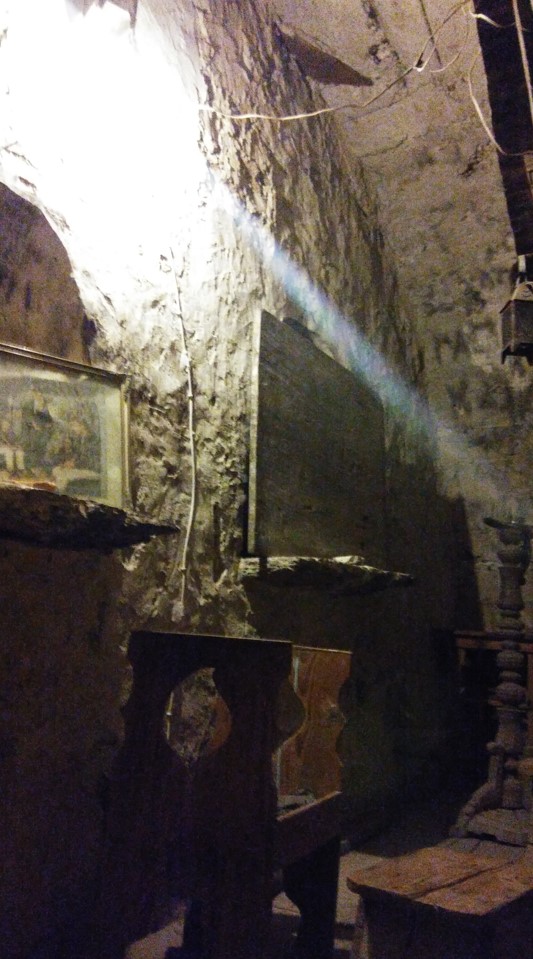
But, above anything else, for me, the highlight was, by far, my chance to see the tiny nook inside the roof of the monastery that used to serve as a ‘krifo skolio’ (secret school) during the time when Greece was occupied by the Ottoman Empire (1453-1821). To get to the roof, one has to take two short stairs that are more like ladders and thus require a lot of attention. The wood they are made off, and the tiny landing in between, creaked with every step, so guests had to allow up to two people to be up there at a time. Time was precious once you got to the top to admire this precious little space.

The first time, out of respect for everyone waiting below, I took a quick look and felt embarrassed to take out my camera. Luckily, the crowd dispersed later, before it was time to leave on our coach, so I was able to go back up again, my camera in hand this time, to drink in the small space a little better, more reverently as it deserved, and to take a couple of photos. I didn’t go over the high wooden hurdle to venture inside, taking the hint that the place was off limits.
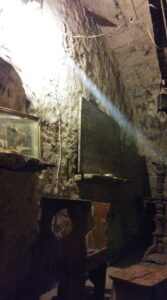
Two elderly men had stepped inside earlier to take a closer look and I thought it was a bit of a naughty thing to do… but also potentially dangerous (creaking floors and all that). But anyway, the photos came out clearer than I’d expected, since the place was deeped in semi-darkness. I love the ray of light captured by the lens, which wasn’t visible with the naked eye. It gives the space that reverence I believe it has. Truly, the ‘krifo skolio’ is romanticised enough in art, just like it is in the famous painting by Nikolaos Gyzis, and it does deserve to be.

After all, every priest and every monk during the Ottoman rule in Greece must have taken it upon themselves to keep the Christian faith and the Greek language alive during those dark 400 years. Had they not decided to organize these meetings in the dark of night to teach Greek children how to read and write in their own language, as well as all about Christian doctrine, chances are the Greeks would not be today the kind of people they are – i.e. people who regard their ancestry something to be proud about and also people that keep God alive in their hearts.

The following stanza from the Greek poet Polemis illustrates the atmosphere of ‘krifo skolio’ perfectly. This is my best effort to translate it into English:

“Outside, black-cloaked desperation

The tangible darkness of a bitter slavery

And inside the vaulted church

The church that every night morphs into a school

The apprehensive light of the oil lamp

Stirs the dreams while trembling

And gathers the little slave children all around.”
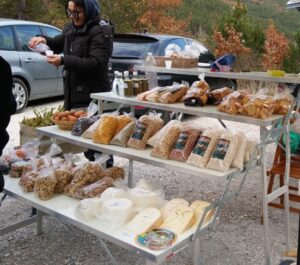
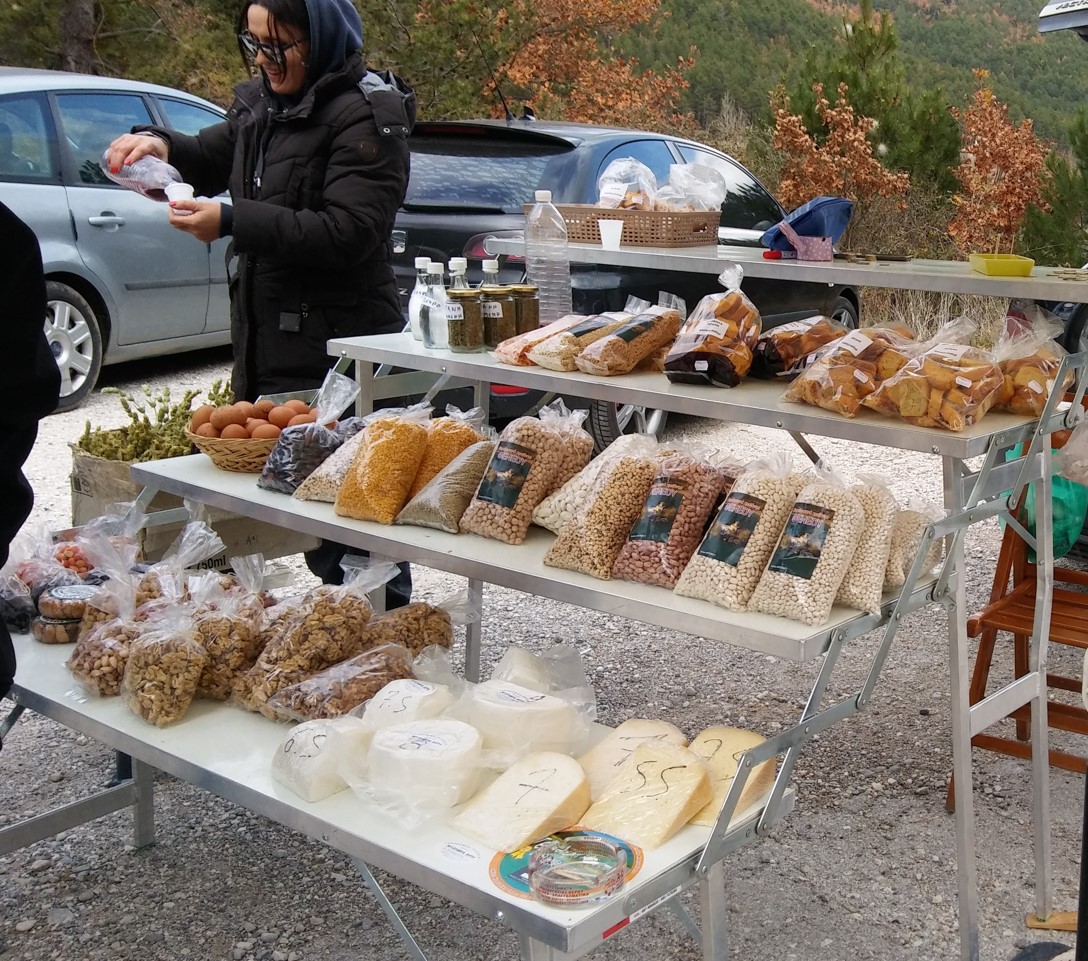
When we visited the lake, I quickly turned around to realize my hubbie was nowhere to be found. Crowds had gathered everywhere to admire the local produce on offer that was laid out across many stands along the bank.

I spotted Andy again a little later emerging through the wandering tourist crowds, and he was singing the praises of the locals, saying how hospitable they all were acting. Turned out he’d only gone on a little tour by himself while I was buying all sorts of lentils from the local plains at amazing prices. He was over the moon, having been offered in that short time various kinds of rusks, cheeses and tsipouro to try. I quickly followed his advice and tried some of the samples on offer as well. He was right; it was all delicious. If you’re ever in the area, make sure to try everything. I think we did haha. And we did go away with a couple of big bags. What a saving it all was haha

I’ve already cooked beans and fava and they were both as delicious as they had promised they’d be. I am still to rub the wild oregano I got off the stalks and put it in a jar. That was incredible timing as my longstanding stock of wild oregano from Moraitika, Corfu had recently been depleted 🙂

The lake itself is phenomenally beautiful. I’d love to go back one day and go around it to drink in its beauty at my leisure. In the summer, one can even rent boats (or is it pedalos?). People can cycle along the bank all year round or rent horses and ponies. We only had a short time to enjoy the views as it was quite cold and threatening with rain, but we managed a short walk to the Agios Fanourios church. It is tiny and sits at the end of a long strip of land extending far into the lake.

Our beautiful day out continued with lunch at the village of Feneos – we had roasted lamb, Choriatiki salad, and a side dish of local butter beans in tomato sauce. All enjoyed with fresh bread as we sat by the fireplace. We couldn’t have been taken to a better place for lunch. After all the walking around in the cold, everything hit the spot perfectly.

It’s been almost two weeks since that day and my mind is still full of beautiful images. The colors on the forest trees, the sparkling lake waters, the ancient woodwork and stonework of the monastery, and, last but not least, the sunrays reaching down to the plains as they pierced through dramatic dark clouds. It all helped to take pictures I will cherish forever. This part of Greece is not well known but well worth a visit.
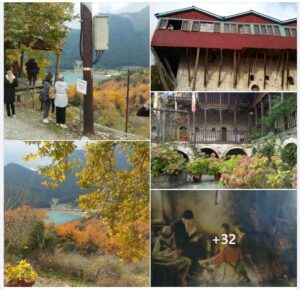
SEE ALL MY PHOTOGRAPHS HERE


OOPPAAA! SIGN UP TO MY BIMONTHLY NEWSLETTER AND GET 3 BOOKS FROM ME AS A WELCOME GIFT! SEE BELOW FOR THIS OFFER!

YOU KNOW WHAT THEY SAY… SHARING IS CARING! Tweet this to spread some love:

Majestic views in Lake Doxa and a secret room in a monastery #Greece #travel #blogger Share on X


3 FREE books for you! Sign up below to receive them instantly!

NEW! Clean Christmas romance. Single mother Cathy Roussos gave up on love long ago, and veterinarian Alex Rallis doesn’t believe in it, but one magical Christmas on a Santorini farm might just change everything…
Check it out on Amazon     Read a FREE sample!


A clean romantic suspense short read with an unreliable narrator that’ll keep you guessing! Vera is losing her mind over famous actor Yannnis Ksenos, except, she isn’t just a fan… Now, she plucks up the courage to ring his doorbell… Visit Amazon


For my delicious Greek recipes, go here
 
Planning to visit Greece? Check out my  FREE guide to south Corfu!

Healthy Greek horta greens and garlic dip

Let’s talk ‘horta’!!!

Picking ‘horta’ (i.e. Greek greens) is something many Greeks do all winter, especially those who have easy access to open fields. Ever since I was a small child I remember the whole family going out for half a day somewhere for a picnic and to pick horta. At the time, we lived in the Athens suburbs so it wasn’t something we did often. Now that I live in a semi-rural area a little further from Athens, picking horta is something I can do in the spur of the moment. The area where I live is surrounded by open fields. Sometimes, I just go on foot around the neighbourhood and come back with a full shopping bag in no time.

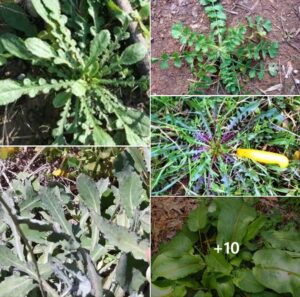
I recently posted on Facebook a short selection of photos that show various edible horta to be found in Greece. I encourage you to get a knife and go picking haha! They are soooo nutritious. But you need to go to the countryside to pick them – not in civic areas.

Choose open fields or mountains, away from roads. The further from road traffic you are the better. Exhaust fumes reach up to 200 metres and contaminate the soil with heavy metals.

If you have access to Facebook, you could check out the photos now. In the comments, I have listed the common names for each weed. I don’t have the English names on most of the weeds, but I identify them all with their common Greek names, if that helps some among you.

Those marked as ‘aromatic’ are best used in pies (hortopitta or spanakopitta). These should be used in low numbers when mixing them with dandelions to have them boiled. Same goes for gaidouragatho. Add only a few of those to the mix when cooking dandelions or the taste will not be as it should be…

Dandelion = Dent De Lion (Lion’s Tooth) Latin name: Taraxacum Officinale)

When I posted about dandelion on Facebook, a couple of my British friends said when they were little their parents used to tell them to stay away from this weed as it would make them wee the bed. I had a good chuckle about that and found it very peculiar. Makes me wonder about folk wisdom in this case. Surely, dandelion is a diuretic, but so is cucumber…

Perhaps… mothers in the old days knew how nutritious dandelion was so they put the kids off touching them so they could then go and cut them in pristine condition haha

HERE’S HOW THE GREEKS COOK DANDELION:

Dandelions, like all greens, need meticulous cleaning, First, you cut off the root with a knife, remove yellow leaves and other weed debris etc. Then you need to wash them thoroughly in a big tub of water (3 times at least with vinegar and salt in the water). Then you just boil them for 30 mins or so in salted water. Toss them a couple times with a fork while they boil. Drain well and enjoy with fresh lemon juice and olive oil. Fried fish or calamari go well with dandelions (we call them ‘radikia’ or ‘horta’). Alternatively, you can accompany them with an omelette, or just with some fresh bread, olives and cheese.

Make sure to keep some of the water as it’s chockful with nutrients, especially if the greens are wild, which means they are bitter. The bitterness in the water is a wonderful detoxifier for the liver. Have a warm mug with a bit of lemon juice, cool the rest and keep in the fridge for up to 2-3 days.

Warm up and have as hot tea with lemon juice. The health benefits are so generous in the case of dandelion.

I hope I have given you enough information (and some inspiration) so you can go out there and pick a batch. If anything, to enjoy that delicious hot bitter tea! Highly recommended!

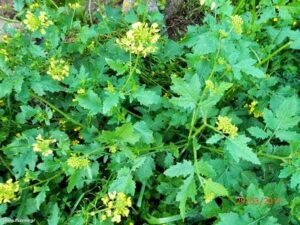
‘Lapsana’ aka ‘vlastaria’. Latin names: Sinapis Arvensis or Sinapis Alba

Lapsana is the only weed among the ones I list on the specific Facebook post that must be picked on its own. No other weed should be cooked with it. You don’t need a knife for lapsana – you just cut off the ends of the stalks that have buds and leaves on them with your hand. And it must be picked before the flowers turn yellow. The greener the better. Sometimes, they have a blue tint. That’s fine too.

Just like dandelion, you can boil, strain, and enjoy lapsana with lemon juice and olive oil. This is by far my favourite weed to pick and eat. The water is not bitter, but I drink that too as a tea anyway. I am sure it’s nutritious in its own right. I waste nothing with lapsana as I love the taste so much.

Lapsana is found in the fields in the spring, whereas dandelions and all the other weeds that are cut with a knife are ready for the picking all through the winter and in the spring.

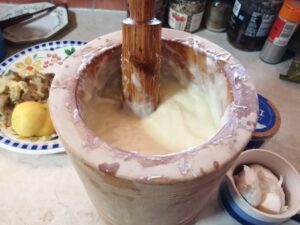
All this talking about horta inevitably made me think of skordalia. Greek garlic dip is utterly delicious, and typically accompanies horta (or boiled beetroots) along with fried fish.

GO HERE and get my skordalia recipe too. Now, you have all you need, LOL!


OOPPAAA! SIGN UP TO MY BIMONTHLY NEWSLETTER AND GET 3 BOOKS FROM ME AS A WELCOME GIFT! SEE BELOW FOR THIS OFFER!

YOU KNOW WHAT THEY SAY… SHARING IS CARING! Tweet this to spread some love:

Precious Greek 'horta' and skordalia dip #Greekfood #bloggers #Greece Share on X


3 FREE books for you! Sign up below to receive them instantly!

NEW! Clean Christmas romance. Single mother Cathy Roussos gave up on love long ago, and veterinarian Alex Rallis doesn’t believe in it, but one magical Christmas on a Santorini farm might just change everything…

Check it out on Amazon     Read a FREE sample!


A clean romantic suspense short read with an unreliable narrator that’ll keep you guessing! Vera is losing her mind over famous actor Yannnis Ksenos, except, she isn’t just a fan… Now, she plucks up the courage to ring his doorbell… Visit Amazon
 

For my delicious Greek recipes, go here
 
Planning to visit Greece? Check out my  FREE guide to south Corfu!
 

Purple jellyfish

YIKES! I remember other early summers of the past when I was looking at the big brown jellyfish in the sea here in my little town of Nea Peramos, West Attica, and I used to think that was scary. Never had I ever imagined that it could get worse!

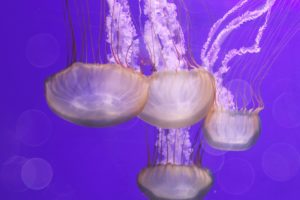
Well, there is worse, and it’s called ‘purple jellyfish’. Also mentioned as Mauve stinger (Pelagia Noctiluca) online, the Latin name owed to the fact that it glows in the dark! And this exotic creature is now found all over the coast of Attica right now, including in my local beaches. It has also been sighted in Ionian waters, so if you’re swimming in my beloved Corfu this summer keep your guard up, folks, just in case!

No one knows with certainty how these jellyfish wound up in our waters in such large numbers this year.

Because of this, I haven’t braved a visit to the beach yet for a swim, and this week it’s 38 degrees C and not fun at all.

The scientists say the phenomenon could abate soon, but then may reappear at the end of July because of the fluctuations of temperature that affect that of the water. So, the news is bad for this summer.

Still, the scientists have given the public precise advice on how to tackle the problem if someone gets stung. As it turns out, the purple jellyfish is not like the others. It is actually recommended not to use the well-known remedies of ammonia and… erm… Joey Tribbiani’s infamous trick of… uhh… ‘weeing on it’.

No. The purple jellyfish’s neurotoxin-carrying cells left on the skin can only be neutralized with the use of baking soda! This is the best way to alkalize the affected area immediately. And, before applying the baking soda, you need to wipe the area with something like a glove or a towel (not the naked hand) in order to remove any cell debris carefully, using seawater. Strictly NOT tap water.

The instruction is very particular, but thankfully clear, as if someone gets it wrong and is allergic to the sting, they could wind up in hospital.

With these horrors to consider, I am definitely packing a small thick towel in my beach bag this summer and some baking soda. Not taking any chances, folks! And it looks like I’ll have to leave my usual straying to the deep waters for another year maybe. I’ll be paddling in the shallows–and checking all around me incessantly–for the foreseeable future this summer!

Note: I found the above on Facebook and I am including it here for more detailed instructions. From what I found out in Facebook groups people do get stung over in Corfu right now. So, if you’re swimming in one of the affected regions of Greece this summer, get the treatment details right!


YOU KNOW WHAT THEY SAY… SHARING IS CARING! Tweet this to spread some love:

Fun news from a Greek author #greek #summer #Greece Share on X


3 FREE books for you! Sign up below to receive them instantly!

NEW! Clean Christmas romance. Single mother Cathy Roussos gave up on love long ago, and veterinarian Alex Rallis doesn’t believe in it, but one magical Christmas on a Santorini farm might just change everything…
Check it out on Amazon     Read a FREE sample!


A clean romantic suspense short read with an unreliable narrator that’ll keep you guessing! Vera is losing her mind over famous actor Yannnis Ksenos, except, she isn’t just a fan… Now, she plucks up the courage to ring his doorbell… Visit Amazon


For my delicious Greek recipes, go here
 
Planning to visit Greece? Check out my  FREE guide to south Corfu!

A day out in the alluring Greek island of Spetses #summertime #Spetses #Greece

Hi, All! I jumped at the chance to visit Spetses on a daily trip last weekend and I am thrilled to share about it today.

First time I visited Spetses was at the age of nineteen with my Uni friends, so it is very close to my heart. I visited it again for short breaks in the 90s and the 00s. Even though this visit was only for a day, it was just as exciting and my husband and I had six whole hours to catch the vibe of it all.

Spetses is an island of the Saronic gulf (close to Athens) that has a huge naval history thanks to Laskarina Bouboulina, the admiral of the Greek Navy, who was a heroine of the Greek War of Independence.

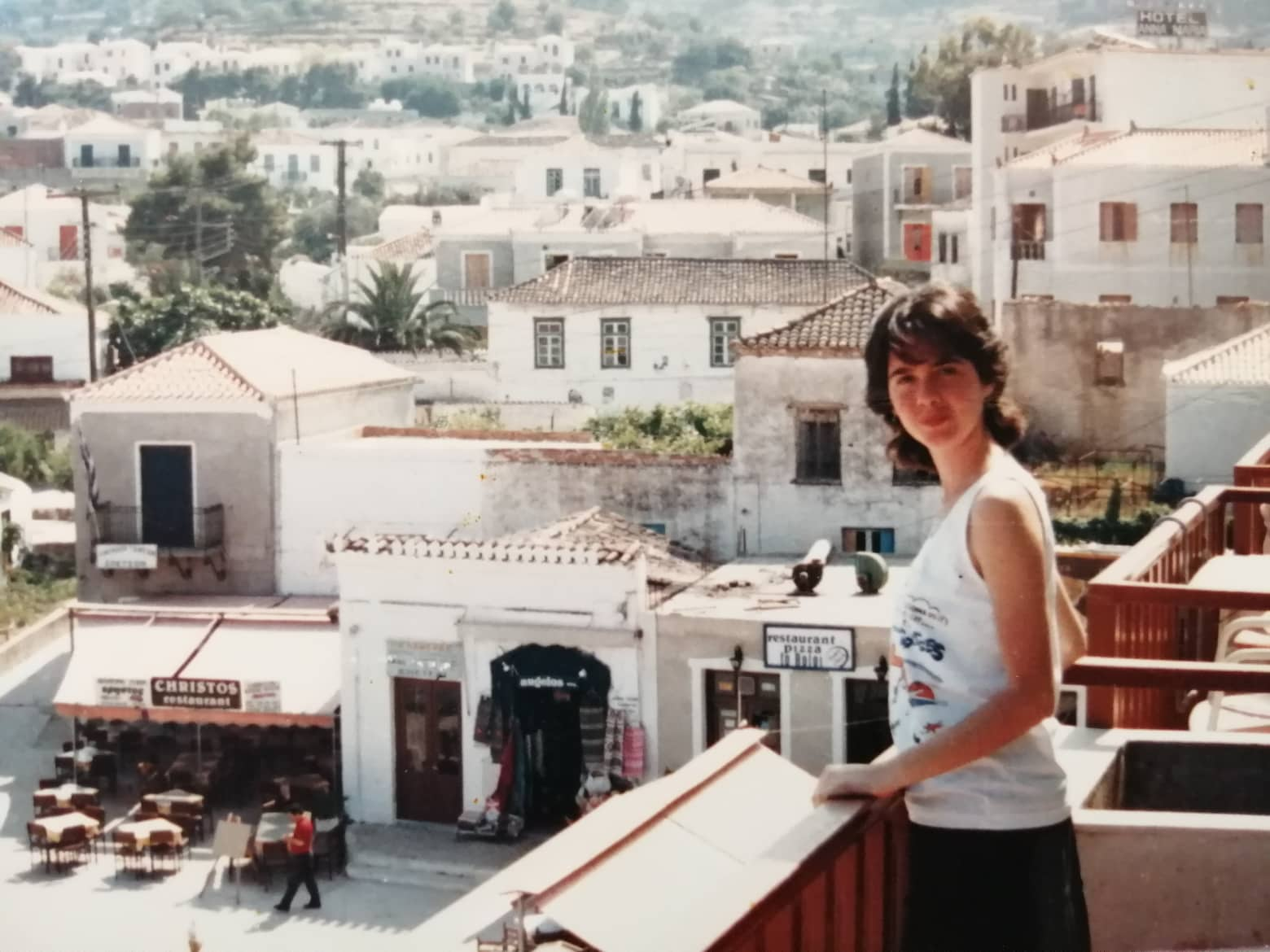
Oh my goodness. This picture makes me feel so old, LOL. But that was 1986 and I was a student at Athens Uni. And I had to show you this picture as it makes the island of Spetses look so idyllic, exactly as I remember it that first time I saw it. My hotel room had a view to the old clock square. It was so built up when I saw it again the other day it was heart-breaking. The middle space was almost taken on completely by restaurant seating areas, and two of them were not even traditional tavernas. They were serving pizza and pasta instead. I found them so out of place. So I like this old, quiet square better… and if you’ve been to any Greek islands in the 80s, you know what I’m talking about and what exactly it is they lack these days. Just looking at this photo makes me hear bouzouki chords in my mind, and my friends from Uni and I even spent an evening dancing in a bouzouki club!

The t-shirt I am wearing says, “If you’re gonna do it, do it right. Do it in Spetses!” and it featured Garfield laid out on a deckchair, sunglasses on, drink in had. So 80s! I was a huge George Michael fan back then so the slogan was perfect; I had to buy the t-shirt LOL. I wore it every summer after that for decades. It was only last year that it’d got so many holes in it I had to throw it away, much to my grief. RIP Garfield of Spetses, LOL!

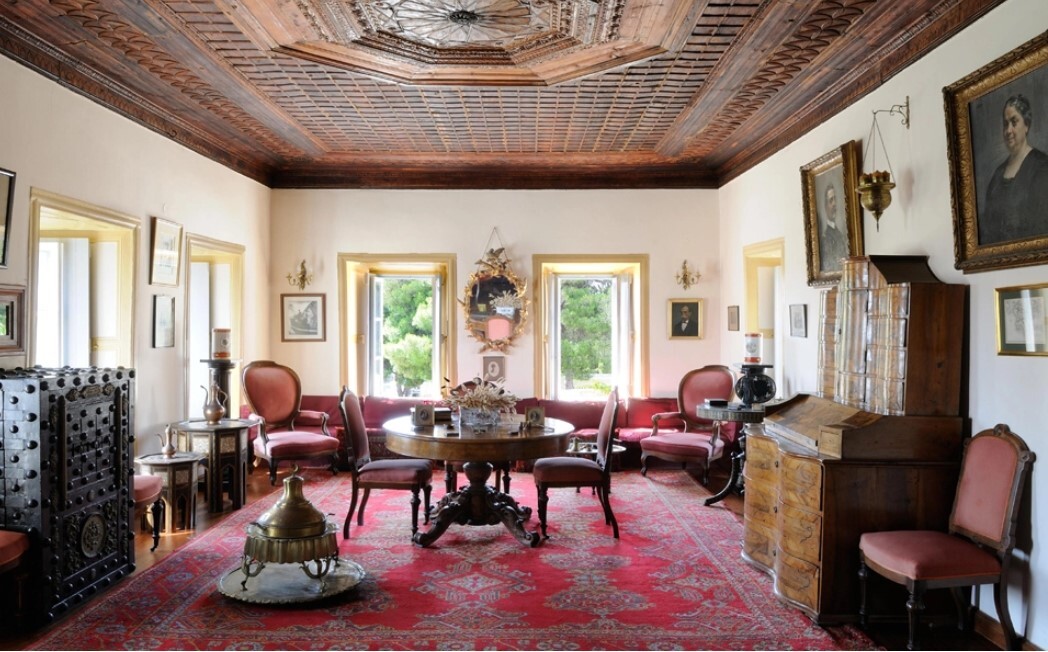
Credit for the image to athensattica.com

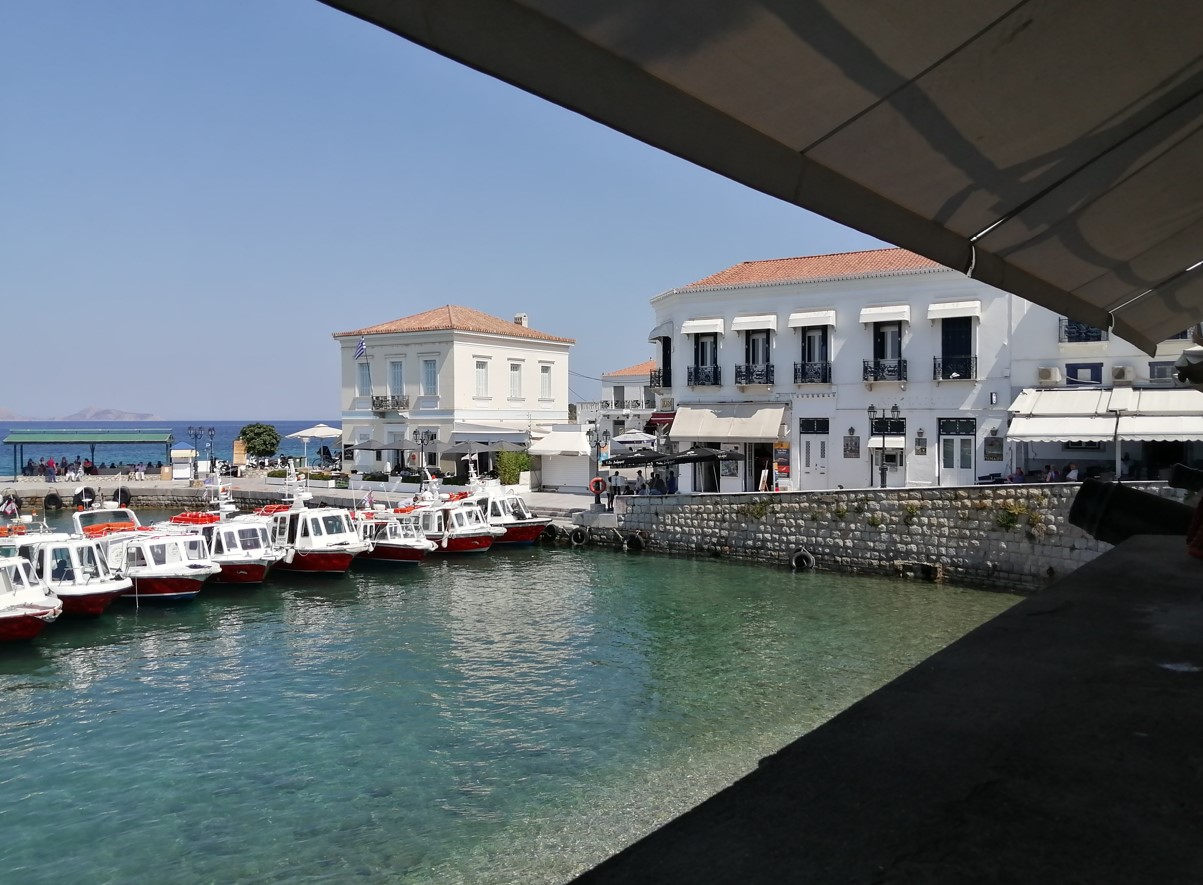
But I digress. Back to my wonderful day out… After a hearty breakfast at the Dappia, the beautiful stone-paved port of Spetses, my husband and I went exploring. On the back streets of Dappia, across from a tiny park, we found Bouboulina’s stately home, now a museum.

Laskarina Bouboulina was a sea captain, and one of the greatest heroines of the Greek War of Independence in the 1820s against the Ottoman rule. 

Inside her home, we saw personal artefacts and beautiful furniture dating from many centuries ago.

Taking pictures wasn’t allowed inside but I was able to find online this photograph of the exquisite living room of the mansion. The wooden ceiling stole my heart. It came from Florence in pieces, apparently, and was assembled at the mansion piece by piece. The intricate designs carved on the wood were breathtaking. And so was the room itself. Just the idea that I was standing at the place where Boubloulina planned the next naval battles with other captains for the liberation of Greece made the hairs on my spine stand on end. It was an experience that made the Greek War of Independence come alive, and I felt the kind of awe I have only felt once before – at Agia Lavra monastery, standing before the legendary banner that started the same war in 1821.

How easy it was to picture Bouboulina in her own spaces! It was a huge privilege to be there. I was deeply moved as I admired her own ancient icon of St Nicholas – the protector of seafarers. It was a beautiful wooden icon with intricate carvings – gold plated. I could imagine how many times she must have prayed before it for the victory of her naval battles so she could save her beloved country. Wow. Just that artefact was enough reward for visiting that special place.

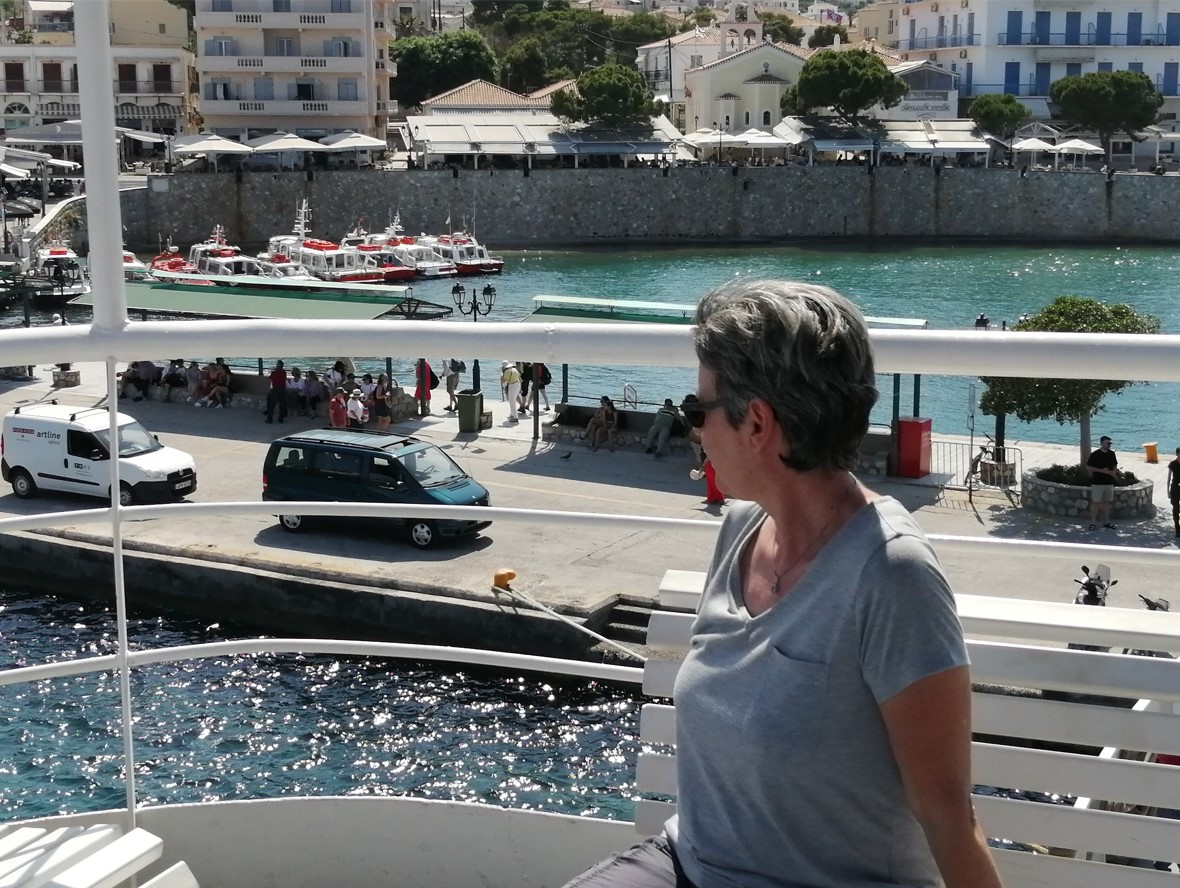
The pictures I’m sharing today from my trip feature the beautiful exterior of Bouboulina’s mansion, and also Spetses’s port (the famous Dappia), the imposing Poseidonion Hotel, and other areas. It was 36 degrees C and we were melting, so the horse and carriage ride and the walk to the end of the peninsula to visit the small marina and the shipyard had to be postponed for another time. All we could do was keep sitting here and there in the shade with food and drink for sustenance and refreshment, LOL.

I am also sharing pictures from other areas we visited on the way – the Corinth Canal, Costa (near the cosmopolitan Porto Heli) where we took the ferry across to Spetses, and the enchanting little town of Ancient Epidavros where we stopped over for coffee on our way back home.

GO HERE TO SEE ALL MY PHOTOS


YOU KNOW WHAT THEY SAY… SHARING IS CARING! Tweet this to spread some love:

A day out in the alluring Greek island of Spetses #summertime #Spetses #Greece Share on X


3 FREE books for you! Sign up below to receive them instantly!

NEW! Clean Christmas romance. Single mother Cathy Roussos gave up on love long ago, and veterinarian Alex Rallis doesn’t believe in it, but one magical Christmas on a Santorini farm might just change everything…
Check it out on Amazon     Read a FREE sample!


A clean romantic suspense short read with an unreliable narrator that’ll keep you guessing! Vera is losing her mind over famous actor Yannnis Ksenos, except, she isn’t just a fan… Now, she plucks up the courage to ring his doorbell… Visit Amazon


For my delicious Greek recipes, go here
 
Planning to visit Greece? Check out my  FREE guide to south Corfu!

St Efraim of Nea Makri. A Greek saint’s chilling tale

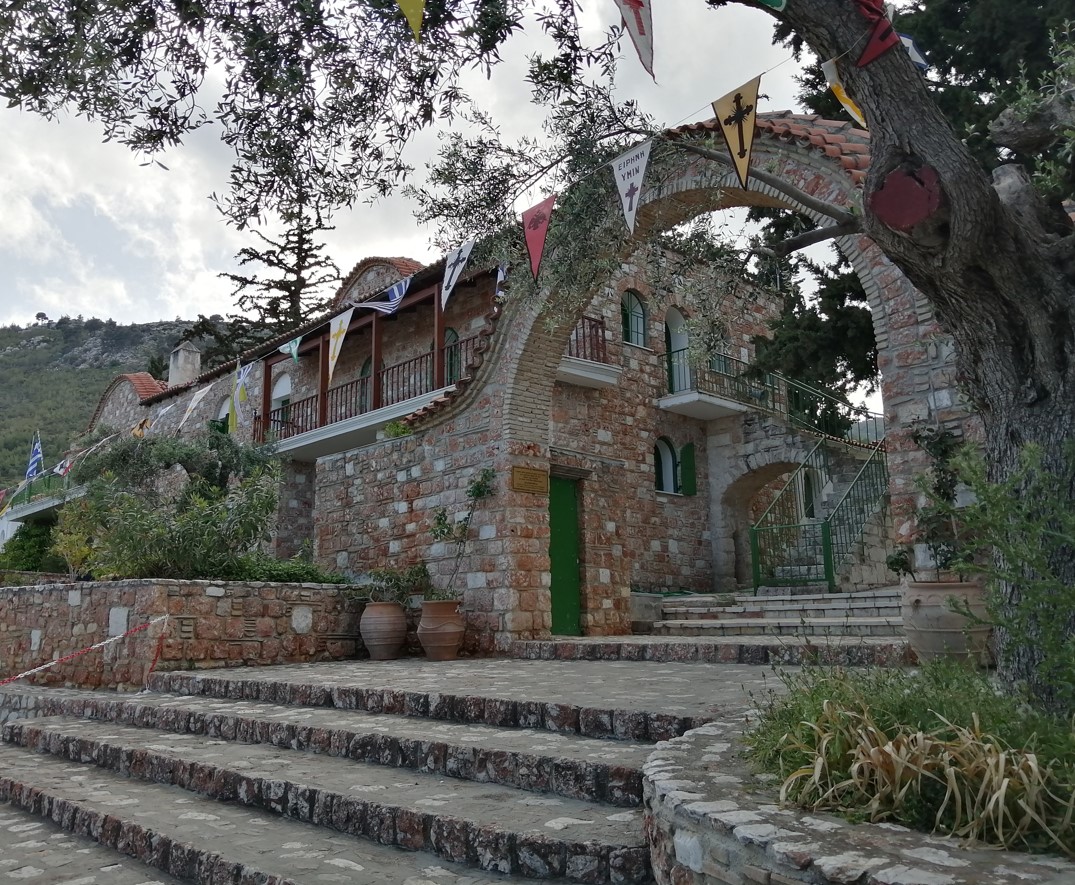
St Efraim Monastery is world famous for the saint’s chilling tale and the miraculous healings connected to his name… Earlier this month, I had the chance to visit St Efraim’s monastery one quiet afternoon. It is located on a mountain overlooking the beautiful seaside town of Nea Makri in East Attica. I was lucky enough to find only a small crowd in the monastery. From what I’d heard, the norm is an endless trail of coachfuls coming and going all day.

St Efraim monastery is visited by Orthodox Christians throughout the year, many going to pay their respects and to pray for a healing for them or their loved ones. The saint is famous for the many visions that the faithful have had of him over time – and still do today. He has appeared in apparent human form even before unsuspecting people who had never heard of him. The saint gave these people advice for their health, and sometimes simply prompted them to get some oil from the lamps at the monastery to put on the part of the body that needed healing… And healings happened every time, apparently. The monastery still receives a multitude of healing testimonies from many parts of Greece and abroad.

Inside the monastery, cotton wool drenched in oil from the lamps are offered in individual tiny plastic bags to the visitors. Those hoping for a healing or just asking for protection are able to buy tall candles, as tall as a person, to light up and leave inside a chapel.

St Efraim’s body is in skeletal form and is kept in a beautiful open casket for people to pay their respects too.

If you’re interested to know more about the saint’s life, his terrible death at the hands of Turkish invaders, and the miraculous way in which his remains were found hundreds of years later, you’re welcome to find out everything in the next segment.

Either way, I hope you will enjoy the photographs I took around the monastery. It’s so peaceful a setting, high on a mountain top, edged by olive groves and overlooking the town of Nea Makri and the coast.

The monastery itself is decorated with beautiful stonework. The court is particularly quaint!

I am including some photos of the seafront at Nea Makri, too. It was the quietest I’ve ever seen it, but it makes sense as it was a weekday. Every weekend, and especially in the summer season, it’s always packed.

GO HERE TO SEE THE PHOTOS 

Who is St Efraim?

St Efraim was born in Trikala on September 14 (Cross Day) in 1,384 A.D. He was one of 8 children and was given the name Constantinos. When his father died, Constantinos was still a small boy, and his mother took on all the challenges of raising her children on her own. Constantinos expressed a love for God and Christianity from a very young age.

When he was 14 years old, his mother feared the Turks would take him during another of their raids where they took young boys to raise them as Genitsari (Note: Genitsari was a brutal rank of ‘Turkish’ soldiers that hated Greeks with passion. All of them had been taken away when they were small boys (Greek Orthodox children) to be given a strict military upbringing while brainwashed to hate their own nation).

Heeding his mother’s advice, Constantinos left Trikala to seek another part of Greece that would be safe from Turkish raids. She had also advised him to find a monastery and become a monk since he had so much affinity for the monastic life. After many wanderings, Constantinos wound up on Mount Amomon (Mountain of the Clean), which is the very place where his monastery now stands.

Constantinos settled well in the monastery. When he turned 18, he was declared a monk and was given the name Efraim. After a few years, he became a priest. By then, he much preferred to live in natural caves on the mountain as opposed to the monastery.

In 1424, Turkish troops arrived on the mountain and raided the monastery looking for gold. They found next to nothing and slaughtered everyone they found. That day, Efraim was spared as he wasn’t in the monastery. When he returned the next day, he found everyone dead and buried them on his own, then went back to his cave. After that, he returned to the monastery only on special days to do mass in the church.

On such a day (Cross Day), September 14, 1425, the Turks returned and this time they caught him. What followed was 8 months of imprisonment and they tortured him from time to time, insisting to find out where the gold was, but there was none to give.

Finally, on May 5, 1526, the Turks hung St Efraim upside down from a mulberry tree in the courtyard of the monastery and killed him by stabbing him in the stomach with a lit torch.

Fast forward 419 years later…

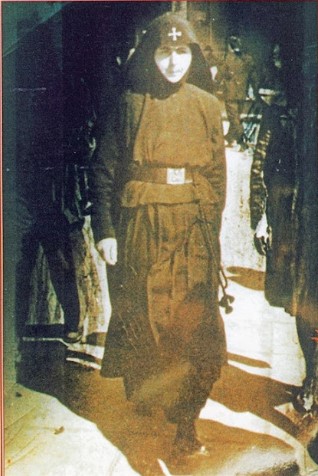
In 1945, a nun called Makaria, driven by divine inspiration, decided to go to Mount Amomon and settle in one of the old cells of the ruined old monastery. Soon, she began to clear the rubble of the old church inside it, hoping to make it operational again. She asked a local, whom she hired as a worker, to dig at a specific spot, as she had been receiving insistent advice in the form of an eerie whispering voice to do so.

The man was difficult and refused to dig in the specific spot, but the nun insisted so he finally gave up. Digging at about 1.70 meter deep, they found what looked like an old cell and the remains of a man. He wore the robe of a priest, and it was intact. A divine fragrance filled the air as soon as the skeleton came to light.

That same night, while she prayed, Makaria heard footsteps. They were coming from where she had found the remains. On her way there, at the entrance of the church, she saw a vision. It was a tall and thin man, with a long black beard that reached down to his neck. He had dark eyes, and he was wearing the robes of a monk. One hand emitted fire, while the other was positioned in a gesture of blessing. He spoke to her then, asking her to move his remains away from the crypt near the grave where she had placed them.

The next day, Makaria cleared the bones and placed them in a crypt inside the church. That night, St Efraim appeared in her dream to thank her. That was also when he gave her his name.

Over time, St Efraim disclosed to her all the details of what had happened with the Turks and how he had been murdered.

According to the Greek Orthodox Church, the miracles of St Efraim to this day are in the thousands. He is honoured twice a year. On May 5, where his assassination is commemorated, and on January 3, the anniversary of the discovery of His remains.

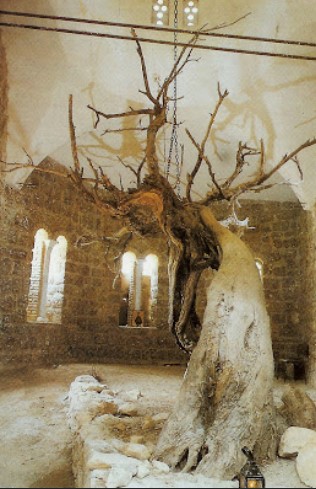
The mulberry tree where Efraim gave up his spirit has been preserved over the centuries, or, rather, what is left of its dried up frame. Kept safe in an enclosed space in the monastery, it stands as a silent witness to St Efraim’s brutal and untimely death.

Interested in Greek saints and their miracles? Check out my posts about St Spyridon (patron saint of Corfu), St Vasileios (the Greek ‘Santa Claus’!) and St George.

Greek vigil lamps, frankincense, and how to clean up your house from stale energy https://effrosyniwrites.com/2022/05/13/greek-vigil-lamps-frankincense/   


YOU KNOW WHAT THEY SAY… SHARING IS CARING! Tweet this to spread some love:

St Efraim of Nea Makri. A Greek saint's chilling tale #Greek #Greece #saints Share on X


3 FREE books for you! Sign up below to receive them instantly!

NEW! Clean Christmas romance. Single mother Cathy Roussos gave up on love long ago, and veterinarian Alex Rallis doesn’t believe in it, but one magical Christmas on a Santorini farm might just change everything…
Check it out on Amazon     Read a FREE sample!


A clean romantic suspense short read with an unreliable narrator that’ll keep you guessing! Vera is losing her mind over famous actor Yannnis Ksenos, except, she isn’t just a fan… Now, she plucks up the courage to ring his doorbell… Visit Amazon


For my delicious Greek recipes, go here
 
Planning to visit Greece? Check out my  FREE guide to south Corfu!

Greek vigil lamps, frankincense and how to clean up your house spiritually

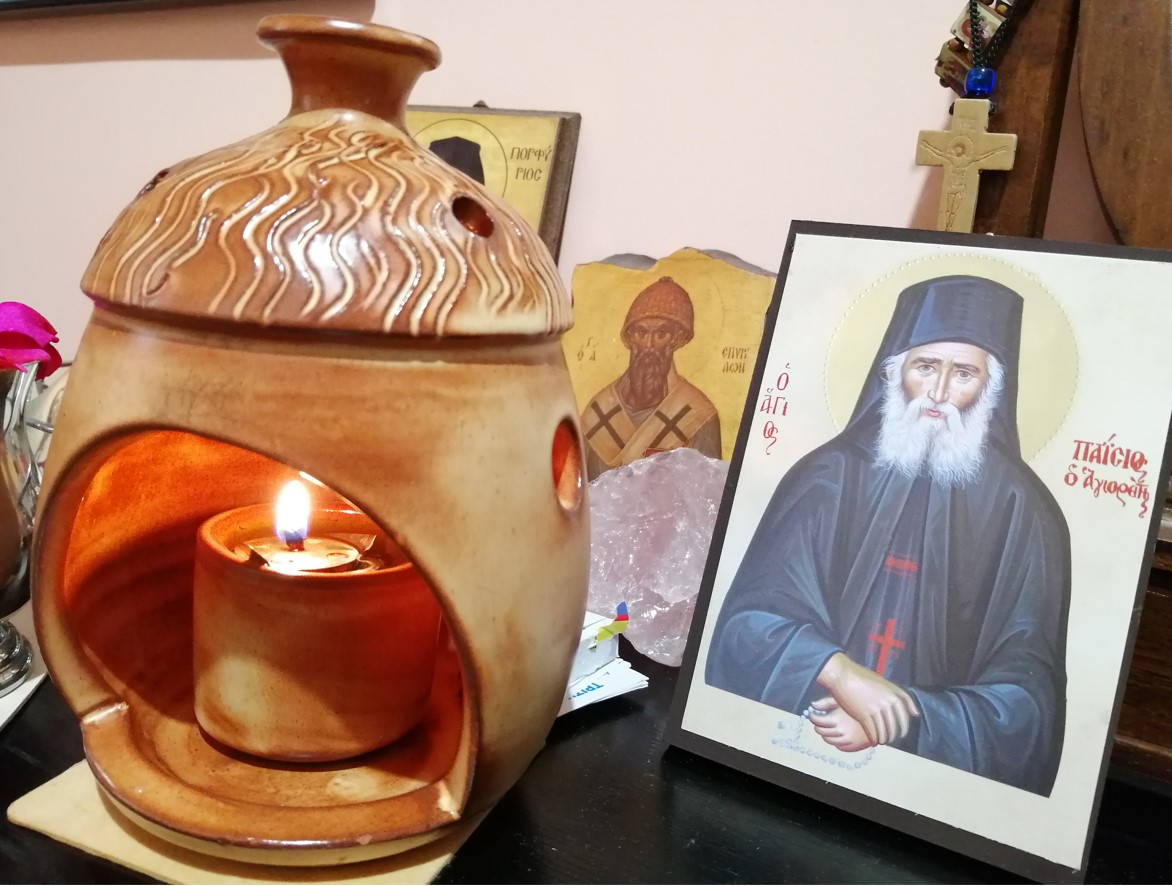
Today, I’d like to share about the Greek custom of the vigil lamp. Vigil lamps are lit in Greek homes on all big religious holidays, but in homes where loved ones have passed away they may be found lit every day, especially in the homes of widows.

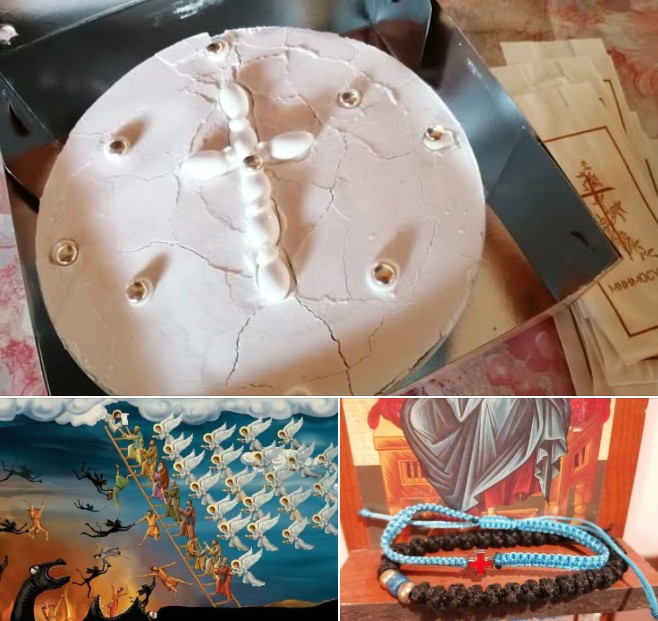
Traditionally, in every Greek home, there is one corner (usually the bedroom), where icons are placed on the wall (along with the wreaths from the wedding ceremony of the home owners so the marriage can remain blessed). The vigil lamp is often placed in the same corner too. I have such a corner in my bedroom, but in the recent years, following the deaths of my Corfiot grandparents and then my mother, I created a second shrine in my study. I burn my vigil lamp in there amongst icons and photographs of my deceased family members. It all helps to keep their memory alive and my spirit connected to them.

The light of the flame serves to remind us that God is light, and that we have a divine light (our soul) inside us too. When the lamp is lit in the memory of a deceased, it is believed that it promotes the peace of their soul. Traditionally, a lamp is always kept lit on the grave for that very purpose, but those not able to visit the grave daily, may light a vigil lamp at home for the souls of their departed loved ones.

Vigil lamps come with a cup which you may fill with just olive oil, or water and olive oil if you don’t wish to keep burning the lamp all day. For example, if you intend to leave the house, as it’s not really advisable to leave a vigil lamp burning at home unattended.

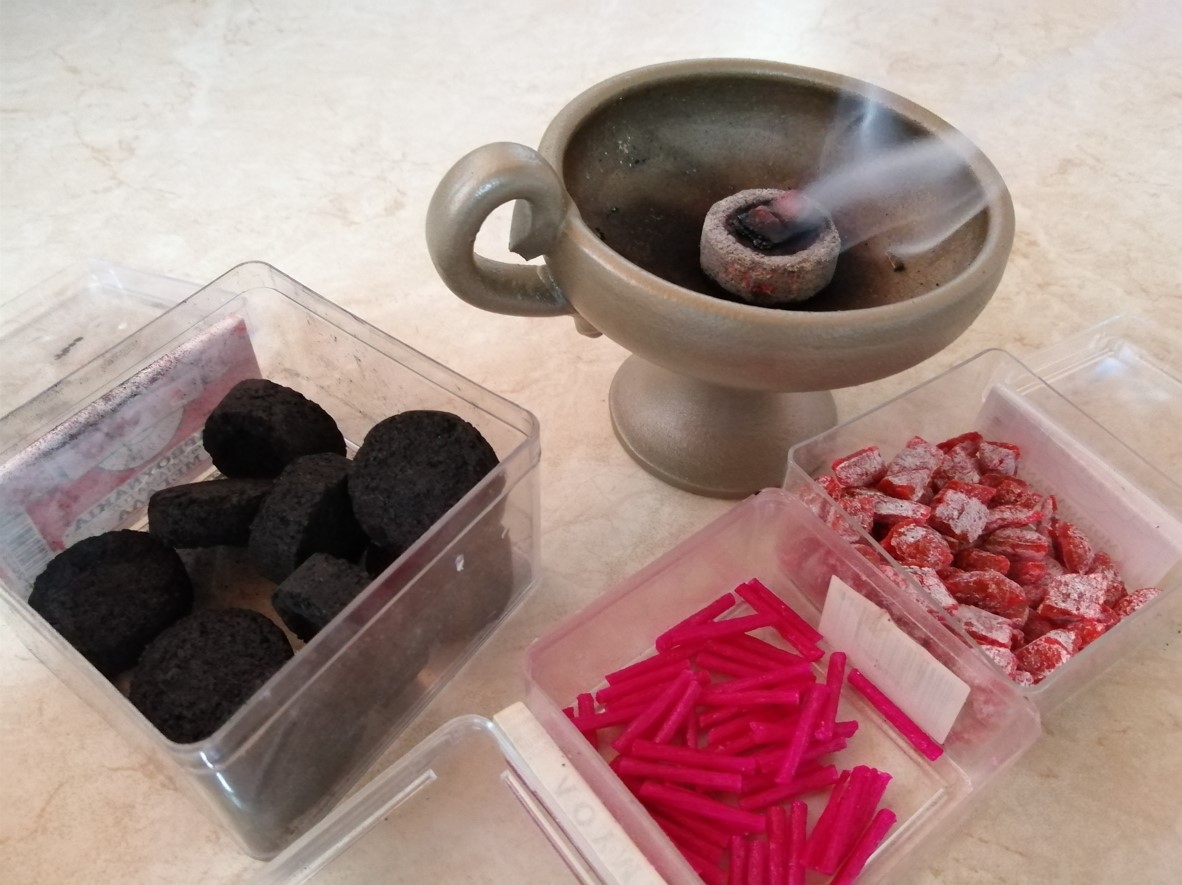
Put in some water first, then the olive oil. The latter will naturally float on top. To use a vigil lamp you will also need a float made of cork and a box of waxed wicks. The wicks look long and pink, as you can see in the photograph below. After you put the wick through the hole in the float, squeeze the wick above the float with your fingernails to flatten it and thus stop it from sinking lower through the hole.

The shorter the wick on top of the float, the smaller the flame and the longer it will burn. Nowadays, tall votive candles are available to buy everywhere in Greece to place on graves. These burn unattended for days on end. However, the traditional burning of olive oil is believed to be the best offering.

The burning of frankincense usually goes together with the lighting of the vigil lamp. Personally, I burn frankincense on the big religious holidays and any other time when the energies in my home seem stuffy, negative or just off kilter. Over the years, I’ve grown quite sensitive to energy and instinctively know when to do this. There is no set interval, so if you want to try this too for your home, just use your instinct to decide when is a good time.

In the above photo, you can see the necessary tools for frankincense burning. i.e a suitable bowl (with a handle, as the bowl itself gets pretty hot), frankincense resin, and charcoal discs to put the resin on. To ignite the disc, hold it in the air between two fingers and place the flame of a lighter under it. As soon as it starts to spark, place it in the bowl and blow on it to encourage it to light up further. I light the charcoal disc in front of my open kitchen window and sometimes turn on the kitchen ventilator too, for good measure.

The reason is that when the charcoal ignites it produces thick white smoke as it starts to spark, a noxious thing to breathe in. So give it a few seconds to let out the worst of it. When it subsides, carefully drop a couple pieces of frankincense resin on the disc, depending on their size.

Depending on the size of the frankincense pieces, you may fit on the disc only 1 piece, or 2 or 3.

As you throw the pieces of frankincense on the disc, if you’re a believer, you may want to do this: If you’re putting on one piece, say, ‘God is one!’ (O Theos ine enas!). If you’re putting on two pieces, say, ‘Two are the natures of Jesus: God and Man!’ (Dio ine i fisis tou Christou. Theos  kai anthropos!). If you’re putting on three pieces, say, ‘Father, Son and Holy Spirit’ (Patir, Ios ke Agio Pnevma!)

Before going around the house with the bowl in your hand, ensure you have opened one window in every room, even if it’s just a tad. Why? Because this will allow your logical mind to accept and understand the notion of ‘sending away’ the demonic aka negative (stale) energy. Negative energy in the home needs to be removed or it will cause all sorts of bad things, like misfortune, disease or disarray…

Now, if you’ve never done this before, here is what I do, and you can adjust the process to your own preferences. The information that follows is my own process, which is quite original for Greek standards. It combines things other Greeks do, along with practices of spiritual people in other countries. Use your intuition, as, for your own home, you surely know best!

Go from room to room with the bowl in your hand making sure that you go to every literal corner, and every nook and cranny. These are the places where stale energy accumulates. In every corner, make a cross in the air with the bowl and say, ‘Jesus Christ wins and makes all evil scatter’ (in Greek: Iisous Christos nika, ke ola ta kaka skorpa). Or, you can simply say, ‘In the name of Jesus Christ, leave now!’ or something similar using the power of His name.

Do not miss the bathroom. Especially the space over the toilet bowl. Honestly. I am not kidding. Do not miss particulatly dusty spaces either. Negative energy loves to accumulate in the spaces that are less than squeaky clean.

As you go around the house, stop at every window and external door, also at every TV or computer screen, every mirror, and the fireplace, if you have one. These are portals from where negative influence may enter the home. So move the bowl in front of them from a distance while vaguely tracing the outline (i.e. that of the window, the TV screen, the computer screen, your bathroom mirror etc). You don’t need to be exact with the lines you draw in the air. It’s the intention that counts.

After you move the bowl around the outline, draw with the bowl an X over the rectangle. This seals the portal and keeps negative influences out.

Stop when you reach your shrine of icons too, if you have one, and do crosses in the air in front of them, offering a brief prayer to God, Jesus, Mary or your beloved saints to help you clear your home and bless it.

When you’re done going around your home, place the bowl in the window sill until the smoke dies away and the disc grows cold, safe enough to throw away. Alternatively, put water from the tap into the bowl to drench the disc and extinguish it.

If you don’t have frankincense discs and the other paraphernalia needed to sanctify your home the Greek way, I am sure you will be able to find similar things in your country. A good choice is the use of frankincense sticks. If you live in Greece, go to your nearest supermarket or search for eshops that sell ‘ekklisiastika products’ (i.e. ‘churchware’) to find higher quality stuff. This eshop, for example, belongs to a monastery, and these tend to offer better quality and thus more aromatic resin, for example.

Is frankincense enough?

Certainly not. Not for me, anyway. I don’t take any chances when ousting stale energy, so I do three ‘sweeps’ of my house back to back! Each time I hold a different thing and always, meticulously, I go in every single corner. If I don’t have much time, I sometimes omit the third ‘sweep’ but I always do the first two.

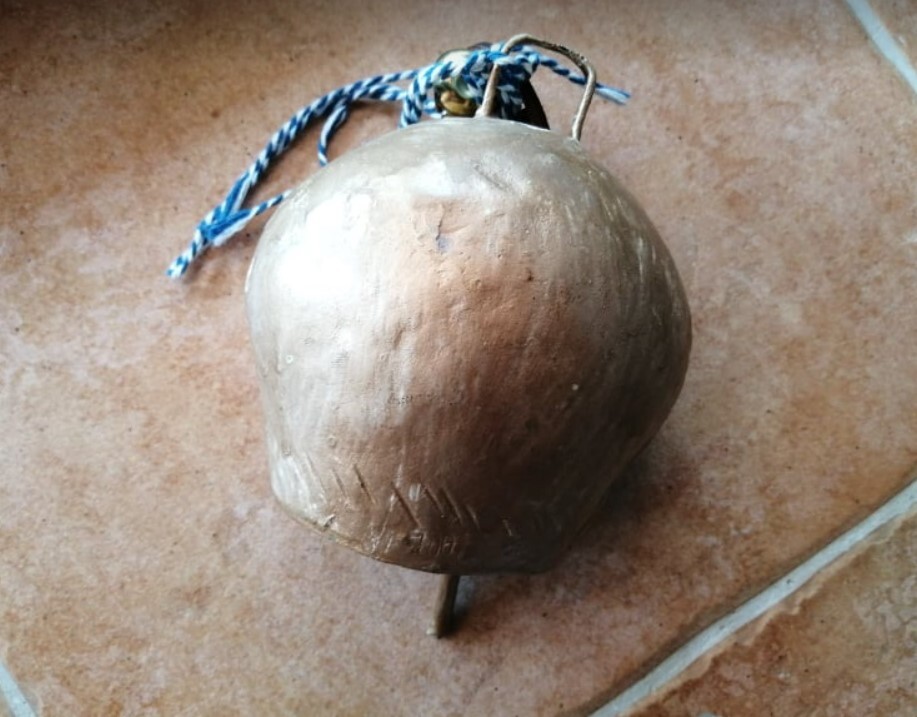
The first one is what I’ve already described, using the frankincense. The second time I use sound. Loud sound makes stale energy run for the hills, so to speak. Bells or gongs work wonderfully for this purpose. More often than not, I use this sheep bell from the island of Limnos that my father gave me. Its sound is very loud so it’s perfect, but sometimes I use my Tibetan bowl instead. This is not as loud but makes a wonderful eerie sound that I find very satisfying and rather mystical. When I use sound, I don’t have to say any words. The loud sound does all the work 🙂

The third time I go around the house, I pick a couple flowers from my garden first. Holding them in my hand with a small icon or a cross, I go around my home to every nook and cranny, and offer blessings, speaking non-stop. “Peace! Love! Prosperity! Radiant health! Balance! Hope! Courage! Joy! Unity! Harmony!” You get the idea 🙂 The power of words is immense!

So there you have it. This is the best way I know to cleanse my home energetically. I swear the air feels lighter after that for days. One last note: It’s best to do this alone in the house. Definitely no one small, sick, weak or vulnerable should be indoors when you do this. No pets, small children and elderly people. When the energy starts to ‘run away’, you don’t want it ‘bumping into’ anyone of the sort, affecting their energy in a bad way.

For the same reason, you must be strong yourself (physically and mentally) when you do this. If unsure, say a little prayer and ask your angels or your favourite saint for protection before you start.

Hey. I know this is not for everybody. If you found this a little ‘out there’ or ‘woo woo’, I totally get it. It’s Greek culture, after all, and we can often act like a crazy bunch. I mean, take that Zorba guy… He certainly was a little loopy, LOL!

Interested in Greek Orthodox traditions? Read here all about the Greeks’ beliefs and traditions for the dead. Hope it won’t chill your blood much, LOL 😛 


YOU KNOW WHAT THEY SAY… SHARING IS CARING! Tweet this to spread some love:

FREE books, and fun news from a Greek author #writerslife #freebies #Greece Share on X

Check out more of my posts on Greek culture here: https://effrosyniwrites.com/category/greek-culture/


3 FREE books for you! Sign up below to receive them instantly!

NEW! Clean Christmas romance. Single mother Cathy Roussos gave up on love long ago, and veterinarian Alex Rallis doesn’t believe in it, but one magical Christmas on a Santorini farm might just change everything…
Check it out on Amazon     Read a FREE sample!


A clean romantic suspense short read with an unreliable narrator that’ll keep you guessing! Vera is losing her mind over famous actor Yannnis Ksenos, except, she isn’t just a fan… Now, she plucks up the courage to ring his doorbell… Visit Amazon


For my delicious Greek recipes, go here
 
Planning to visit Greece? Check out my  FREE guide to south Corfu!

St George’s Easter egg? A Greek tradition, but not for every year!

“St George wants a red egg!”

That’s what my Corfiot grandmother used to say whenever I asked her why St George’s Day is late in any given year. As you may know, St George’s Day is celebrated on April 23rd, but in Greece this is not always the case. The reason for that is because in the Orthodox faith, the hymn used to honour Him in church, mentions Christ’s Ressurection. Therefore, it is not possible to honour the saint unless Greek Easter has come and gone. So, if Easter is later than April 23rd, St George is celebrated on Easter Monday.

I took this photo on Easter Monday (2022) in the main street of my little town of Nea Peramos (west Attica). After the mass, a procession took place to honour St George. The icon was accompanied by a brass band, the priest and town officials, boy and girl scouts, and other youngsters dressed in traditional Minor Asia costumes.

The town of Nea Peramos (‘New’ Peramos) was founded by refugees from Peramos in Asia Minor, who had brought with them an ancient icon of St George – their patron saint. The icon you see in these photos is not it; this is a contemporary one used to worship Him in the town’s church (St George’s church, naturally). The old icon is kept safe in the church as it’s so precious.

St George has always cast his protective gaze over Nea Peramos and its people. The locals speak of sounds of His horse clip-clopping all around town at night. They say the saint was patrolling around town on his horse every night all through WWII, and they believe this is why not one of the people of Nea Peramos lost their life during the war.

As you may know, St George was from Cappadocia, an area now in Turkey that used to be Greek. Legend has it that there was a dragon in Libya that guarded a water spring. Every now and then, people had to pick one of the locals in random to offer for sacrifice so that they could get water from the spring.

When the princess of the land was picked to be sacrificed next, St George, a young officer of the Roman army, arrived on his horse, saved the princess and slayed the dragon with his spear.

Legend or fact? Either way, I am sure you will agree that it makes for a very charming story!


YOU KNOW WHAT THEY SAY… SHARING IS CARING! Tweet this to spread some love:

A St George celebration on Easter Monday. A Greek tradition, but not every year #StGeorge #Christianity #Greece Share on X


Check out more of my posts on Greek culture here: https://effrosyniwrites.com/category/greek-culture/

3 FREE books for you! Sign up below to receive them instantly!

NEW! Clean Christmas romance. Single mother Cathy Roussos gave up on love long ago, and veterinarian Alex Rallis doesn’t believe in it, but one magical Christmas on a Santorini farm might just change everything…
Check it out on Amazon     Read a FREE sample!


A clean romantic suspense short read with an unreliable narrator that’ll keep you guessing! Vera is losing her mind over famous actor Yannnis Ksenos, except, she isn’t just a fan… Now, she plucks up the courage to ring his doorbell… Visit Amazon


For my delicious Greek recipes, go here
 
Planning to visit Greece? Check out my  FREE guide to south Corfu!

My springtime processes involve flowers, books, and marvellous sea views

Hello, All! Today, I am sharing about the processes I follow every spring! Interested? Curious,even? Read on, I hope it will give you some ideas to follow 😉

Springtime, for me, is a time for renewal. It’s the time to shake away the chill of the winter, and not just from my bones – from my heart and soul too, as I find winter depressing and dreary. Not my favourite time of year at all, so the spring has always been for me a time when I take conscious action to renew myself and to ‘come alive’.

At the first signs of spring, I get to work, opening windows wide and letting the sun soak every nook and every cranny of my home, while I go through it with a fine comb, so to speak, to renew it from the inside out.

Starting from the inside, other than the much-needed spring cleaning, I always make sure to go through my wardrobe, giving away what is not needed. Next, I go through the books in my heaving bookcases. Thank goodness for the local library and the eager friends, who take the unwanted ones from my hands!

I believe in the Universal Law of Recycling, which says that if you create a vacuum in any physical space, the Universe will rush to fill it with something new. More often than not, people come with offerings shorty after I’ve given things away. Always makes me chuckle!

Other than cleaning the house and giving away what I don’t need, I also tidy up all living spaces from the clutter that tends to accumulate in the winter months. I find this helps to calm and clarify my overloaded mind, which tends to get worse when I see disarray and overstuffed corners, especially when it comes to paperwork in my study.

Tidying up and getting rid of unnecessary old papers do wonders for my sense of well-being and mental clarity.

All the above are indispensable procedures I follow religiously every spring.

But that’s not the fun part. The fun starts when I venture out to my balcony and garden… where my two fur babies daily offer me laughter and affection in abundance.


Meet Loulou (left) and her daughter, Sissi. They are both gentle souls, and the only cats I’ve ever had who’ve never clawed at me. I feel so lucky to have them, as they bring me untold joy, though I may occasionally feel otherwise – that is, whenever they bring up to the balcony birds of all kinds and sizes, mice, roaches, or lizards. I tend to like them a little less, just for a little while, as I clear up the carnage LOL.

Loulou and Sissi take great interest in my activities on the balcony and around the garden – when I replant pots or pick weeds or vegetables, for example. They tend to follow me around when I water too, making me laugh with their excited manner and meows.

Every spring, especially, there is lots of that, because I tend to plant colourful flowers to place on the balcony. By miracle, Sissi, who is quite naughty, has never destroyed a single one of them, even though she tends to attack everything else!


Working from home, especially in the spring, has wonderful benefits. One of them is that I will occasionally take a small foldable table outside to sit with my laptop and work in the fresh air, sweet birdsong in my ears. Having beautiful blooms around certainly brightens my day even further.


I live in a small seaside town near Athens, which means I get to enjoy wonderful sea views during my walks along the seafront. There are beaches and a large marina with a string of cafes and eateries, and it’s all pretty idyllic.

This is one of my favorite spots for sitting to look out to sea (and the island of Salamina that’s opposite at a very short distance). Sitting on this bench, I love to empty my mind, and other times to plot my stories, or even to pray or meditate when I feel stuck mentally or emotionally. Sitting on this bench has often proved a lifesaver, my mind clearing and my heart lifting within a few minutes as if I’d been touched by a magic hand. In the spring, of course, this idle pastime serves to plan my summer vacations, too, or simply to dream endlessly about them!

Living near the sea is a huge blessing that adds fun and beauty to my days all year round. Enjoying swims daily is easy throughout the summer since the beach is only a five-minute drive away from home. My husband and I love to sit under a pine tree and enjoy a packed lunch (or a bought souvlaki!) sometimes after our swims with the cricket song in our ears. During the spring, picnics on the beach are just as precious and help to bring the summer a little closer. Personally, I start daydreaming about the summer at the first sign of spring, and it tends to offer new inspiration for new stories to write too. Blessings all around!


YOU KNOW WHAT THEY SAY… SHARING IS CARING! Tweet this to spread some love:

Springtime processes from a Greek author #spring #springtime #Greece Share on X


3 FREE books for you! Sign up below to receive them instantly!

NEW! Clean Christmas romance. Single mother Cathy Roussos gave up on love long ago, and veterinarian Alex Rallis doesn’t believe in it, but one magical Christmas on a Santorini farm might just change everything…
Check it out on Amazon     Read a FREE sample!


A clean romantic suspense short read with an unreliable narrator that’ll keep you guessing! Vera is losing her mind over famous actor Yannnis Ksenos, except, she isn’t just a fan… Now, she plucks up the courage to ring his doorbell… Visit Amazon


For my delicious Greek recipes, go here
 
Planning to visit Greece? Check out my  FREE guide to south Corfu!