Greek beach wildlife, gemista, and eggs in tomato sauce

I was spooked in the water by a sea turtle ! (but, in my defense, it was huge!)

If you’ve been following me for a while you must know that I live in the small seaside town of Nea Peramos (near Athens).

Our local beaches. and especially the popular one that I swim in, are graced by sea turtles.  I have repeatedly seen two together, but other locals say they have seen a whole family floating together.

In the recent years, we have been spotting a seal too. One day, it floated right past my husband and me in the deep waters. By the time we’d recovered from the shock it had swum away.

The seal has long disappeared from our area, but the sea turtles are still here. I see them on most days, far in the deep waters, mostly.

Their heads are so big they are easily spotted from afar.

The other day, one of them, a huge one, was splashing by a buoy in the deep water. That kept on for whole minutes. It was quite a show, and I seemed to be the only one who had noticed it.

I guess it’s because I always look out for them. That day, I could see its giant head and its whole fin as it splashed about, looking like it was having fun or hunting for something by the buoy.

And then, another morning, I had the shock of my life. I did a deep dive in fairly shallow waters, and as soon as I came out, about four-five meters away from me, I saw a huge sea turtle staring at me, its head fully out of the water. I froze. It had big black round eyes like buttons, and a green head covered with scales. Of course, I panicked 😨 and swum swiftly to the shallows.

As I neared four elderly women, I told them I just saw the turtle. Soon, a bunch of people gathered there, all of them looking out to sea to try and spot it.

By the time I got out to sit on the sand, I was laughing. They were all looking at a cormoran in the deep water (we have loads in the marshes of our area and they come over all the time to hunt in the sea).

The cormoran, as you probably know, has a long and thin neck, much like a swan’s, while the sea turtle has a huge, almost ball-like neck as seen from afar.

And yet, the locals were looking at the cormoran and going: “Oh! Look! It’s the sea turtle! Oh, how cute!”

Bless them, they couldn’t tell the difference. The funniest thing, though, was that the sea turtle was just to the left of them at the time, a fairly short distance away, but they never saw it. They totally missed it. They were focusing on the cormoran in the far distance instead.

This is what real-life comedy is made of, surely. I know I tittered as I watched the sea turtle swim near them totally unnoticed and couldn’t stop 😅
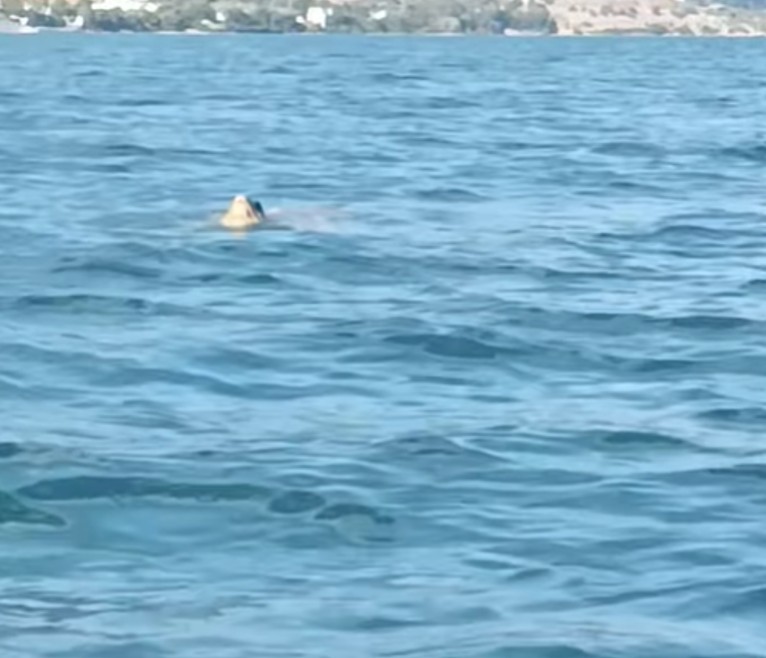
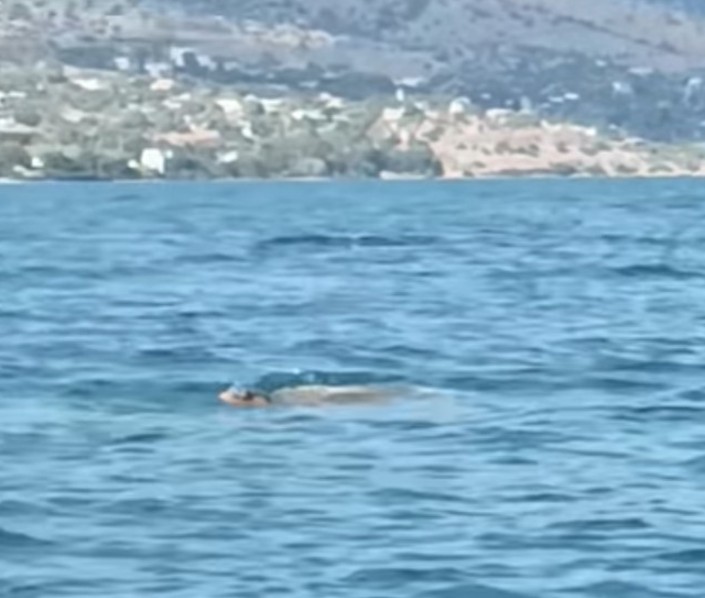
I was pleased to find these photographs online, taken by a local lady, who spotted the turtle while kayaking in the deep waters. These are the only photos I have of the turtle, but hopefully, more will follow. Just look at the size of that head. No wonder I panicked! 😛
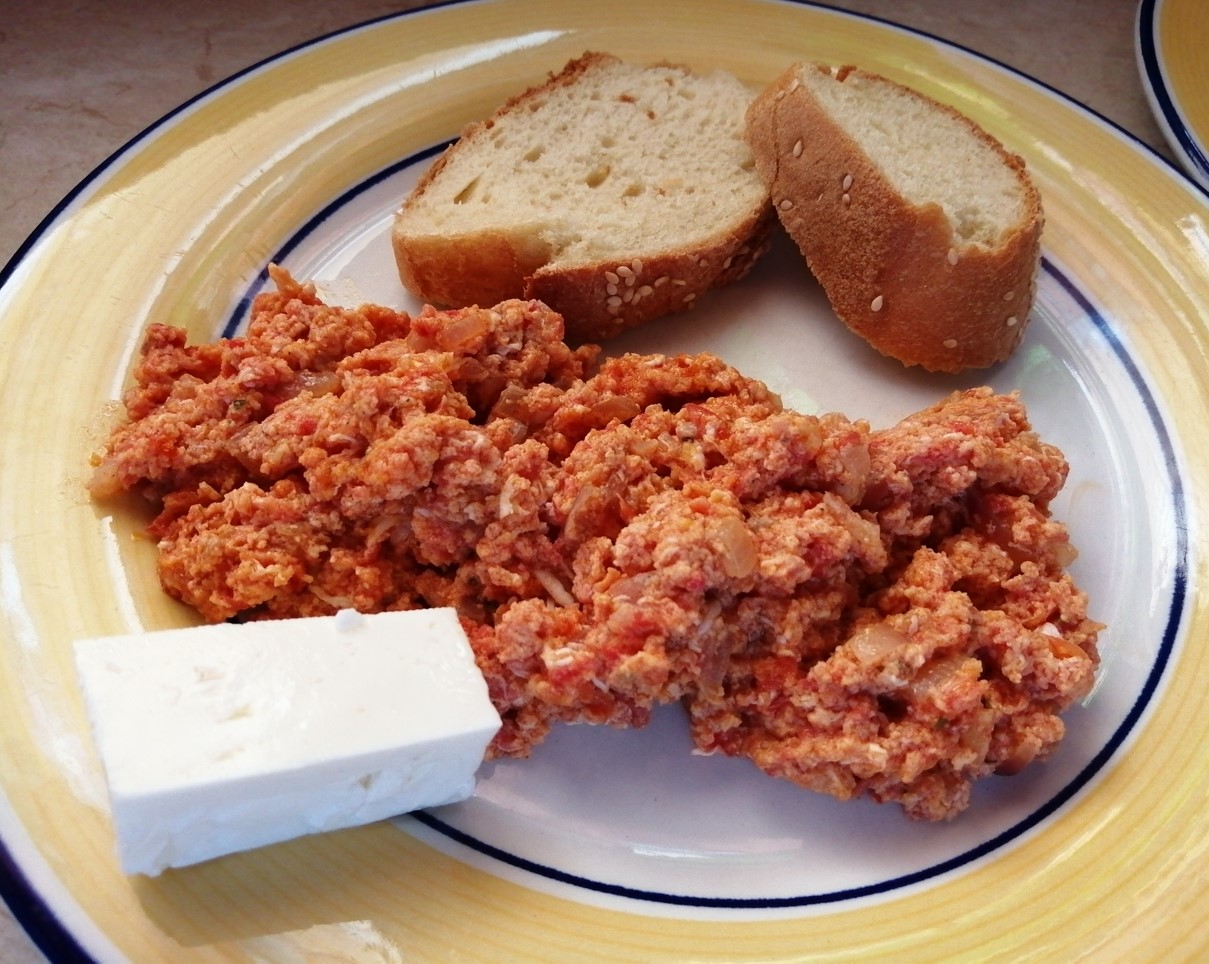


Who enjoys cooking when it’s scorching hot?

I certainly don’t! This special, fried eggs recipe I am sharing today is my late Grandmother Antigoni’s. You will find many variations of it online with the names ‘kagianas’ and ‘strapatsada.’

Back in the 1980s, when I used to spend three months every summer on Corfu, Granny used to serve this often for lunch. She used ripe beef tomatoes and lashings of olive oil.

The sauce was divine and ample, begging for pieces of bread to be dunked in it. I remember feeling amazed every time. How could something made from just a couple of basic ingredients taste so heavenly?

I kept asking my granny to fess up, convinced she kept a special ingredient as a secret, but every time, she assured me she did not.

These days, I use much less oil than Granny did, seeing that when she treated me to that meal I was a youngster, but I am getting long in the tooth now, LOL. Still, despite the fact I serve it rather dry on the  plate now, it still has the same heavenly taste.

Following Granny’s advice, I only make it with summer tomatoes. Try it! Just make sure to serve it with fresh, crusty bread. It makes all the difference. Yum!

GET THE RECIPE
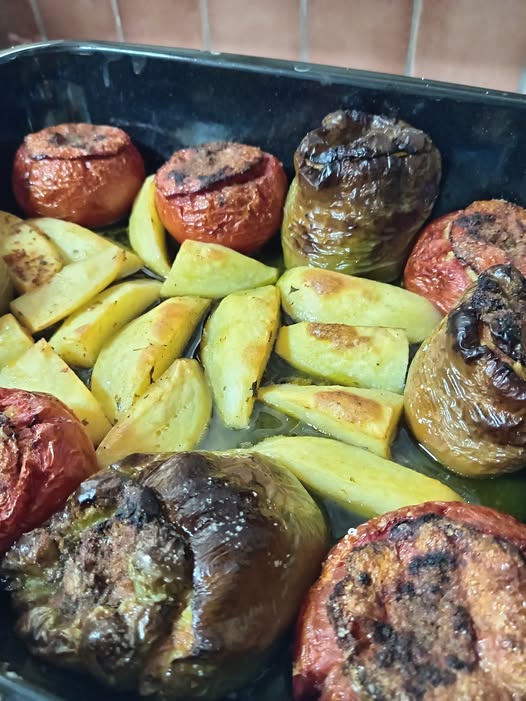


My new, enhanced Gemista

Speaking of summer recipes, I had to squeeze in this one since I recently updated it on my blog.

I made a couple of changes that enhanced the meal, including the temperature it cooks on.

Also, I now add half a teaspoon of turmeric in the bowl that contains the raw rice, tomato, and herbs mix. This enriches the taste further, not to mention giving the potatoes this mouthwatering, yellow tint.

So, what do you think? You’re welcome to get the recipe and dine like a Greek!🍴

This meal is perfect for a summer lunch or dinner. It’s equally delicious served cold, so makes for great picnic food on the beach 🏖️

GET THE RECIPE

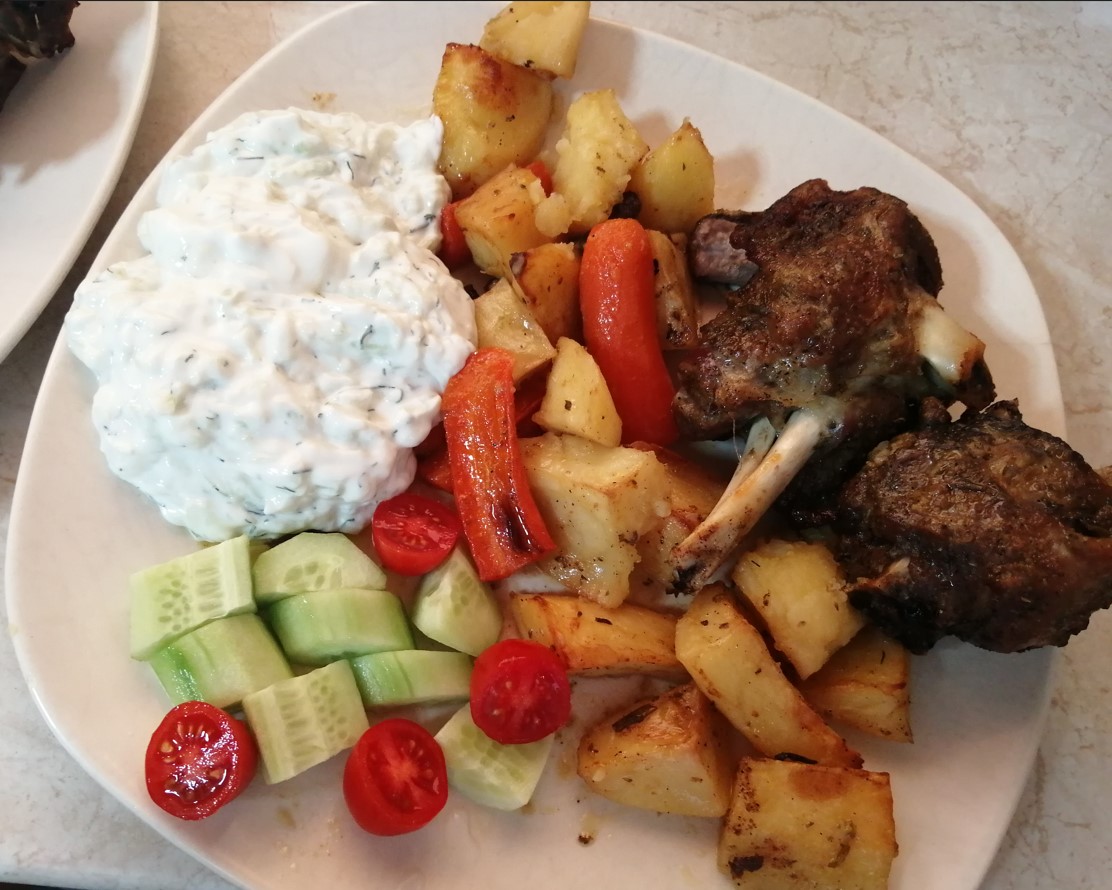
And don’t forget the tzatziki! 😘
 

Sharing is caring! Here’s a ready tweet for you to spread some love:

Interested in travel, food and books from Greece? Here's a blog you will love! #Greek #blogger #writer Share on X


3 FREE books for you! Sign up below to receive them instantly!
New! Clean Christmas romance. Two broken hearts. One magical holiday. A Santorini farm where anything can happen. 
Check it out on Amazon     Read a FREE sample!


For my delicious Greek recipes, go here
 
Planning to visit Greece? Check out my  FREE guide to south Corfu!


Swallow baby boom, hunting cats and glass stickers. A fun post.


Swallow baby boom

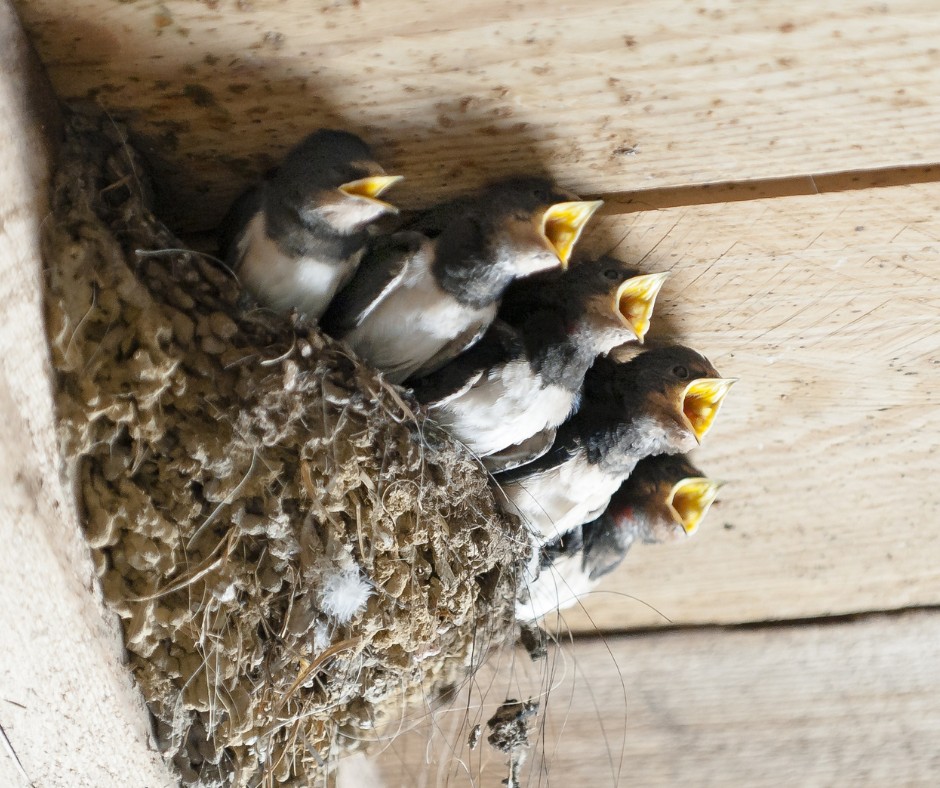
One swallow does not make a spring, they say. But what about two nests brimming over with swallow babies?

That’s right. Next door to me, on the porch of my parents’ house, swallows have come and gone for years now. Two nests remain there all year to be filled again and again every spring. Sometimes, they claim just one, and sometimes both.

I don’t know what happened this spring, but both the nests have been claimed and they are both filled with babies!

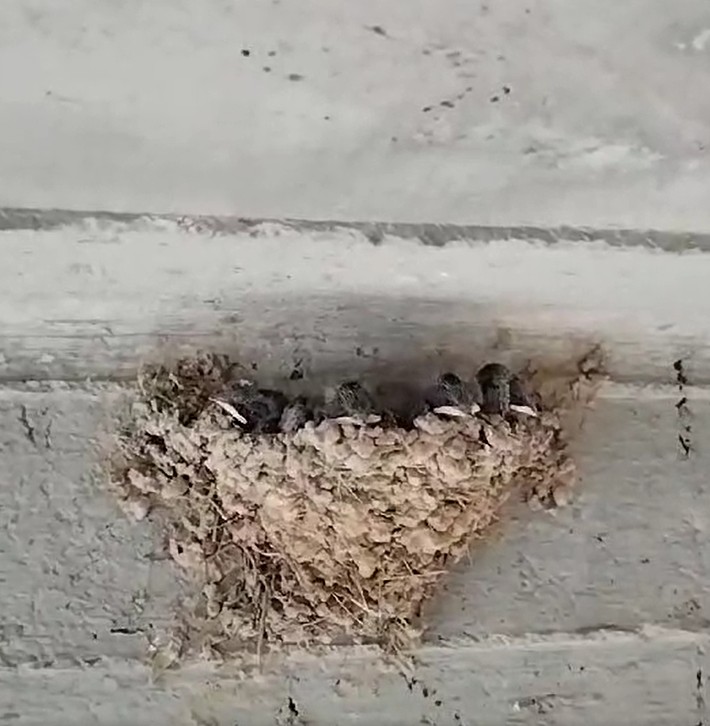
In the picture above, you can see one of the two nests on my parents’ porch.

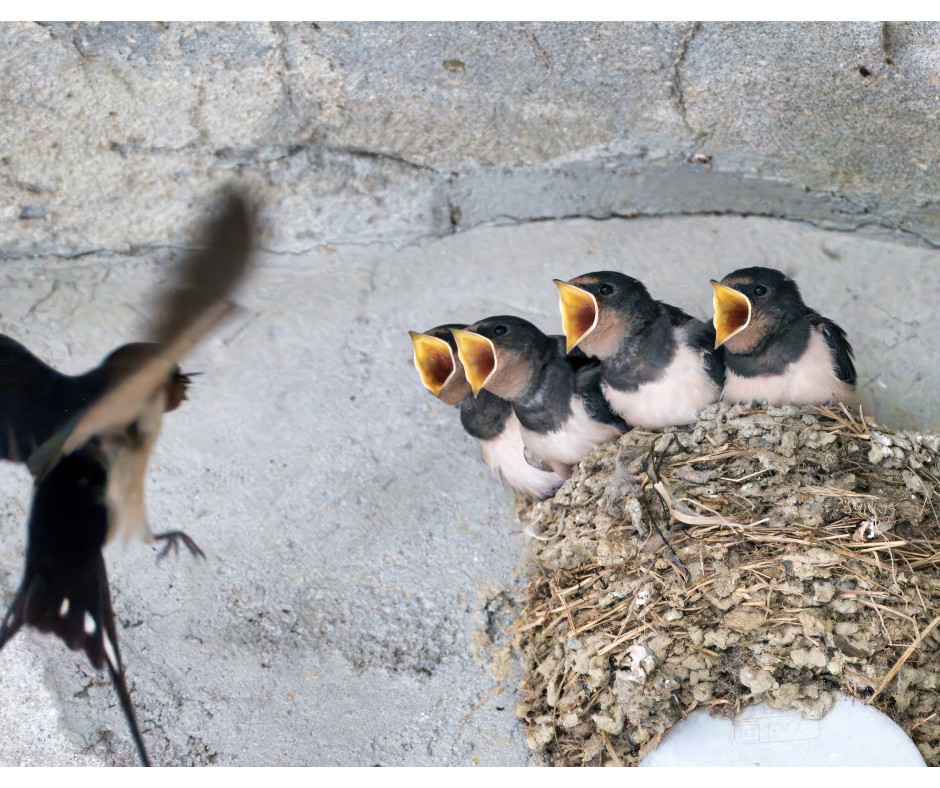
The result? A small murmuration of swallows keeps busy flying here and there all day, bringing sustenance to the little ones. I can count 4-6 birds swooping over my head at any one time, whenever I visit the porch next door.

They have been particularly more daring this year, flying low over our heads when we are in the garden near the nests. Sometimes, they perch on cabling overhead, peering at us, whereas in other years they would fly off the moment they saw us approach.

One morning, I was milling about in the garden, really early in the morning, and I thought I’d go see the nests. It was about ten days ago when none of the babies had flown out the nest yet.

Well, to my surprise, I found one baby on the ground! And I am so glad I checked as I don’t normally do that, so early in the morning. It was a fully formed swallow, with its wings all perfect, but it was just smaller, naturally.

It was standing on the ground, totally still, and it looked pristine, so my first reaction was relief, seeing that I have two avid feline hunters around and a very inquisitive doggie–my parents’ dog, Gino, that I have ‘taken under my wing’ (pun intended) since they passed away.

Anyway, I went closer to catch the baby bird, and it hopped away from my grasp, moving toward a large table. I panicked in case it hid somewhere out of my reach, so on my second attempt I really went for it and caught it in time.

The moment I trapped it inside my loose fist it calmed down and totally stopped thrashing.

Thinking quickly, I then went next door to my house and took one of my cat-carrying bags to keep it safe. Putting it inside proved tricky.

The baby seemed too scared to let go of my hand. It had curled its little claws all around one finger and wouldn’t let go. I had to shake it off my finger gently while giving it a little nudge with my other hand to transfer it to the bottom of the bag.

Once it was secure in there, I put the pet bag on a table before the window, so the baby could see the sunlight. It sat calmly looking from behind the mesh.

And then, I got to work…

The problem was I needed help to put the baby back up in the nest. They are located really high, you see, on the level of a tall ceiling, and because of a health issue I cannot lift any heavy weight. That meant I could not move the really tall ladder needed for the task.

Plus, I didn’t want to wait till my husband came back from work in the late afternoon to do it for me, as I worried the baby wouldn’t make it without food all these hours.

A couple of phonecalls later, I found a kindly neighbor to come and help. As he lifted the heavy ladder to place it under the nest, he told me the swallow nests are considered good luck for the home in his country of Albania.

This made me smile, as my mother and father also thought that. They had swallows return for many years, not just to their house here but also to their country home on the island of Limnos where my father came from.

So, anyway, my neighbor first checked the nest from which the baby had fallen–I knew which one it was because I’d found it on the ground directly under it–but that one was so full of babies that it was obvious why it had fallen. It probably got squeezed straight out by its siblings. So, the nice man put it in the other nest that was luckily less full.

I thanked him and we both went our way, and I hoped the baby would be fed soon as I didn’t know for how long it had been on the ground. I was worried the parents might not feed it, as I understand sometimes wild creatures abandon the young that have been touched by humans. I hear we humans leave quite a stench to the things we touch–at least, to their nostrils 🙃

I also worried it might fall again, in case it had actually tried to fly while not being ready yet. Perhaps, I imagined, I was unlucky enough to save the most overconfident swallow that ever lived 😅

But, anyway,  I worried for nothing. In the afternoon, my husband and I witnessed the babies being fed busily by their parents in both nests.

A couple days later, the oddest thing happened. I was on my porch, putting clothes on the line, and one swallow came to perch on a cable near my porch, almost at eye level.

It just sat there watching me, not in the least skittish about me being so close and gazing back at it.

I like to think it could smell me, perhaps, and knew it was I that had saved the baby. Maybe, it had come to check me out, or perhaps, even to chirp a little thank you to me 🦜

What do you guys think? I could be imagining things! Or, perhaps, as my husband often tells me, I am humanizing, as always, the way I forever humanize the cats and the dog, by trying to explain their behavior in human terms. I do admit… I am guilty as charged!


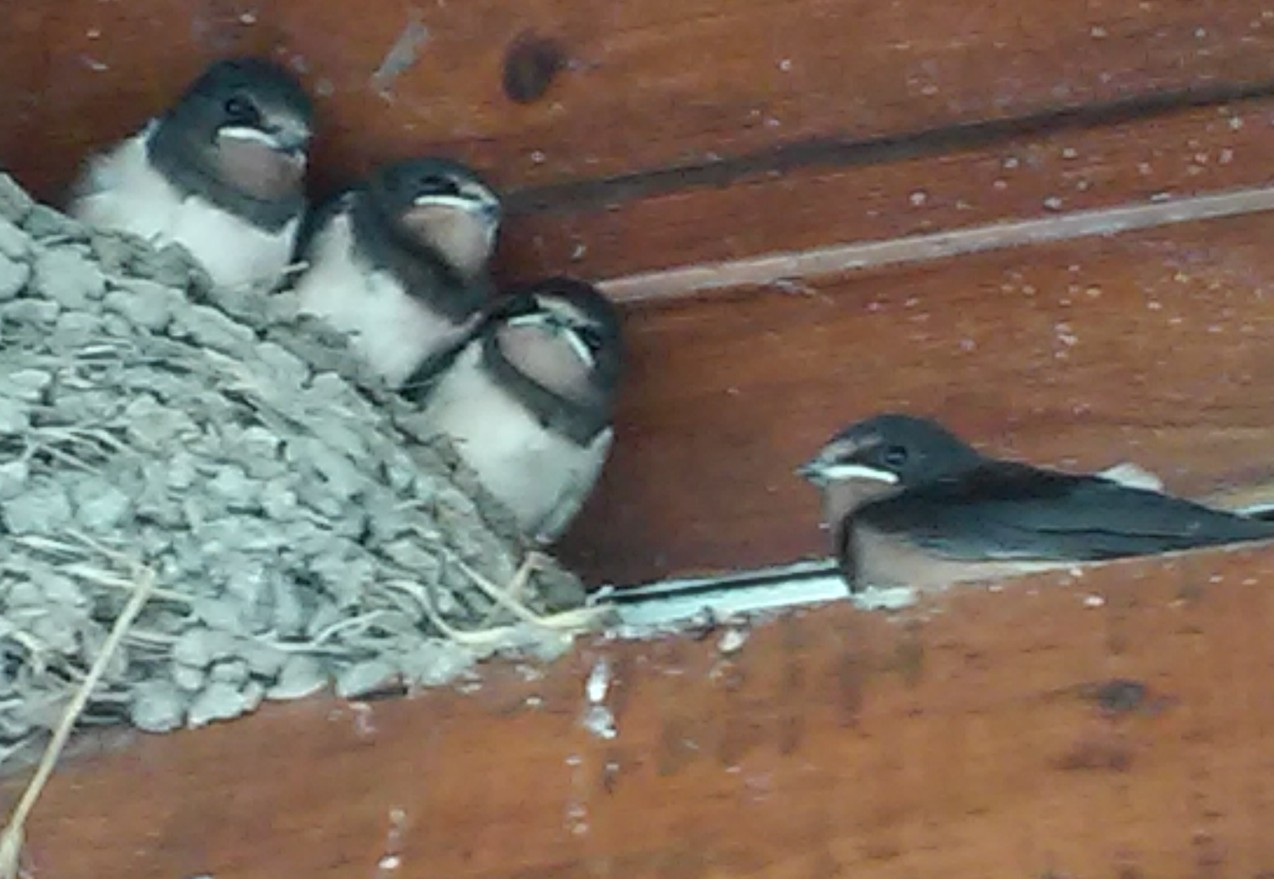
This is an old photograph taken by my mother at the porch of their house on the island of Limnos, where they used to spend much of every spring and all their summers during their retirement.

As you can see, the swallows came for a visit there too, though these do not look like typical swallows to me, seeing that they have these striking white lines on their heads and these nice brown shades. The swallows we have here in my town are the common house martins–they have black on their backs, white underneath, and no white lines on their heads.

Anyone recognize these birds? I’d love to know what swallow species they are. I am guessing they are a less common species for Greece.

As it turns out, there are five different swallow species that are  common in Greece:  the red-rumped swallow, the barn swallow, the common house martin, the sand martin, and the Eurasian crag martin.

The first three species have mainly black and white colors while the last two also have brown or gray shades.

Four of these five species make nests high above the ground using mud and dry plant fibers. The shape of the nest varies among the species. The sand martin is the only one that makes holes in the ground to make a nest, usually near water.

Greek law forbids the destruction of swallow nests, and the punishment is up to 1,000 euro fine and 1 year in jail! Many people, sadly, mind the visit of these intelligent, minute creatures and heartlessly destroy their nests on their walls.

I cannot imagine ever being bothered by the swallows’ sweet and busy song. It is rich in my ears every morning when I go out on my porch. It’s the sweetest goodmorning ever.

The only thing that seems a little bothersome is the small mount of poo that gathers under the nests, but a sheet of cardboard or a scrap of old cloth on the ground fixes that. And if it is built over furniture, perhaps, then one could place a makeshift shelf underneath the nest using a plank of wood and fix this problem.

The swallows arriving in Greece fly across the Mediterranean from Africa and can even fly back and forth from Siberia. And, these delicate little creatures have quite the stamina. They can fly across the Mediterranean in just one day!

In contrast to other migrating birds, the swallows only fly in the day, and pause to rest in different places during their journey.

Last, you may be surprised to learn that swallows don’t feed from the ground, but only during flight, catching bugs mid-air!


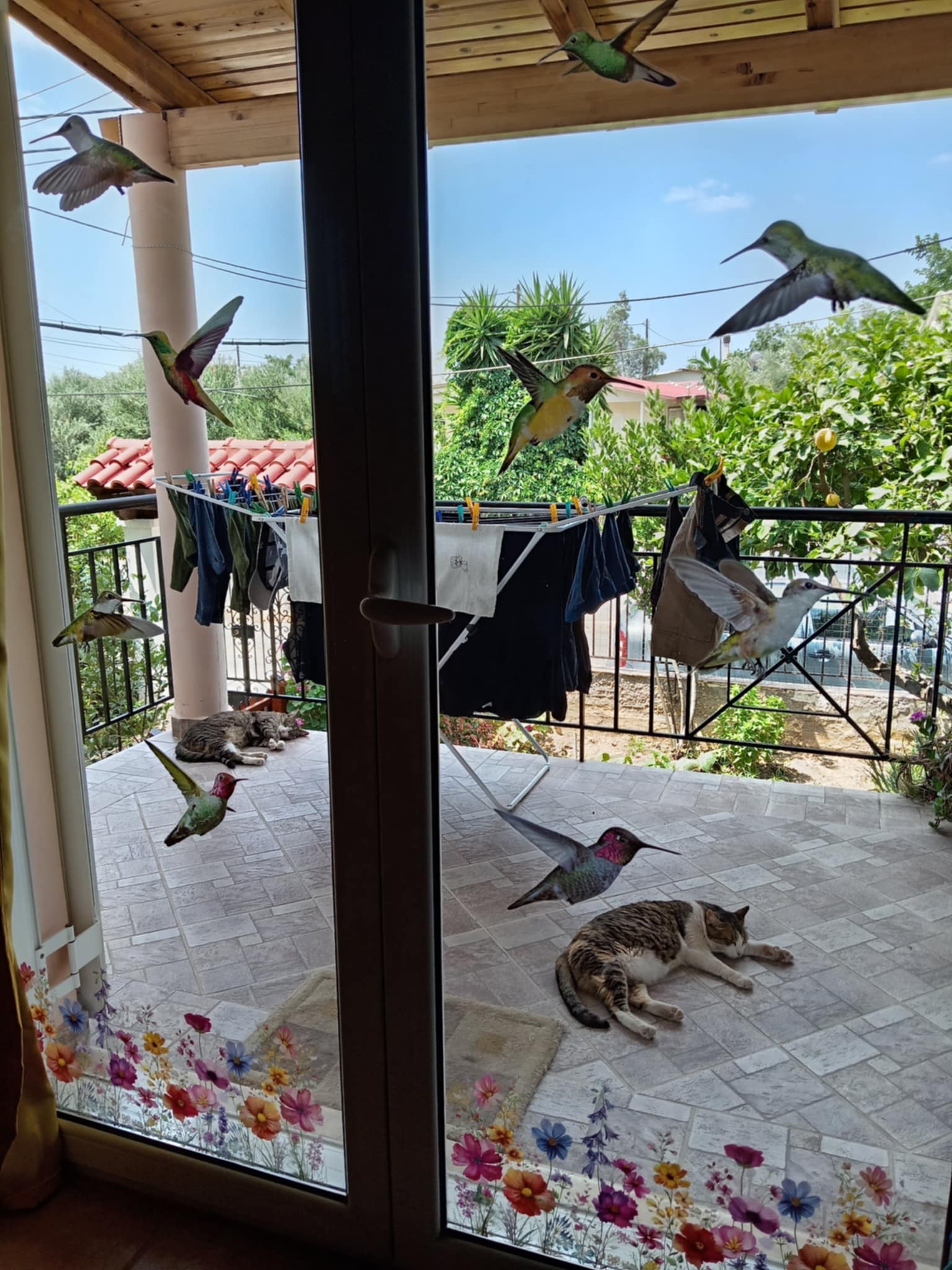
I recently installed these stickers on my living room window. The flowers went in first, just for fun, and then, I got the hummingbirds too, this time for a specific reason. I wanted to protect the swallows and sparrows that are prolific where I live.

Earlier this month, a little bird, probably a sparrow, perhaps blinded by the glare of the evening sun on the glass, hit it hard mid-flight.

I was in another room at the time and came straight out to see what the thud was about. It was pretty loud. I hoped it wouldn’t be a bird, as this had happened twice before over the years, before I even had cats, and when I saw what it was my heart sank.

By the time I got there, one of my cats–the younger one, Sissi–had already snatched the poor soul. She catches birds with gusto, and she’s really good at it. So, as sad as I was, I wasn’t surprised…

I managed to catch only a glimpse of the birdie lying still in her mouth, and I couldn’t save it, as Sissi then ran off with the bird and there was nothing I could do about it.

It broke my heart so much I knew I had to do something.

Happy to report I haven’t had any more mishaps since installing the stickers. I really hope they will deter the birdies from flying that way again.

In the first day or two, my cats, Sissi and her mommy, Loulou, sat and gazed at the hummingbirds from time to time, and also raised their paws, trying to catch them. Now, they coexist peacefully, as you can see.

And, if they mind these birds are made of plastic I’d rather they feel a little peeved than snatch another birdie while I’m watching. It’s not always easy being a cat mamma!

Till next time, enjoy this glorious summer and reading awesome stories!😀


Interested in Greek wildlife and nature? Check out these posts:

Sharing is caring! Here’s a ready tweet for you to spread some love:

Greek life, travel, food and books. Here's a blog you will love! #Greek #author #writerlife Share on X


3 FREE books for you! Sign up below to receive them instantly!


New! Clean Christmas romance. Two broken hearts. One magical holiday. A Santorini farm where anything can happen. 
Check it out on Amazon     Read a FREE sample!


For my delicious Greek recipes, go here
 
Planning to visit Greece? Check out my  FREE guide to south Corfu!

A majestic cave in the Peloponnese and a road for smooching

A visit to Kastria Cave (aka Cave Lakes)

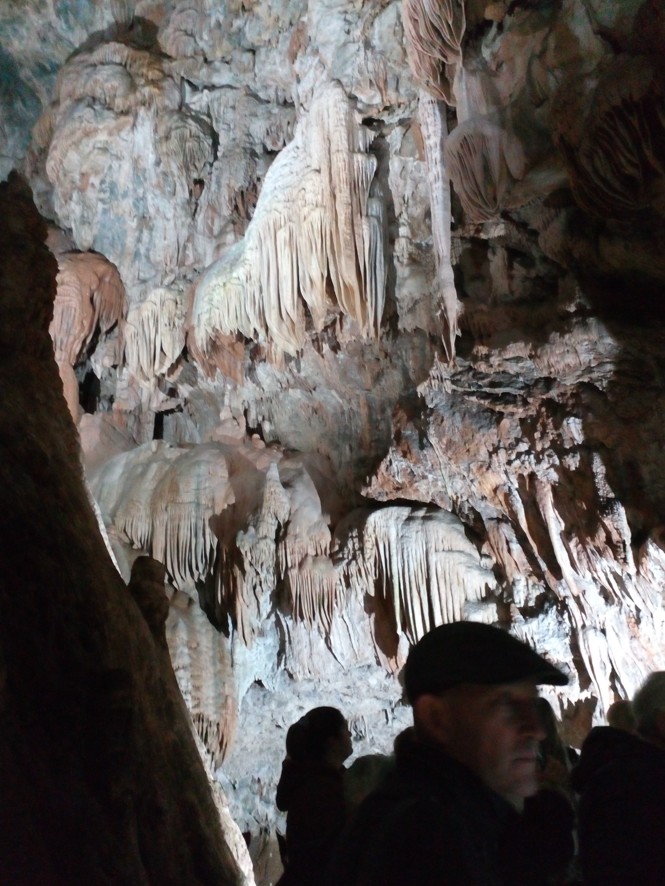
Today, I am pleased to share photographs from the majestic Kastria Cave (aka Cave Lakes) in the area of Kalavryta.

The cave system is vast and only a small part of it is open to visitors.

We had an enthralling tour for about 30 minutes, exploring the small part of the cave that is open to the public. The main reason why the rest of it will remain out of reach is to ensure its preservation, as well as the survival of its fauna that thrives there for thousands of years.

There are ten bat species in the lakes, something I wasn’t exactly pleased to be told before entering🫣Immediately, my mind conjured up an image of Jim Carrey’s Pet Detective bolting out of a cave that was full of bats and guano and screaming!

Ha ha. Luckily, I didn’t have to do that. The tour guide said we might find droppings on the ground, and said not to photograph any bats if we happen to see them. Again, I was spared from any encounter of the sort 🙃

But, actually, the guano is useful in the caves, as it becomes food for other species, including three endemic ones: a scorpion, a beetle and a spider. These, along with an endemic cricket, have survived safely inside the caves for millenia.

More than 18,000 bats live in the caves. When I found that out I felt even luckier I never saw a single one LOL!


This was not my first visit to a cave. I have been to the impressive Lake Melissani in Kefalonia and the beautiful Diros Caves in the Peloponnese (both explored by boat).

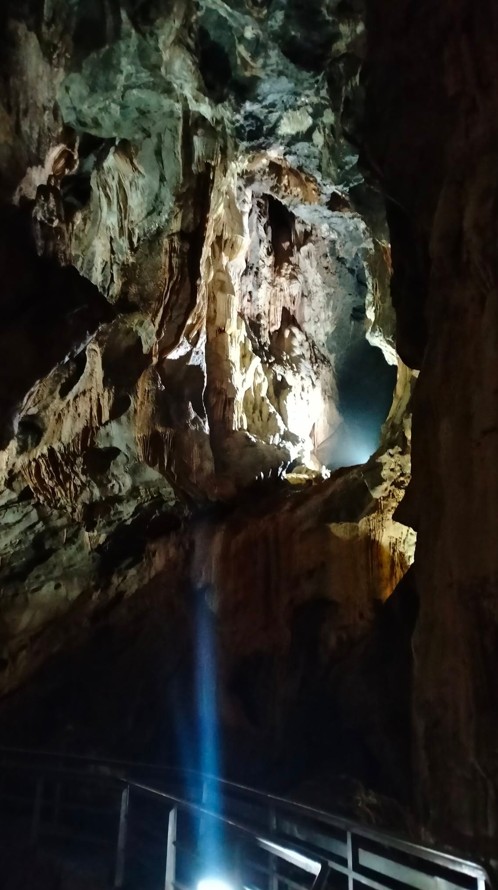
But, entering the Kastria Cave, I was stunned. Nothing could have prepared me for the staggering size of the chambers. I’d never seen a cave before clothed in every way with such sheer magnificence.

I kept looking up and marvelling at the tall ceilings and the beautiful formations from that very first chamber we entered.

The walking tour lasted for about thirty minutes. Walking on artificial bridges over the serene lake waters and going up and down steps, we explored a series of majestic chambers of incredibly high ceilings.

Some of the formations were really impressive, such as a series of natural ‘bathtubs’ that reminded me of those stone bathtubs one can find in luxury hotels in Aegean islands, like Santorini, which imitate natural cavernous spaces. Or, the much larger natural Kolibithres in Mikro Papigo, Zagori, that are out in the open and people can actually swim in them.

But the natural ‘bathtubs’ of the Kastria Cave are out of reach to the public, of course, and can only be viewed from a bridge at close distance. The guide on site told us all of them stay full of water in the winter. They had little to no water during our visit mid-April.

There are 13 lakes inside the cave. The total length is 1.980 meters, but only 500 meters are open to the public. The cave system is laid out on three different levels. Visitors walk along a short, sloped tunnel to enter the cave which takes them straight to the second level.

There are heavy security doors either side of the tunnel to ensure they stay shut in order to preserve the low temperature in the cave. You feel the sudden drop in temperature as soon as you enter.

The exploration of the Kastria Cave took place between 1964-1965. In 1981, it was handed over to the Greek Tourism Authority, and it has been open to the public since 1988.

Across from the entrance to the cave, in a beautiful court with greenery and trees, stands a small, yet interesting, museum. Various findings from excavations in the caves are housed there, including tools, and remains of animals (even those of a hippo!) from the Bronze and Neolithic eras.

All in all, it was a memorable and exciting visit, and if you’re in the area of Kalavryta, I highly recommend you check out this wonderful site.

The nearby village of Planitero is the perfect place for lunch if you’re visiting the area. Planitero is a stunning little village with trout farms and rushing river waters inside a plane tree forest. I did go there for lunch on the same day and you can see photos and read all about it in this post.

Here, I’d like to thank Perivassis Tourism & Τravel Services and our amazing tour guide, Katerina Liontaki, for another wonderful day spent under her wing, and also for her sending me some of her own photographs to post.

GO HERE to see all the pictures from Kastria Cave. Some of them are posters mounted inside the tunnel and depict speleologists. These photos show the cave and the lakes in all their splendour!


Vytina, a beautiful town with many treasures…

On the same day my husband and I visited Kastria Cave on the coach tour, we stopped at Vytina for coffee.

Vytina is a traditional settlement in the Peloponnese that has beautiful stone buildings. It is built at the foot of the mountain range, Mainalo.

Go here to see my pictures from Vytina.

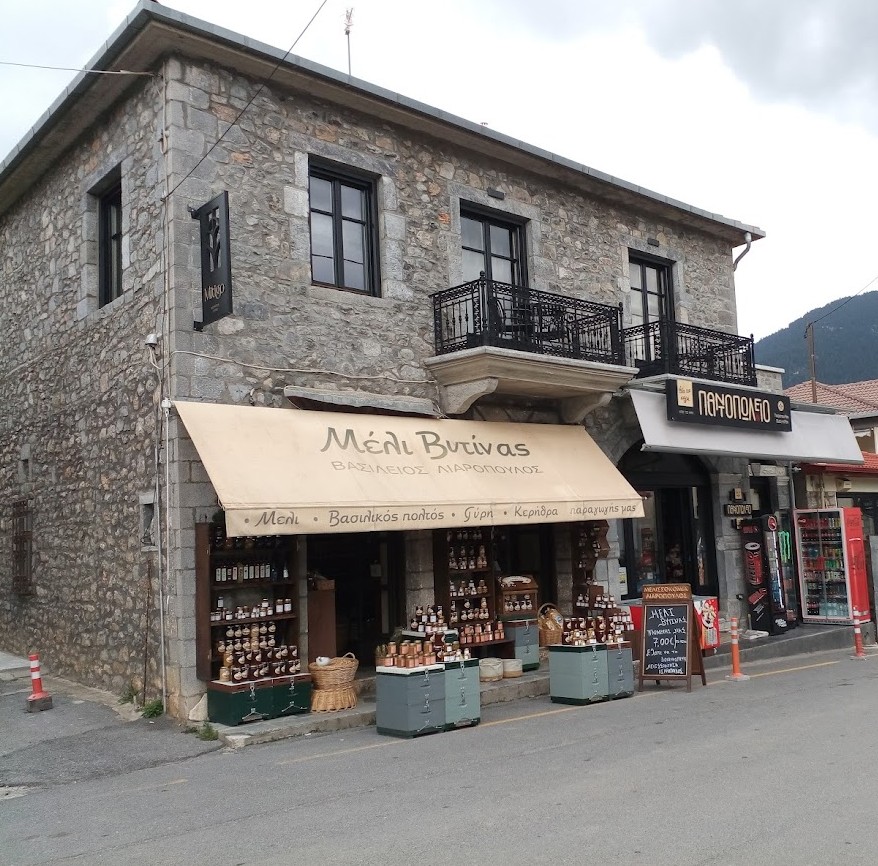
We had coffee at the square in one of the many cafes beside a beautiful stone-built church. Then, we looked around the shops that sell traditional products, including the local honey variety that has a striking yellowish color.

It is called Elati Vanilia, and it is a treasure to the immune system, and also beneficial for a number of health issues.

We also found out that the region also produces a variety of marble that is named The Black of Vytina. Truly, it’s a blessed little place, with many treasures.

But that wasn’t all we discovered there. Thanks to our wonderful guide, who tipped us off, we then took a downward street from the square, looking for love…

And love, we did find, just a couple minutes later, getting into the most serene little road lined by trees that has a very special name 😍


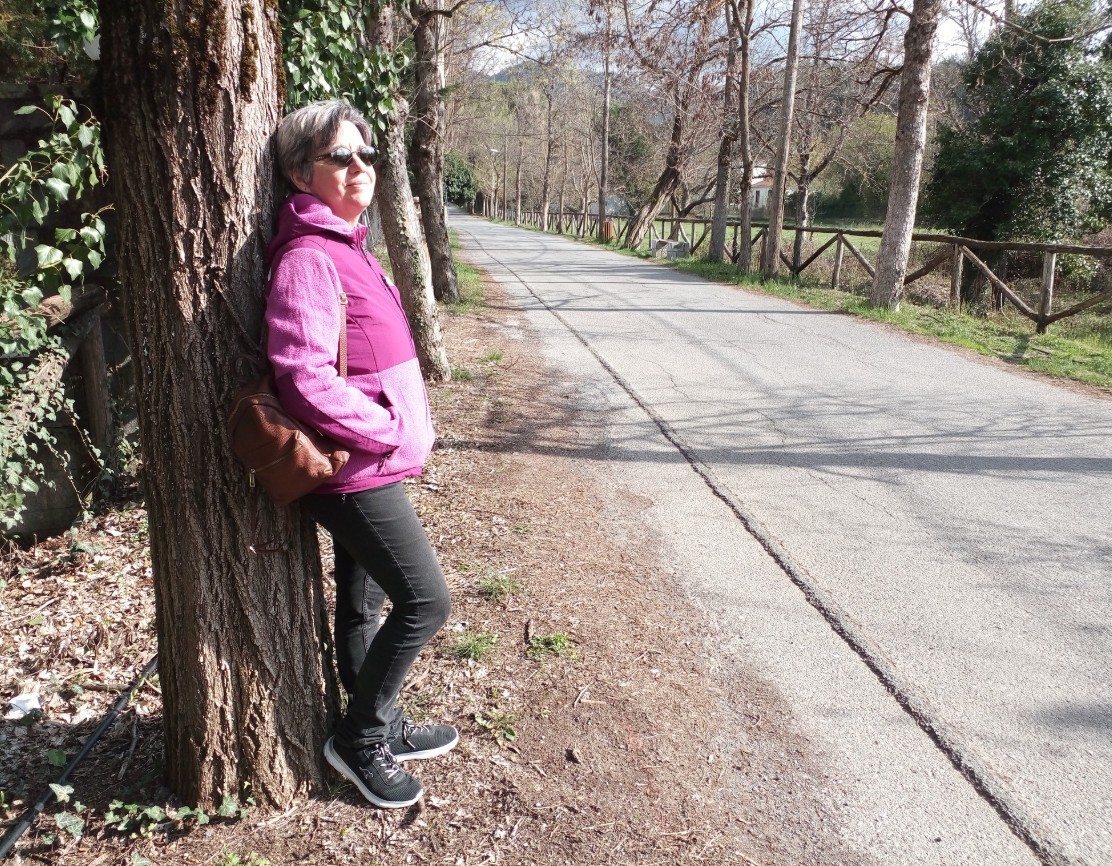
This is a photo of me on ‘The Road of Love’ (O Dromos tis Agapis) in Vytina. It has been named thus by the locals because, for many generations, it has been the meeting place for young lovers to take a walk in the quiet.

The road stretches out into the distance, as far as you can see, with beautiful tall trees either side. There are hardly any houses around, just grassy fields and more trees.

Back in April when I visited, the distant snow-capped mountains were the perfect backdrop. The birdsong was ample and sweet in my ears. The grassy ground was strewn with tiny white flowers, including chamomile.

It all combined to create a sweet springtime memory that I will treasure forever.

I am at an age when I need nothing in terms of physical things. Most of the time, I don’t wish for a present anymore on the big days but always go for a meal out, or a day out in nature to celebrate, instead.

Beautiful memories is the only thing I seek when I think of exciting new ‘acquisitions.’

It is a privilege and an honor to share my experiences with you. Once again, I’d like to thank everyone who writes to tell me how they enjoy reading about my travels. You give me encouragement to keep on traveling and sharing!

Before I go, to share my big news. I just finished writing My Greek Island Christmas! What I can tell you is it got me and hubby (who is my forever eager editor) in the same places!

This means that if we laughed or cried in certain scenes, chances are you will too 😃 But it has a nice balance of humor, romance and family drama. Oh. And lots of Greek food. That blessed girl cooked every day in that farm in Santorini, and she kept me salivating 😛

Anyway, I am really pleased it’s done! Another baby of mine born, and the feeling is amazing every time 💗

GO HERE to check out the book and download a FREE sample! The book is available on preorder in various stores 🥳

Till next time, enjoy summer and keep reading amazing books!

Interested in discovering more places in the Peloponnese? Check out these posts next!

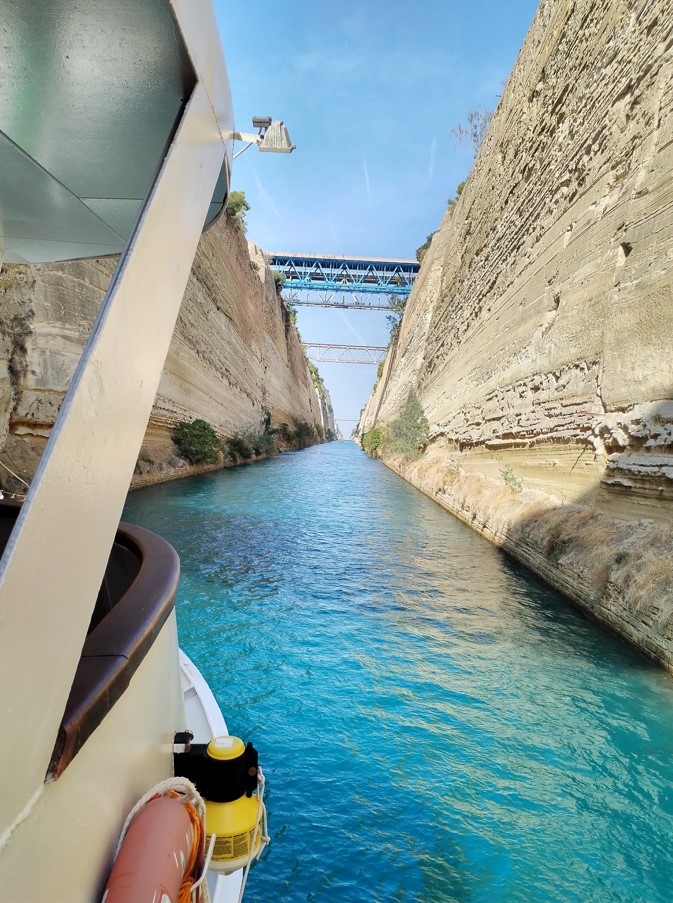
A cruise through the Corinth Canal and fun facts  https://effrosyniwrites.com/2024/10/25/corinth-canal-cruise-and-corfiot-pastitsada/

A stunning fresco at the Isthmia Roman Baths, Nero, and a mollusc with a royal secret https://effrosyniwrites.com/2024/11/08/fresco-isthmia-roman-baths-nero-corinth-canal/

Majestic views in Lake Doxa and an old secret school… https://effrosyniwrites.com/2022/12/09/majestic-views-secret-school/


Sharing is caring! Here’s a ready tweet for you to spread some love:

Interested in travel, food and books from Greece? Here's a blog you will love! #Greek #travel #romancebooks Share on X


3 FREE books for you! Sign up below to receive them instantly!


New! Clean Christmas romance. Two broken hearts. One magical holiday. A Santorini farm where anything can happen. 
Check it out on Amazon     Read a FREE sample!


For my delicious Greek recipes, go here
 
Planning to visit Greece? Check out my  FREE guide to south Corfu!

Cervantes in Nafpaktos and the Battle of Lepanto

The stunning fortress of Nafpaktos, and the famous naval battle of Lepanto

Nafpaktos is situated in the region of Greece called Aetolia-Acarnania on the mainland. It is a short drive from the magnificent Rio-Antirrio bridge that stands between the Gulf of Patra and the Gulf of Corinth.

This historic town has a vast history and its beautiful old fortifications attest to that.

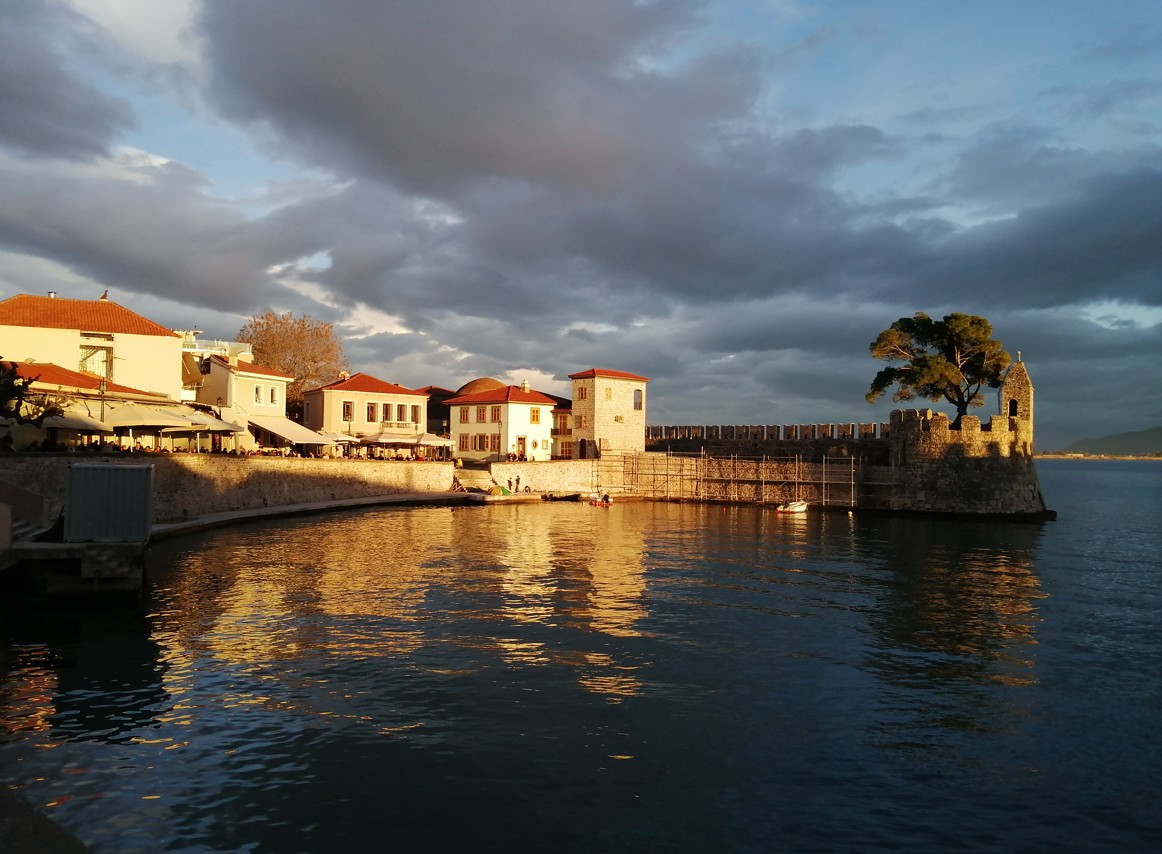
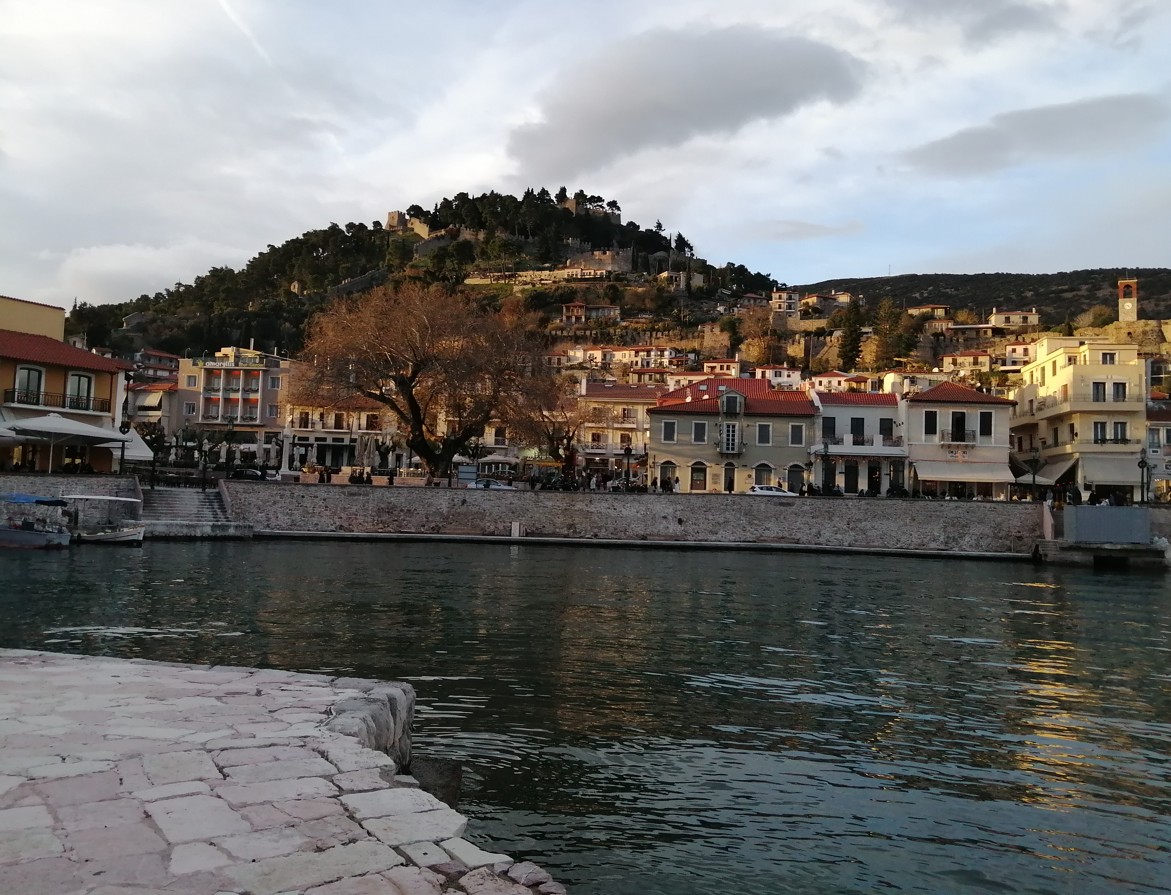
The Venetian 15th-century fortress of Nafpaktos stretches out from the top of the hill all the way down to a stunning little harbor. There, the fortress walls stand on the beach, a stone’s throw away from the water.

This quaint little harbor is a focal point for locals and tourists alike to take a walk, swim or sit in one of the many cafes and eateries.

My husband Andy and I visited Nafpaktos on just a 2-hour stopover during our tour to Epirus (Arta and Ioannina mainly) by coach so we didn’t have the chance to  enjoy the place fully.

We had lunch at the amazing taverna “Nikos” on the square across from the harbor. Then, we only had time for a quick walk around before we had to leave.

I am looking forward to a chance to visit Nafpaktos again, this time to stay, and explore it fully. On the mountain region nearby that is called Orini Nafpaktia, there are numerous villages of stunning beauty for the visitor to explore as well. This is another of the reasons why I am gagging to go back and when I do you’ll be sure to know 😉

Two war heroes honored at Nafpaktos harbour: Georgios Anemogiannis and… the Spanich author of Don Quixote, Cervantes!

As I walked along the harbor and read the numerous plaques mounted here and there, I quickly delved into the town’s glorious history, and especially The famous Battle of Lepanto, i.e. of Nafpaktos. Lepanto was the name of the town in the Venetian era.

The Battle of Lepanto took place on October 7, 1571, and it was fought between the Holy League, i.e. a coalition of Catholic states, and the Ottoman Empire. The Holy League that was mainly comprised of the Papacy, Spain and Venice won the battle.

This victory had a great significance as it lifted the morale of the European Christian nations and, more importantly, it put an end to the Ottomans’ naval supremacy in the Eastern Meditteranean.

The Battle of Lepanto was also considered to be a forceful Christian retaliation, a grudge match of sorts, against the Ottomans, since the latter had shown extreme brutality in the way they tortured Christian heroes of the war that they captured and executed.

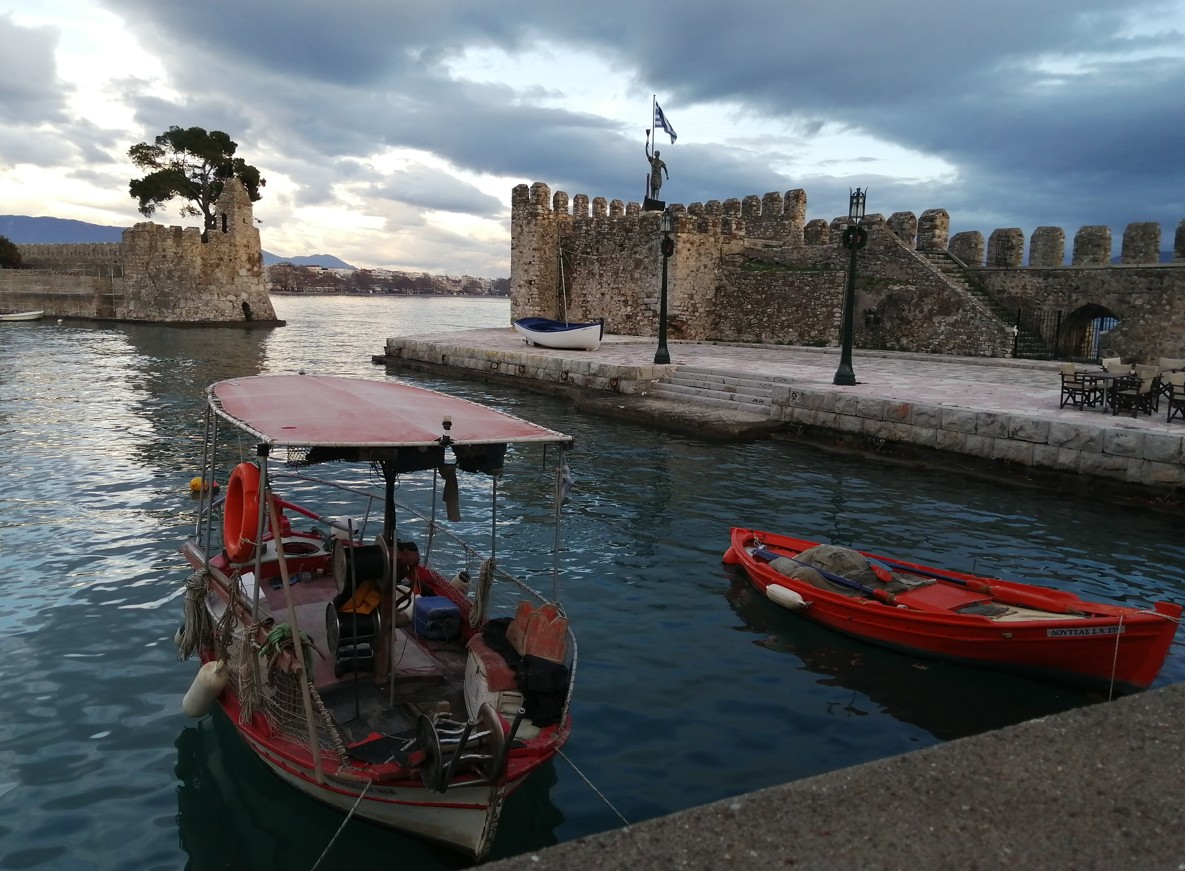
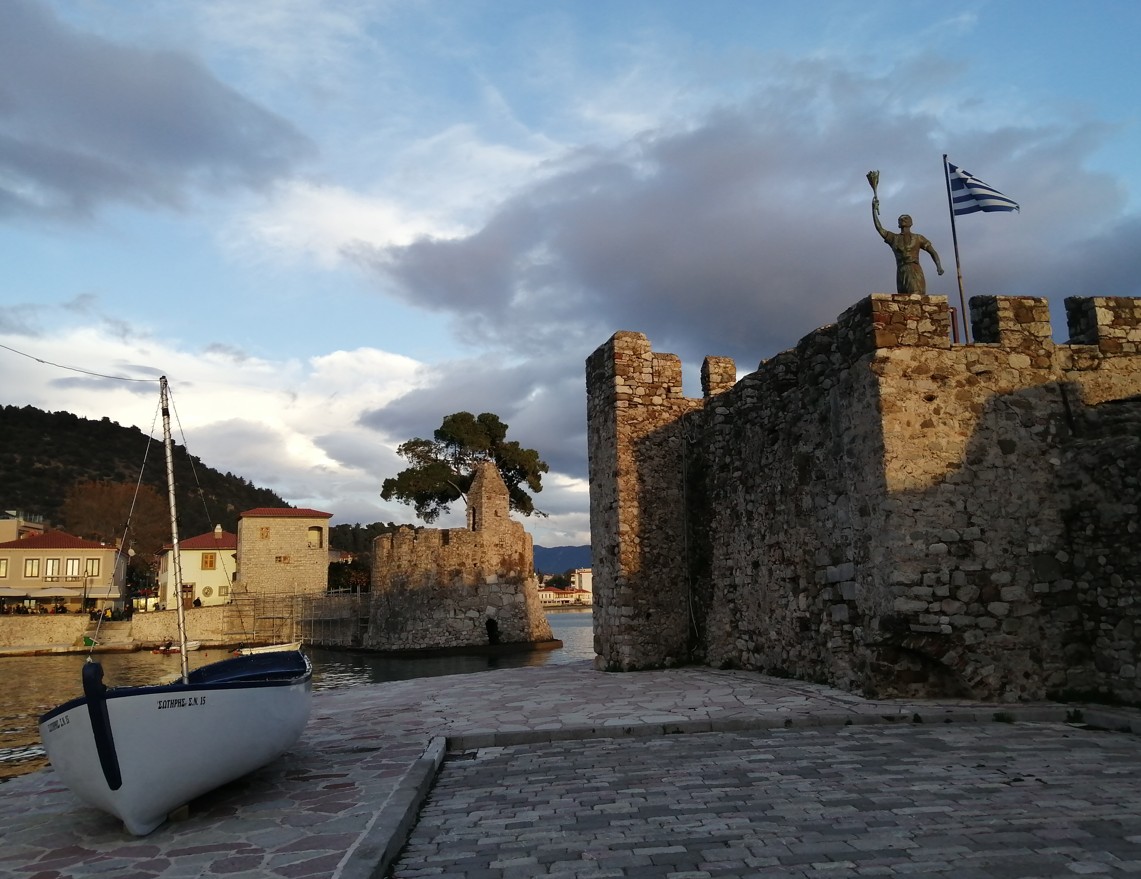
One of them was the Greek hero Georgios Anemogiannis, a statue of whom stands today at the harbor.

Anemogiannis (1798-1821) is depicted raising a torch as he stands atop the wall of the fort (see picture above). The reason is because he was a fire-ship captain, setting the Ottoman boats on fire. An almost identical statue of Anemogiannis  stands in Gaios on Paxos, the island where the hero was born. He was tortured and murdered brutally at the age of 23 having been captured by the Ottomans in Nafpaktos in 1821, i.e. in the year when the Greek War of Independence began.

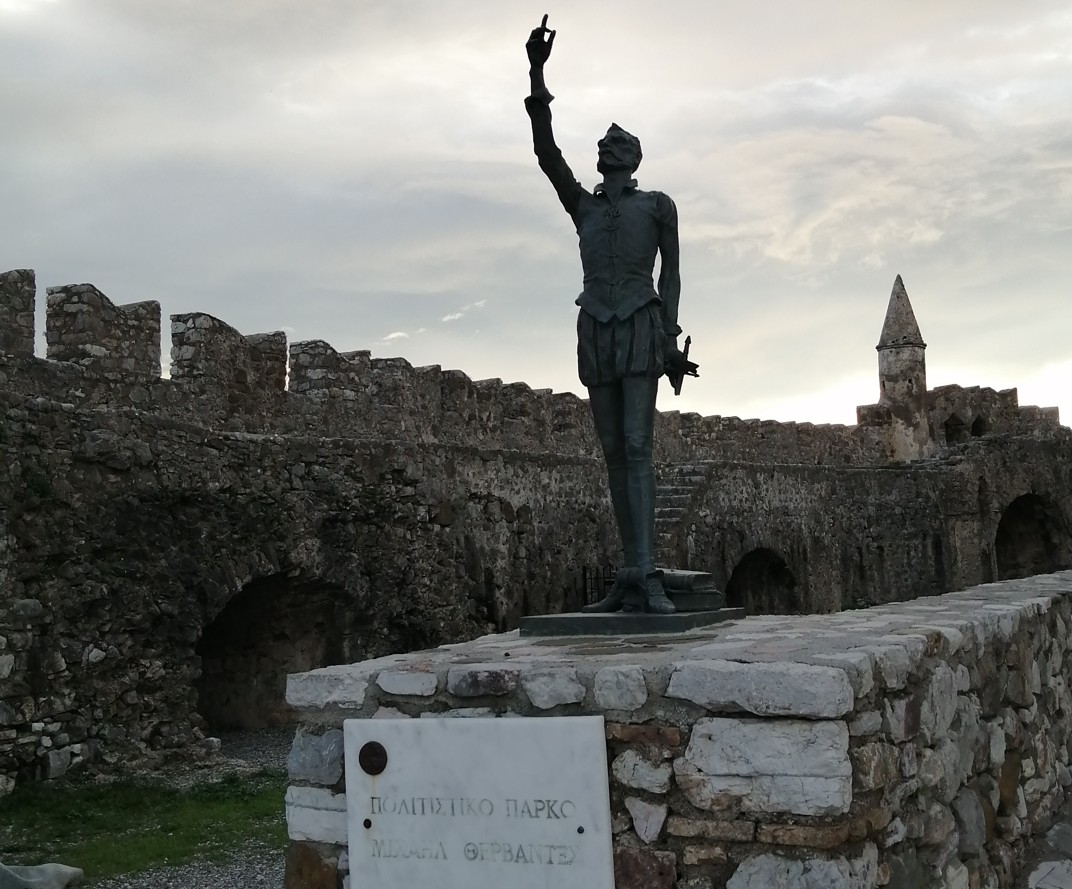
Across from the statue of Anemogiannis, depicted as if greeting him back across the short distance, stands a statue of Miguel de Cervantes Saavedra (1547-1616).

He is the Spanish author of Don Quixote, the first modern novel to be published in Europe, and one of the world’s favorite classics today.

Cervantes is depicted holding a feather in his raised hand, a nod to his great literary achievement. Cervantes drew from his own war experiences and chivalric romances of his time to write Don Quixote.

He enlisted in the Spanish Navy in 1570, serving as a soldier until 1575. When he fought in the Battle of Lepanto in 1571 he was 23 years old.

Although he was ill with fever during the battle, he offered to take part saying he’d rather die for his God and his king rather than hide under the blankets. His heroic choice left him with three gunshot wounds: two in the chest and one in his left arm, which was then amputated.

Cervantes always said that the loss of his left hand served to glorify his right one, referring to his later literary work. For the rest of his life, he carried his wounds from The Battle of Lepanto with pride.

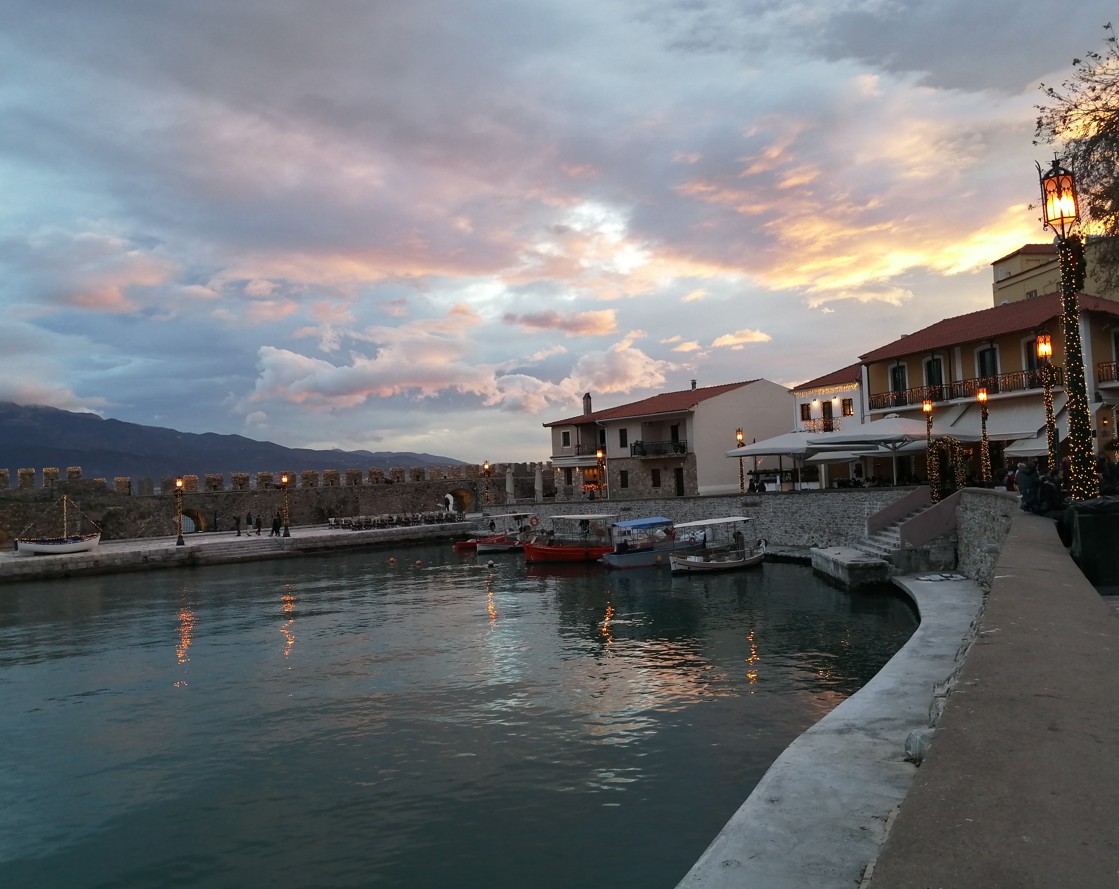
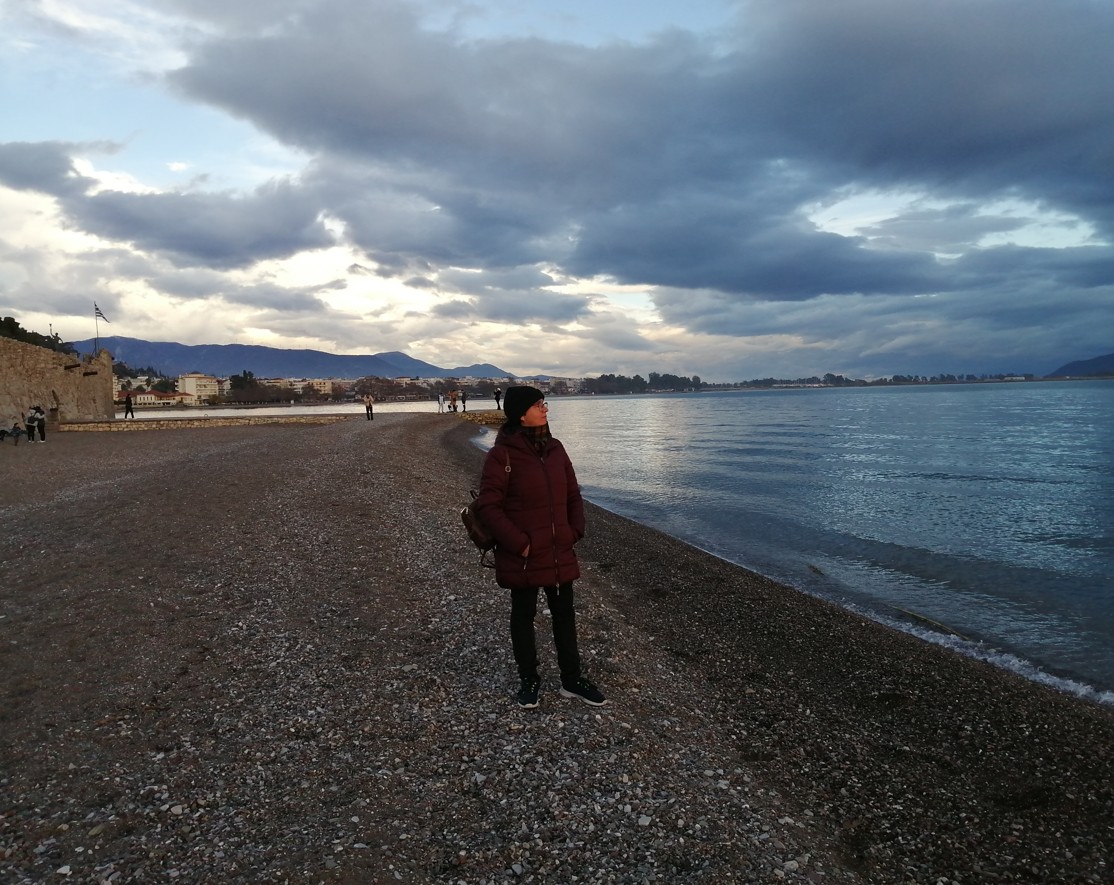
As the sun began to set during my short visit in Nafpaktos, the views became increasingly breathtaking. The beach, right before the fortress gate, is beautiful and seems to be stretching out all the way to the Rio-Antirrio bridge in the far distance.

GO HERE for a short video that I took on the beach. The serenity, the dramatic sky and the sweet murmur of the sea are enchanting.

GO HERE to see all the stunning views of Nafpaktos that I was blessed enough to capture that day. Shortly after sunset, the Christmas lights came on everywhere and the dramatic sky made the snaps just perfect!


Sharing is caring! Here’s a ready tweet for you to spread some love:

Interested in travel, food and books from Greece? Here's a blog you will love! #Greek #blogger #writer Share on X


3 FREE books for you! Sign up below to receive them instantly!


New! Clean Christmas romance. Two broken hearts. One magical holiday. A Santorini farm where anything can happen. 
Check it out on Amazon     Read a FREE sample!
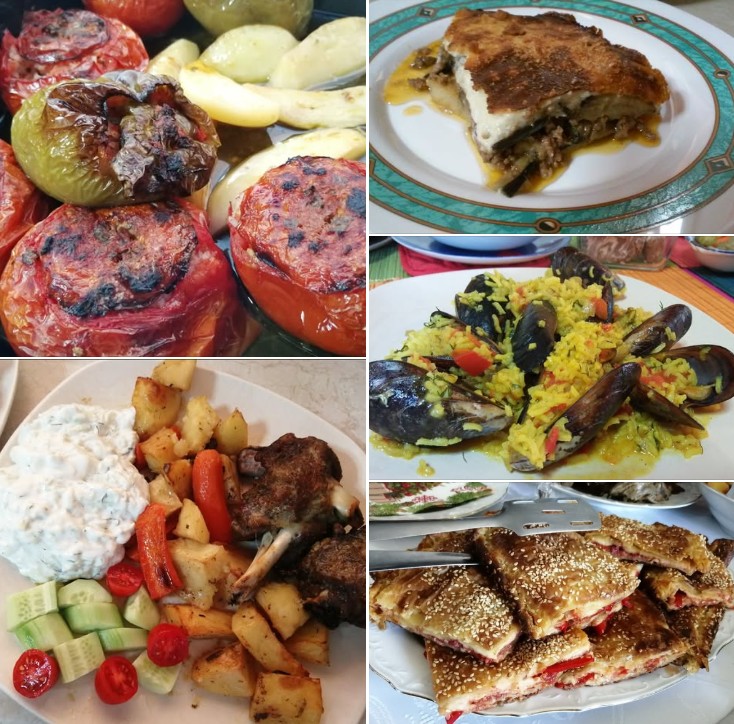
 

For my delicious Greek recipes, go here
 
Planning to visit Greece? Check out my  FREE guide to south Corfu!

The Castle of Ioannina and delish air fryer frittatas

The Castle of Ioannina

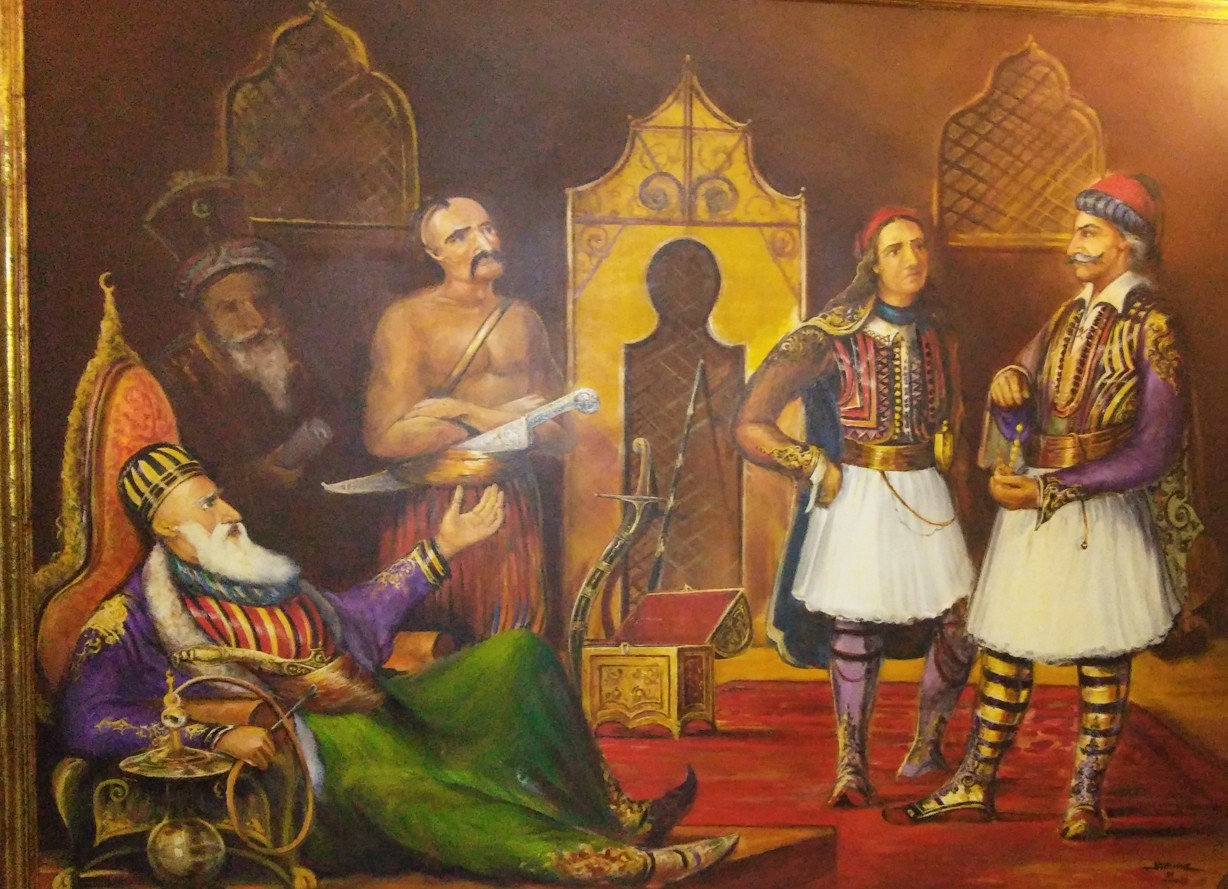
In a recent post, I shared about the island on the lake of Ioannina and the history and the legends that connect it to Ali Pasha.

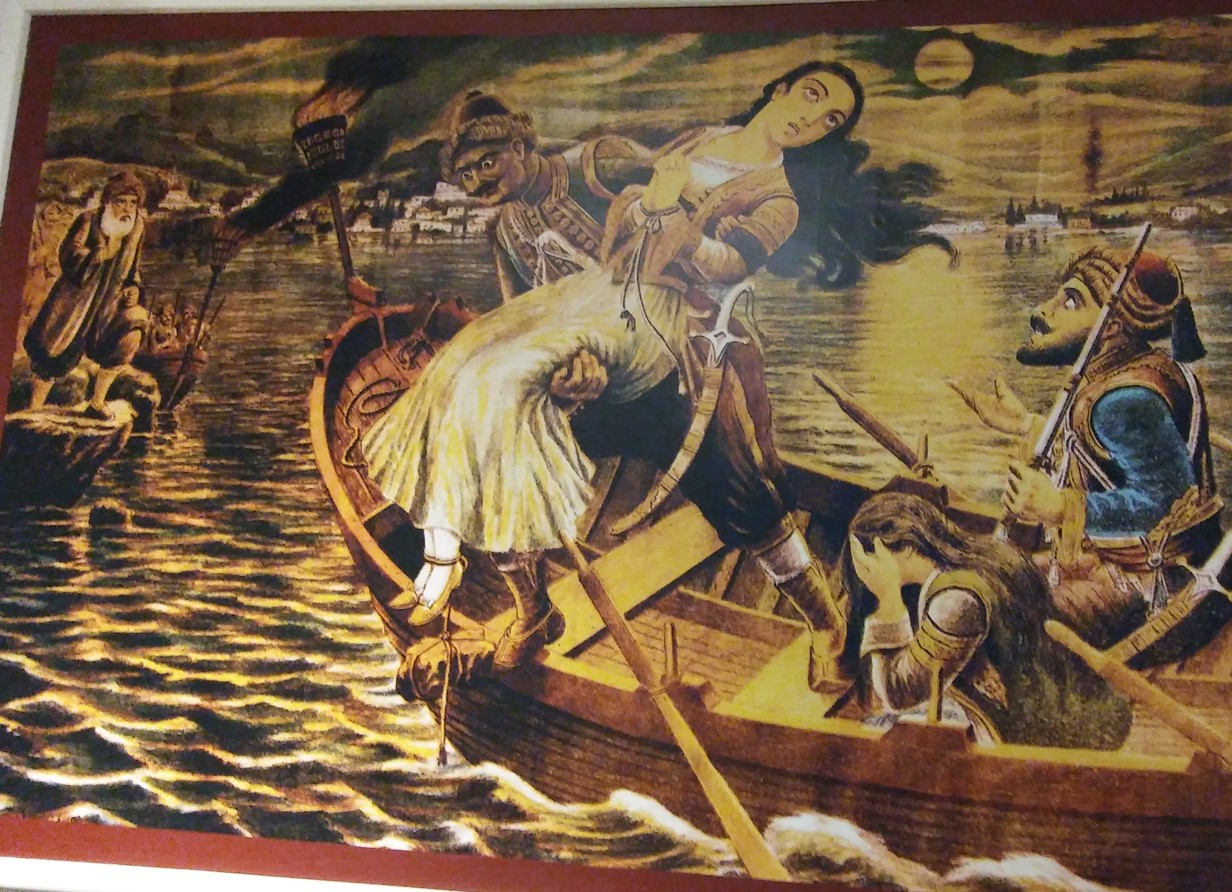
This evil Ottoman ruler had given the order to drown Lady Frosini and seventeen other women in the lake, and it was an injustice so huge and so cruel that the Greeks never managed to forget it across the centuries. You can read my post here if you missed it.

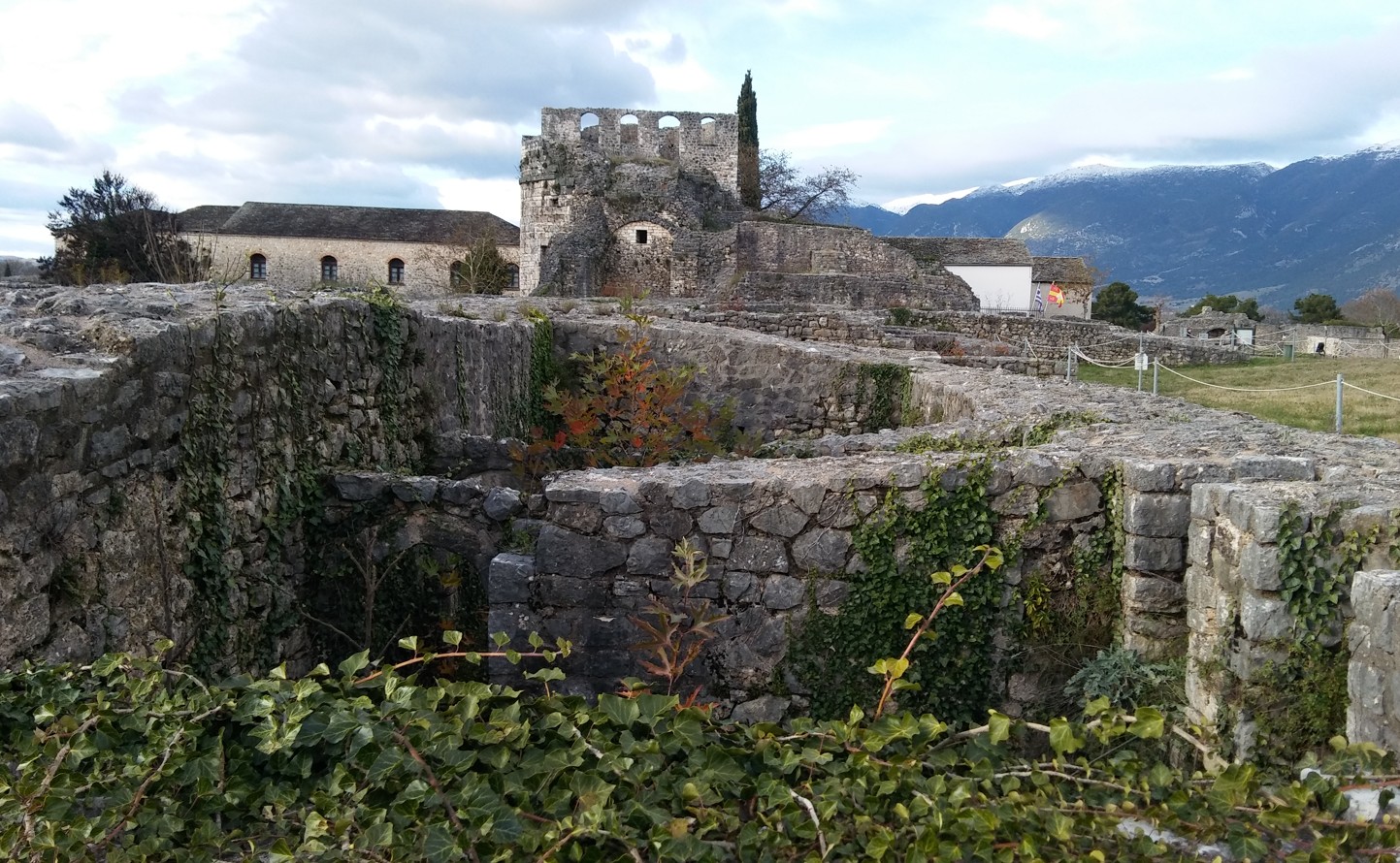
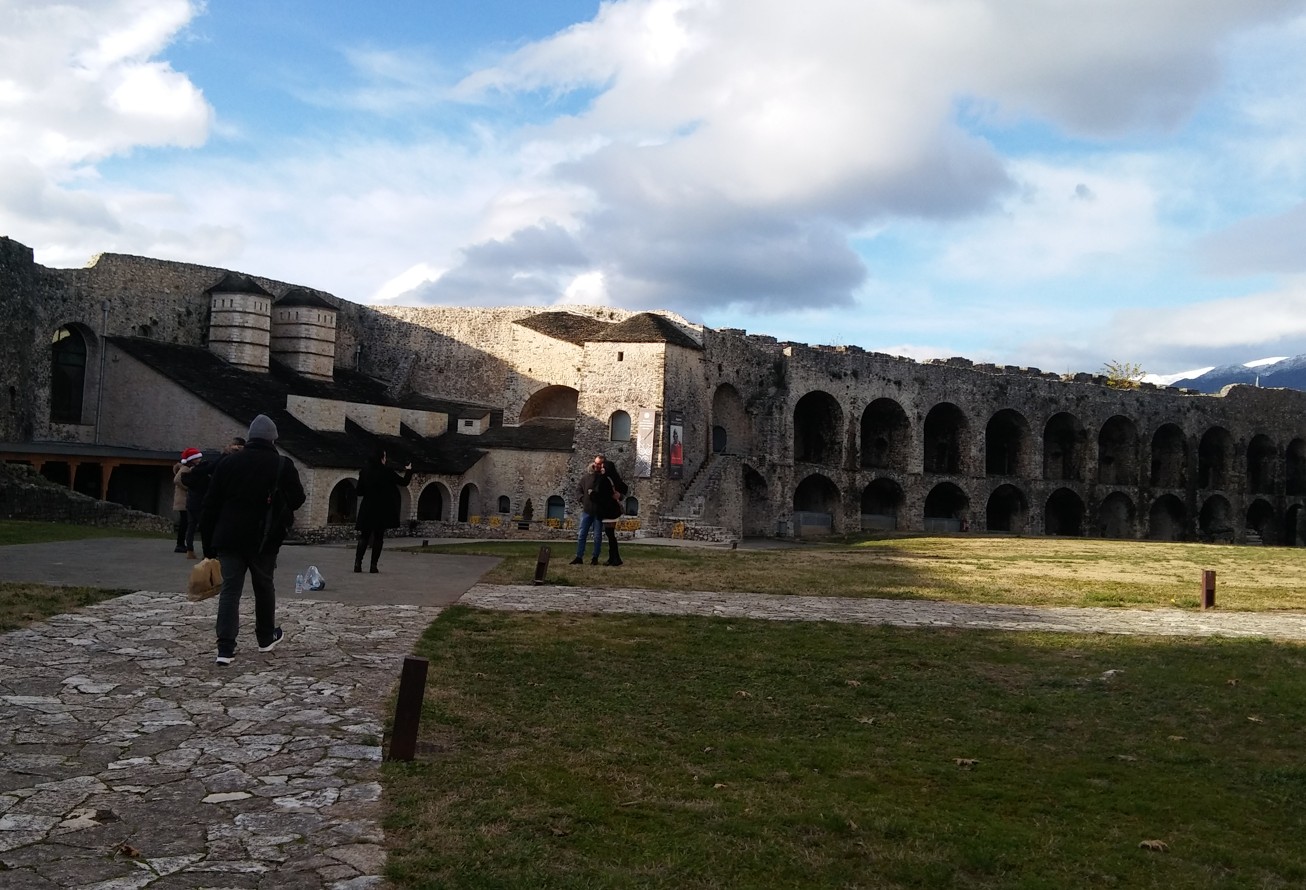
Today, I am sharing about the Castle of Ioannina, i.e. the fortified old quarter of the city that offers stunning views of the mountains and the lake. Visitors can visit there a series of historical buildings.


The Castle of Ioannina has maintained the same form since the Ottoman period. Ali Pasha rebuilt it in 1815 almost from scratch. Previously, the grounds were used as a fortress in both the Byzantine and Hellenistic eras. The Normands also occupied the Castle and made alterations to it.

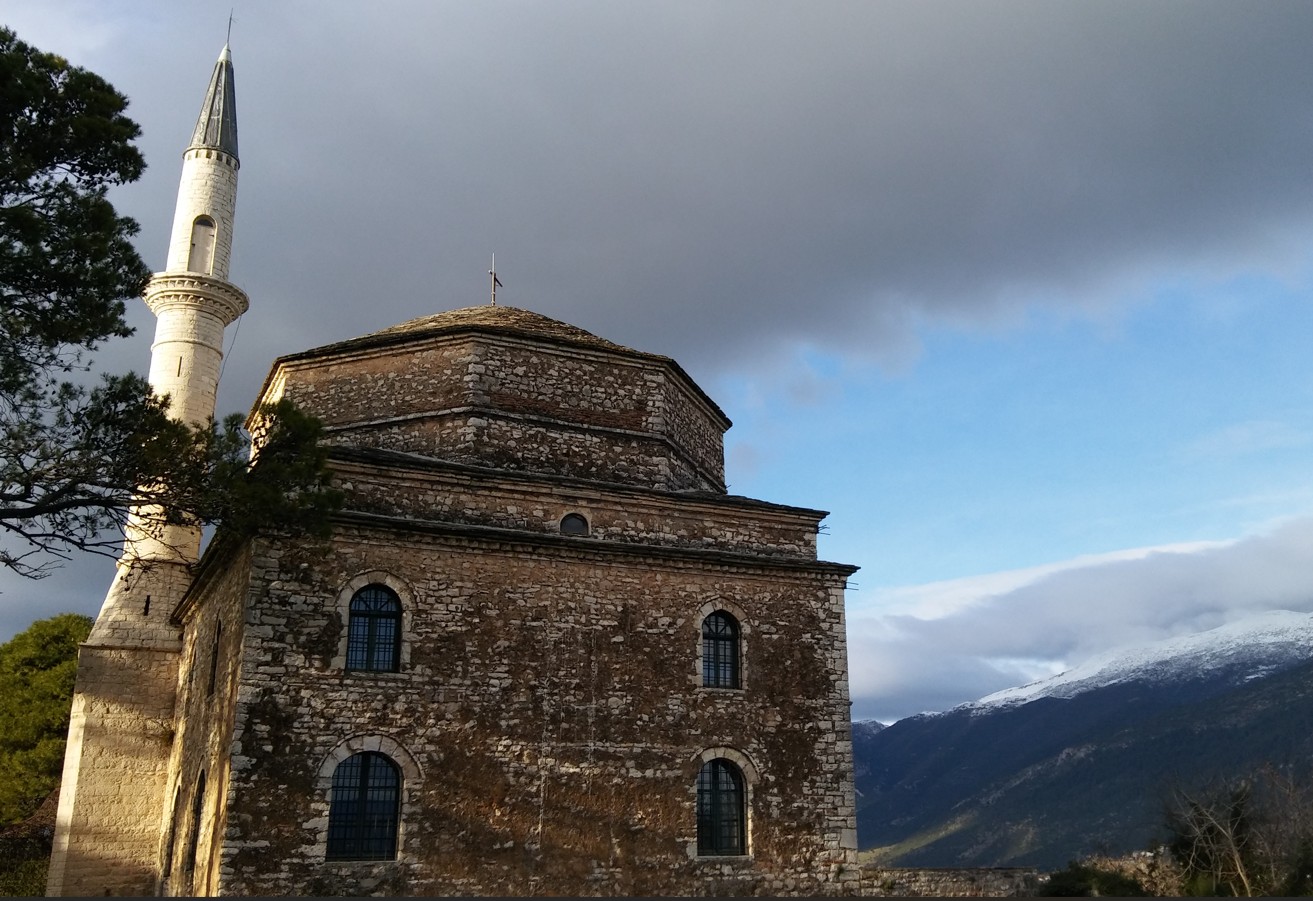
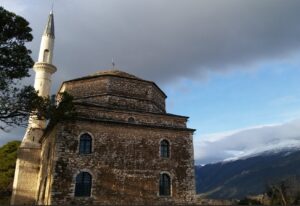
Perhaps, one of the most beautiful historical buildings in the Castle is the Fethiye Mosque (see photo above). The Church of Archangel Michael used to stand in its place during the Byzantine period.

The tomb of Ali Pasha is situated before the mosque today. Beside it stands the impressive Byzantine Museum of Ioannina that has a line of old cannons outside, on the back end of the building. It was built on the ruins of Ali Pasha’s “Serai” (Turkish for “Palace”).

The visitor will find these edifices in one of the two inner fortresses of the Castle that is called “Its Kale” (Turkish for “Inner Castle”). It was made by the Normands and it is on the southestern corner.


The northeastern corner was once the main fortress area of the Byzantines. The main point of interest here today is the Mosque of “Aslan” Pasha (Turkish for “Lion”).

Other points of interest on the Castle include: The Silversmithing Museum (see photo above), the Treasury, the Hamam, the Byzantine Baths, the Synagogue et al.


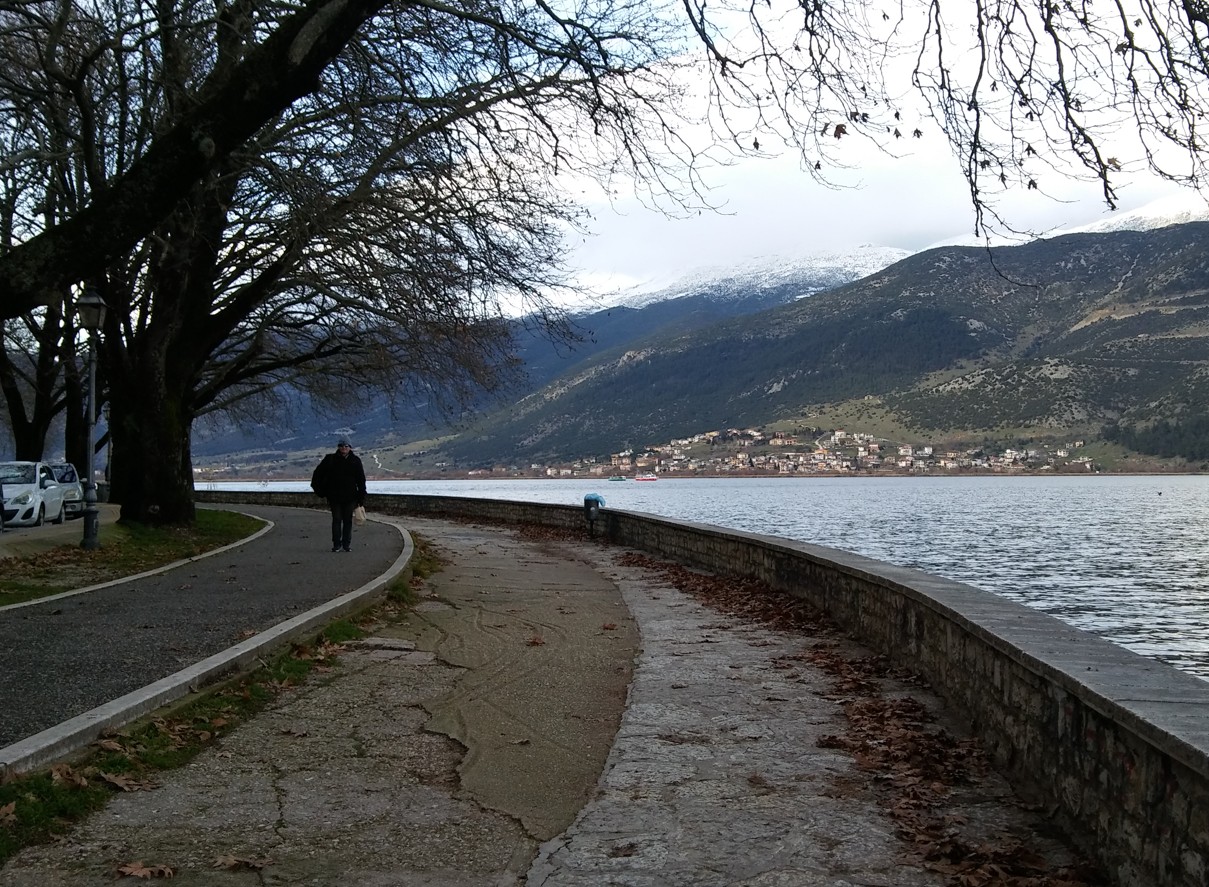
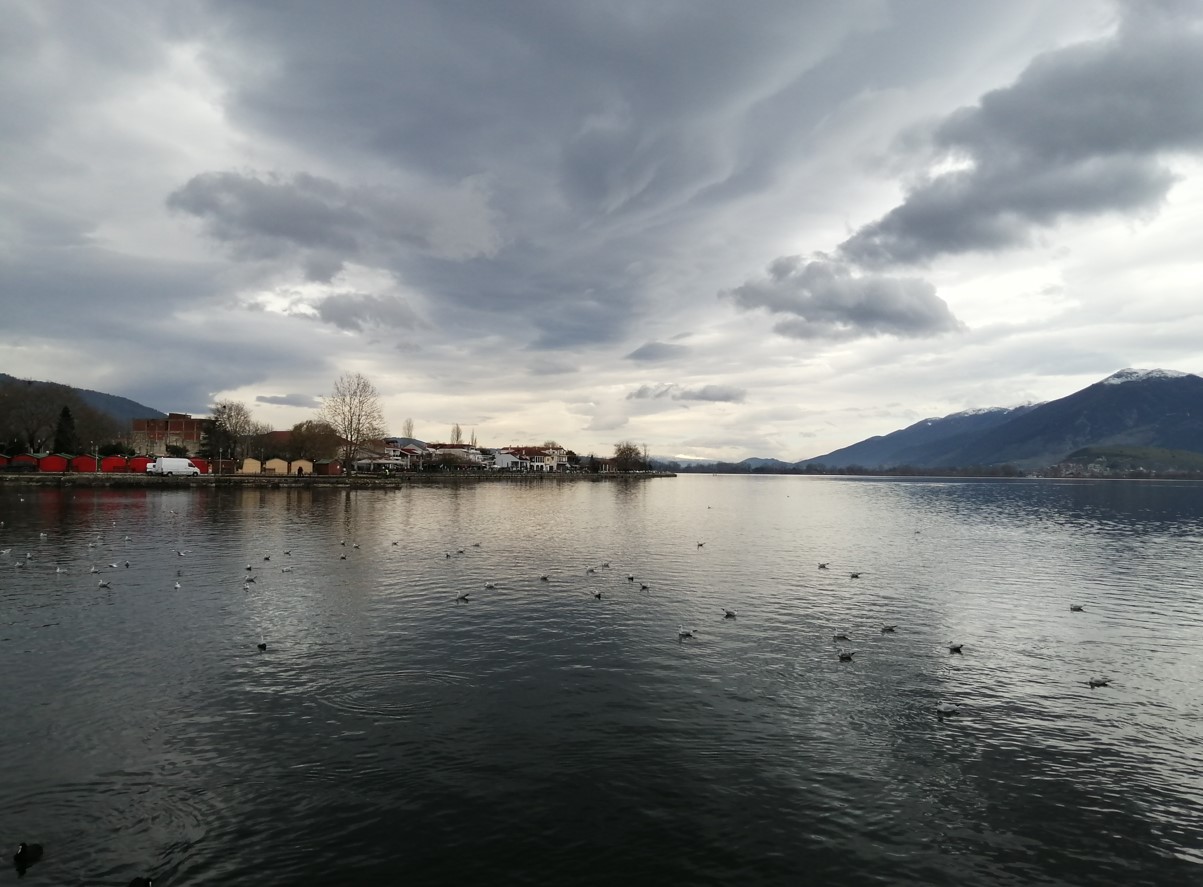
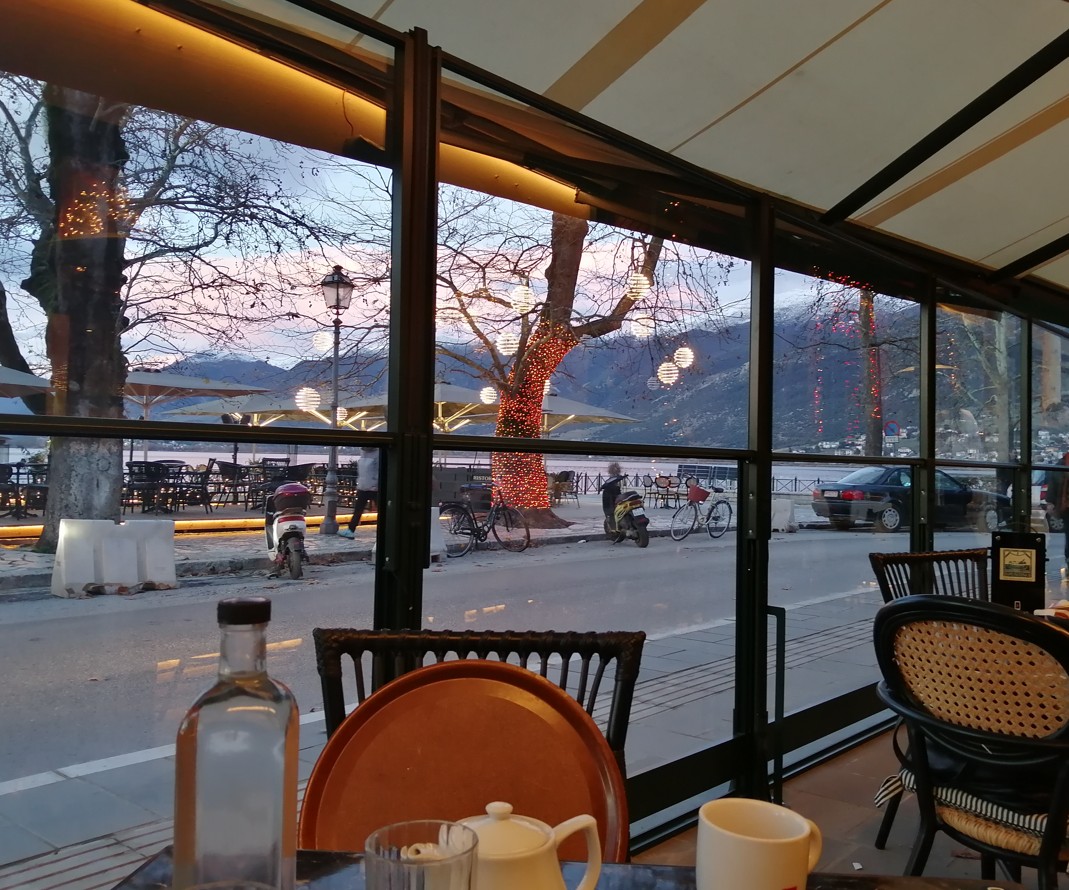
More breathtaking views awaited me as I walked along the Lake Pamvotida. The pedestrian path is wide and seems to go on forever. But alas, it was Christmas Day and particularly chilly, so I only had a quick stroll and then dived into a semi-closed space at one of the lakeside cafes that was nicely heated.


The cafe I picked called to me from afar as its sign read “Kyra Frosini” i.e. Lady Frosini of the old legend, which is basically my name – Effrosyni.

I am glad I chose it as it served delicious coffee and the freshest mille feuille that I have ever tasted 🥰

Earlier that day, I had picked a busy family taverna for lunch, which is called Rebetiko. I had roast lamb and it was absolutely yummy. I highly recommend both these places if you’re ever in town!

Again, if you’ve missed my post about Ali Pasha and the museum that bears his name on the little island, you can find it here. I highly recommend a visit there too, if only for the quick ride on the cute little boats across the serene lake waters.

GO HERE TO SEE MY PHOTOS from the lake and the Castle of Ioannina!


My new toy in the kitchen is an air fryer!

Finally, my husband Andy and I caved a couple weeks ago to everyone’s insistence, who kept praising their air fryers, hailing them as the best thing since man invented the wheel (well, not really, but you know what I mean🙃 )

I guess we had to see it for ourselves to believe it.

And it is true. The air fryer has tranformed the way we cook and we now use it on most days. It’s amazing how crunchy it makes fries with just a sprinkle of oil and what a big saving it is on electricity to cook meat as opposed to the oven.

And I still can’t believe how fluffy and tender it makes everything it cooks, especially eggs and meat.

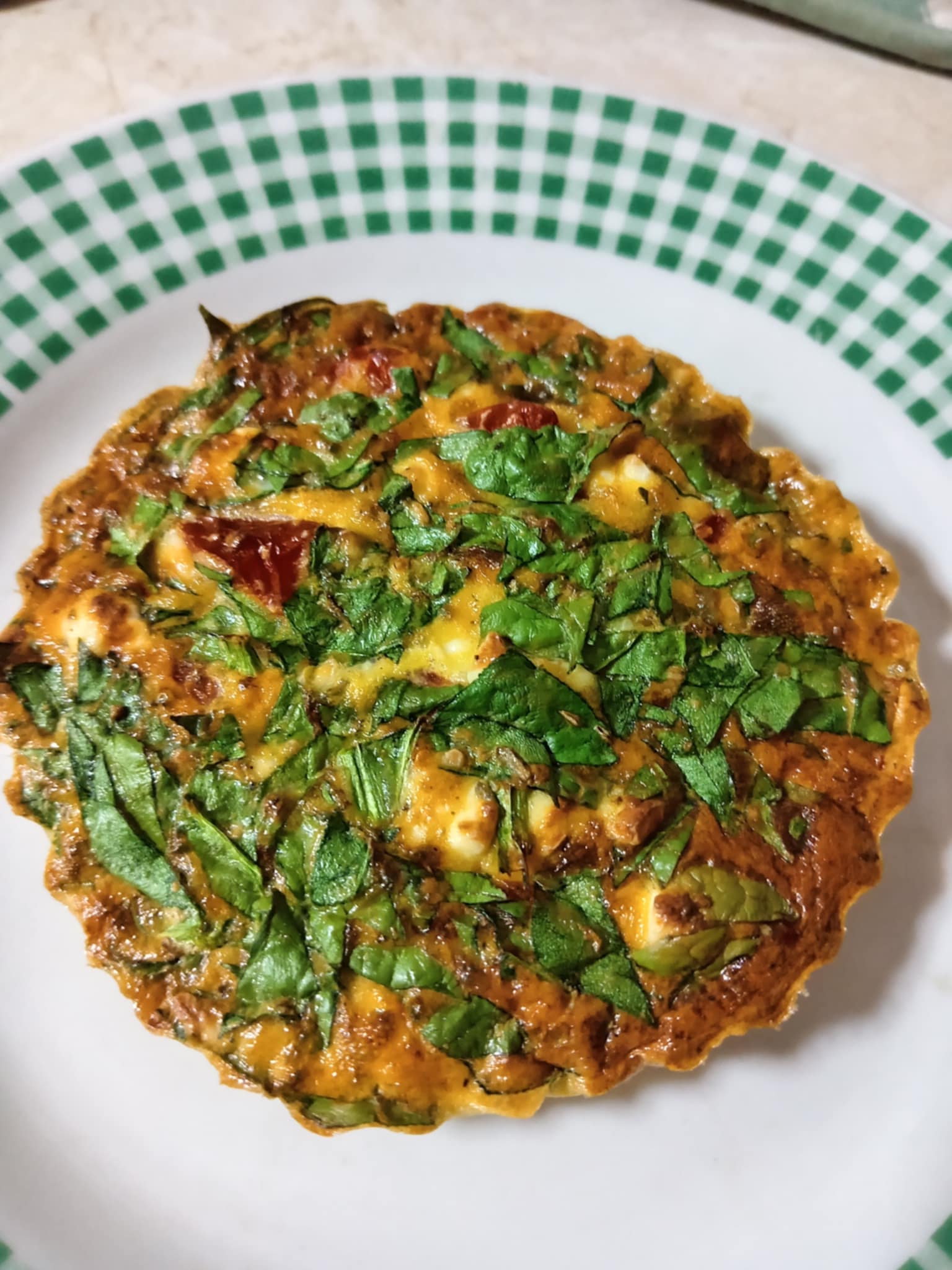
This small frittata with egg, spinach and feta cheese in the above picture is out of this world good. My air fryer is large so I can fit four silicone moulds in it at the same time.

Using 4 eggs, I can make 4 frittatas in no time at all. I just beat the 4 eggs with salt, pepper, oregano, paprika, optionally adding some basil too. Then, I mix in 100 ml milk, 50 gr of chopped spinach, 50 gr of crumbled feta cheese and 50 gr of chopped tomatillos.

Using a ladle, I fill the 4 silicone moulds and carefully place them in the air fryer basket.

No need to preheat! I set them to cook at 160 degrees C for 15 minutes and they come out fluffy and golden, a piece of heaven!

Since I am still a new user I am still discovering new recipes. If you have one that you love cooking in your air fryer do comment below or send me an email and share it with me. I’ll be really grateful!😃


Before I go, to share a FREE sample from my upcoming novel, “My Greek Island Christmas”, set in Santorini. Enjoy!

New! Clean Christmas romance. Two broken hearts. One magical holiday. A Santorini farm where anything can happen. 

Check it out on Amazon     Read a FREE sample!
 

DID YOU ENJOY THIS POST? CHECK OUT THIS ONE ABOUT MY VISIT TO THE AMAZING MUSEUM OF ALI PASHA THAT’S ON A TINY ISLAND IN THE LAKE OF IOANNINA. READ ALL ABOUT THE LEGEND OF KYRA FROSINI AND THE SCARY LITTLE DUCK I MET THERE THAT MADE ME LAUGH NO END 🙂


3 FREE books for you! Sign up below to receive them instantly!

NEW! Clean Christmas romance. Single mother Cathy Roussos gave up on love long ago, and veterinarian Alex Rallis doesn’t believe in it, but one magical Christmas on a Santorini farm might just change everything…
Check it out on Amazon     Read a FREE sample!
 

A clean romantic suspense short read with an unreliable narrator that’ll keep you guessing! Vera is losing her mind over famous actor Yannnis Ksenos, except, she isn’t just a fan… Now, she plucks up the courage to ring his doorbell… Visit Amazon


For my delicious Greek recipes, go here
 
Planning to visit Greece? Check out my  FREE guide to south Corfu!

The island of Ali Pasha, a scary little duck, and fish in tomato sauce


The island of Ali Pasha in the lake of Ioannina offered sadness but also laughter

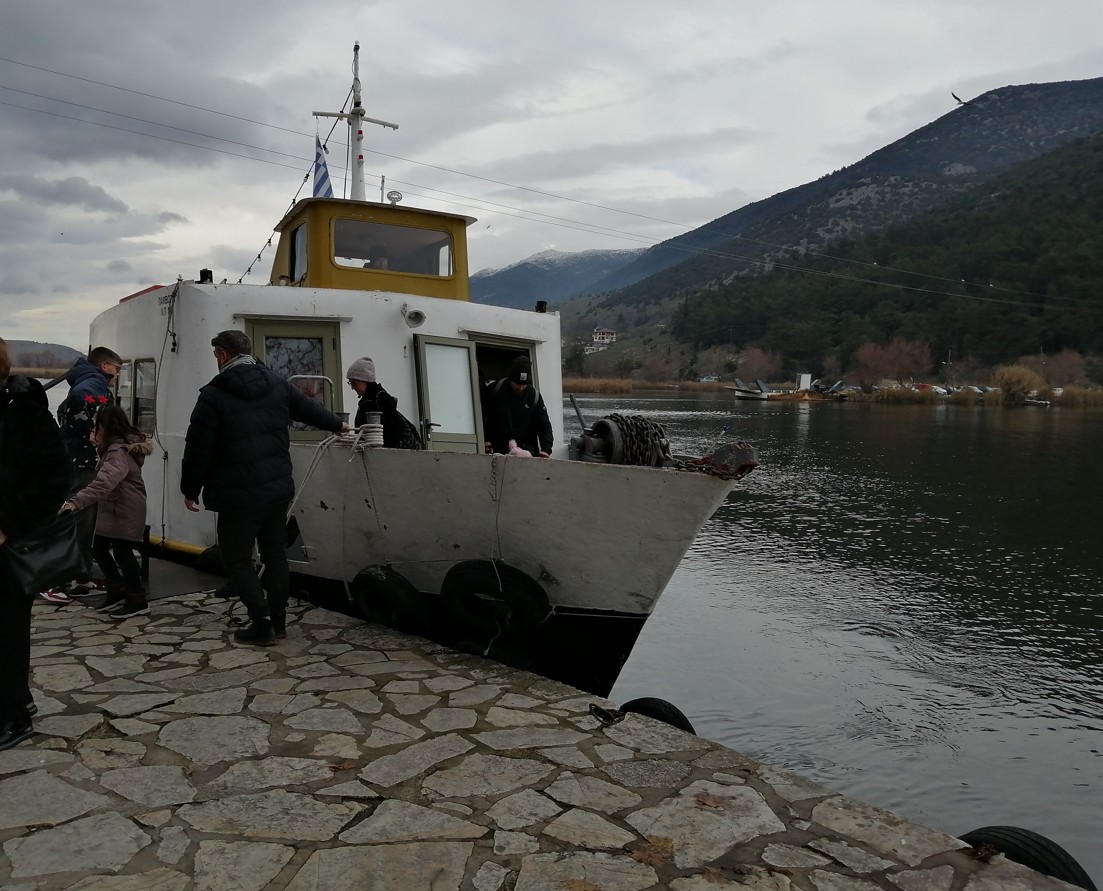
During my recent trip to Epirus where my husband and I stayed in the historic city of Arta, we visited another historic city – Ioannina – for a day. Ioannina is a stunning city built on the lake Pamvotida, and there is a small inhabited island in it that people can visit on small tourist boats. All day, they go back and forth on the lake, full of tourists.

The first thing we did when we arrived at Ioannina was to queue up for the next boat to the island to see the museum of Ali Pasha and have a walk around.

Seeing that this island was never given a name, it is colloquially called “The Island of Ioannina”, “The Island of Ali Pasha”, or “The Island of Kyra Frosini.”

Ali Pasha was an Albanian from Tepeleni who became a ruler of Epirus in the days of the Ottoman Empire. Although during his longstanding rule over the Greeks he built many Christian churches, roads, and generally benefited the Greek people greatly, he was also infamous for his cruelty.

In my post about the famous bridge of Arta I mention an ancient plane tree by the bridge where Ali Pasha would have people hanged. He loved to sit under it and watch the people hanging on the branches.

That was him all over. And the comeuppance he got in the end was just as cruel, I believe. As they say, what goes around comes around… I’ll tell you about that a little later in this newsletter…

Perhaps one of the most cruel deeds of Ali Pasha was the heartless decision to have a local woman, “Kyra Frosini” (Lady Effrosyni), drowned at the lake along with seventeen other young women on the night of 11 January 1800.

Kyra Frosini was no Jane Doe, and her execution caused much upheaval in the community. She was an aristocrat and socialite, a mother of two children, who was greatly admired for her beauty and her intelligence. Her family was local but very rich, seeing that her father was a merchant in Venice.

Frosini had an affair with Ali Pasha’s son, and Ali Pasha’s wife couldn’t stand it. It was because of her insistence that Ali Pasha gave the order to have Kyra Frosini arrested and drowned at the lake for adultery, while punishing at the same time seventeen other innocent girls in the same way.

However, there are rumors that Ali Pasha himself was in love with Frosini and thus had her killed out of spite as she’d chosen his son instead of him, and that he had the other girls executed to hide his real motive.

Whatever was the real reason for the executions, the legend still holds strong today. The name Kyra Frosini is famous all over Greece. Her name is especially prominent on the lips of everyone who visits Ioannina, seeing that through the centuries the attrocity transpired in the lake is still deemed so difficult to digest that everyone keeps speaking of it, unwilling to let it be forgotten.

The museum of Ali Pasha is housed in a traditionally stone-decked old building that is in the grounds of the old Monastery of St Panteleimon. Before entering the museum, I visited another small building at the court. It had a single space inside, the display dedicated to the drowning of Kyra Frosini.

Inside a small barge, the visitor will see dummies of Kyra Frosini and the Turks who carried out the merciless deed of her execution. A lament echoes through the speakers while a large TV screen silently plays on a loop the scene of the drowning from the 1959 movie, The Lake of Sighs starring Irene Papas in the role of Frosini.

It was heartbreaking to stand inside that room and witness all that, to say the least, and I lingered a few moments silently in there to contemplate upon the cruelty and attrocities of evil rulers, and the longstanding oppression of the barbaric Ottoman Empire over my homeland, in particular.


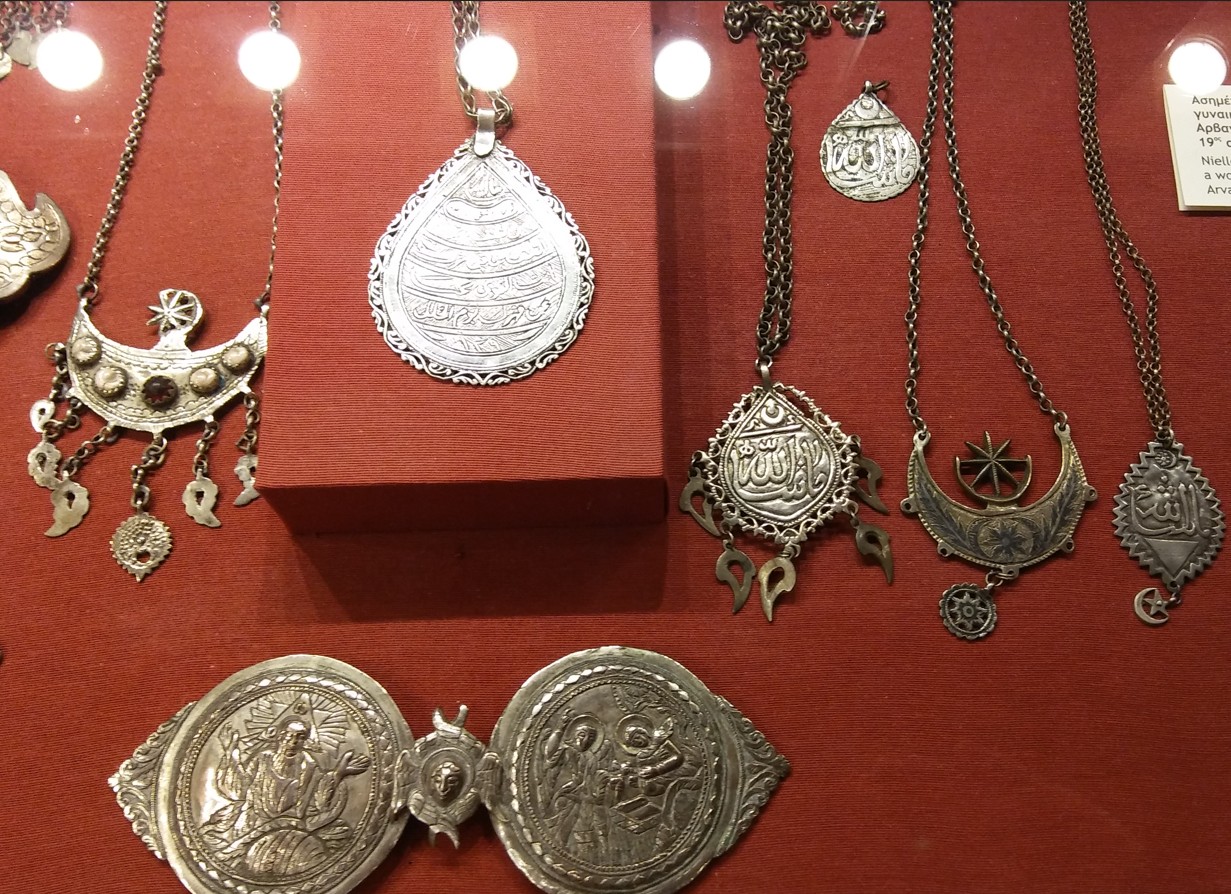
In Greece, we have a saying that goes, “He/she put on Arta and Yannina” (Yannina is a colloquial way to say “Ioannina”.) The saying is used when someone is overdressed, especially when they’re wearing too much jewellery.

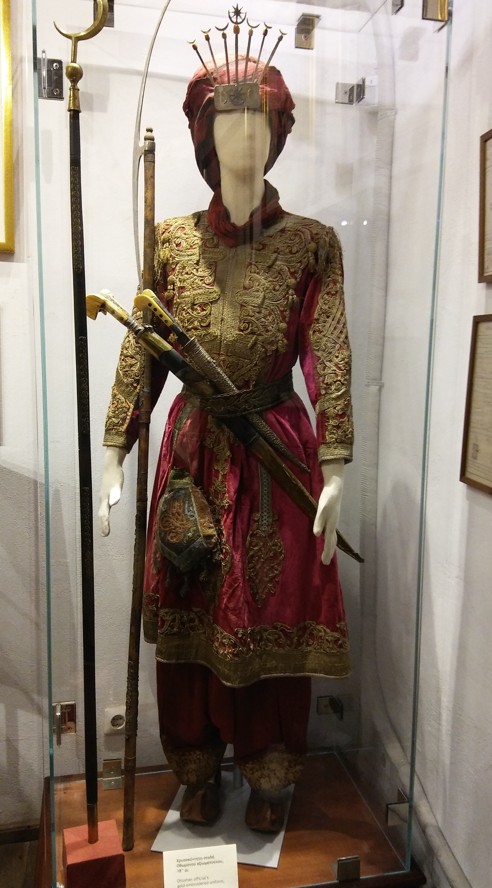
This is a remnant from the days of the Ottoman Empire, where places like Arta, Ioannina, and Zagori were inhabited by rich Greek merchants. They lived in luxury, displaying their wealth with gold-threaded clothing and heavy jewellery, in huge contrast to the masses of their countrymen who lived under miserably poor conditions.

Inside the museum of Ali Pasha, the many artefacts of clothing and jewellery from that era attest to that fact, showing how this saying came about.

The museum has two levels full of displays, some easier to digest than others. I refer here to the dungeon and torture instruments part of the displays where one can see torture tools that I am having trouble to forget.

The most gory of all was an instrument that ‘separates flesh from bone’. Just looking at it behind the glass and imagining how the very thing had been used, surely even on innocent people, caused my blood to chill. Sometimes, being an author with an active imagination can be counterproductive LOL!

After considering the oppression and the cruelty of the Turkish rulers, and the suffering they have caused to my countrymen while I shuffled from display to display, I finally reached one that told the story of Ali Pasha’s day of demise.

In the end, it was his own people who turned against him, branding him a traitor. So, on January 24, 1822, knowing that Ali Pasha had found refuge at the Monastery of St Panteleimon on the island of Ioannina, Turkish military men attacked him there. Ali Pasha shot at the men and a short battle ensued.

Having been mortally wounded, the 81-year-old was rendered helpless. The men dragged him to the court outside and beheaded him there, at the same space that is now the entrance to the museum. They then took his head to the Sultan Mahmud II, who had ordered the execution, to show proof that it had been carried out.

Leaving the main museum building, I entered another small one across from it. It had two tiny halls that house letters from prominent Greeks, like Alexandros Ipsilantis, and many household items too, like porcelain figurines and pottery.

After that, making a right turn past the Ali Pasha Museum I arrived at the small caves that were used by the locals in WWII. They fled there to shelter themselves from the bombings carried out by the Italians in November 1940.

In the cave openings, now stand dummies of men, women and children, while old items of the era are scattered everywhere, like a radio, lanterns, flasks, stretchers and petrol containers. Sounds of bombings echo from the speakers. It is a bleak, yet, I expect, accurate representation of another harrowing era in this city’s vast past.

The same caves also served as dwellings to holy men in the 15th century – like Saint Savvas and monks Theophanes and Nektarios Apsarades who founded the Varlaam Monastery in Meteora.

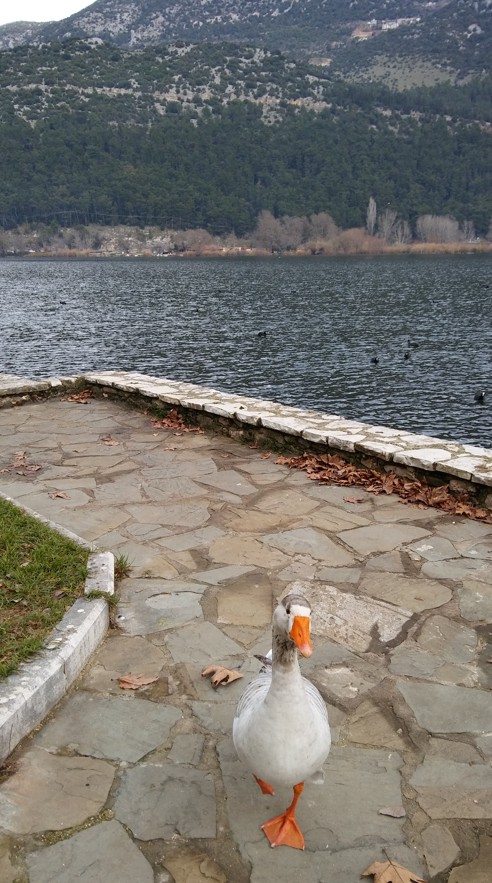
An insistent (and rather scary) little duck

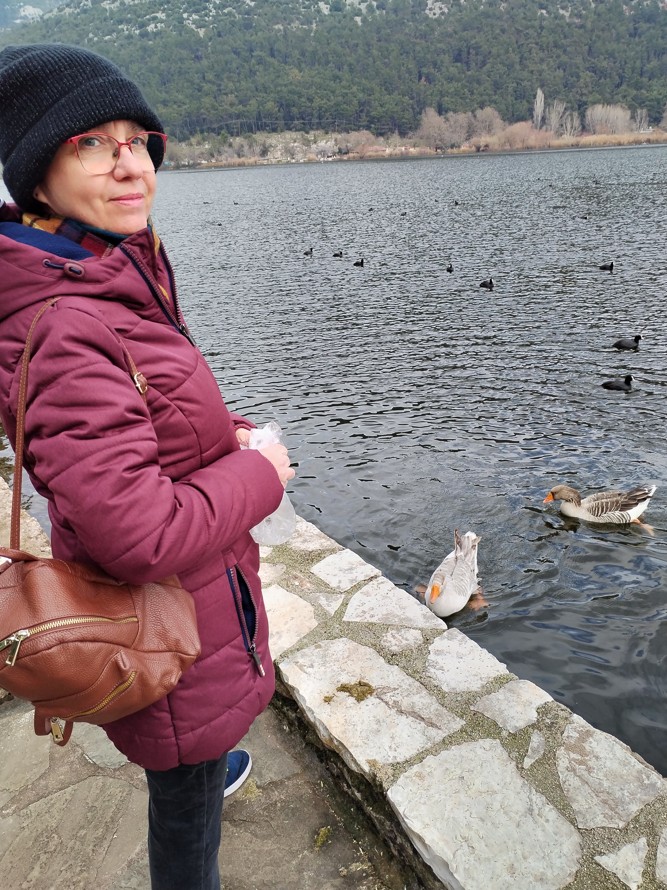
After seeing all the displays, it was time for some fun outdoors. I had kept some ‘koulouri’ (sweetened bread with sesame) to feed the ducks and once they saw me holding it they swam straight at me. One of them quickly proved to be the quickest to get to the bits of sustenance, but it also turned out to be insatiable!

Once I’d thrown all the bits, it came out of the water and started to follow me around. I kept shooing it and laughing, and it kept looking at me inquisitively, as if saying, “Come on! Where’s the rest of it?”

Somehow, it let me go in the end, and once it began to waddle away from me an Asian lady approached it and tried to pet it. The moment her hand hovered over its head, before she even got to touch it, this duck emitted the most shrill loud scream one could ever imagine would come out of such a small creature.

The poor Asian lady literally jumped back in horror, then walked away in a hurry from the mad fowl. It’s been four months and I still laugh when I think about it haha

More fun awaited at the sweet shop, “A Thousand Quintals of Sugar.”

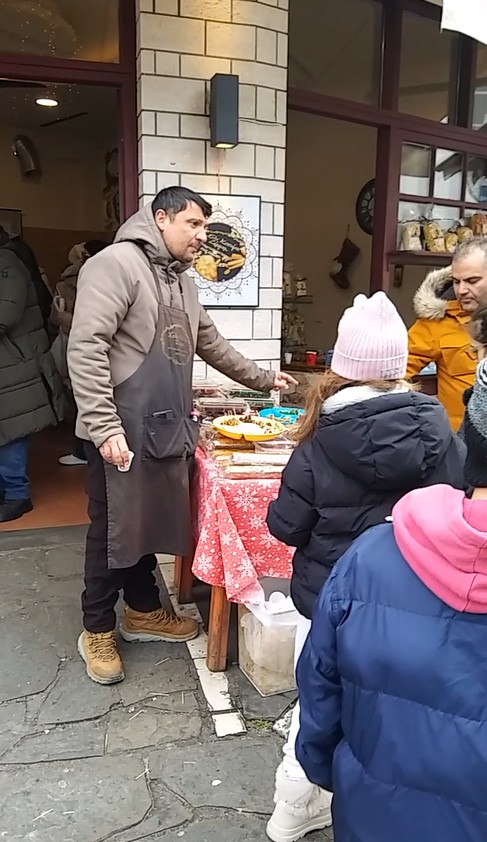
Before visiting the island someone had tipped me off to look out for the ‘funny guy’ who is famous on Tik Tok. They said he sells traditional syrupy desserts of Ioannina in his shop that are unmissable. The family make them in their own preparation facility a little further down the road from the shop.

I clocked the guy easily! And you can’t miss the shop. It’s on the path from the dock to the museum of Ali Pasha, and it’s right in front of you when you get to it.

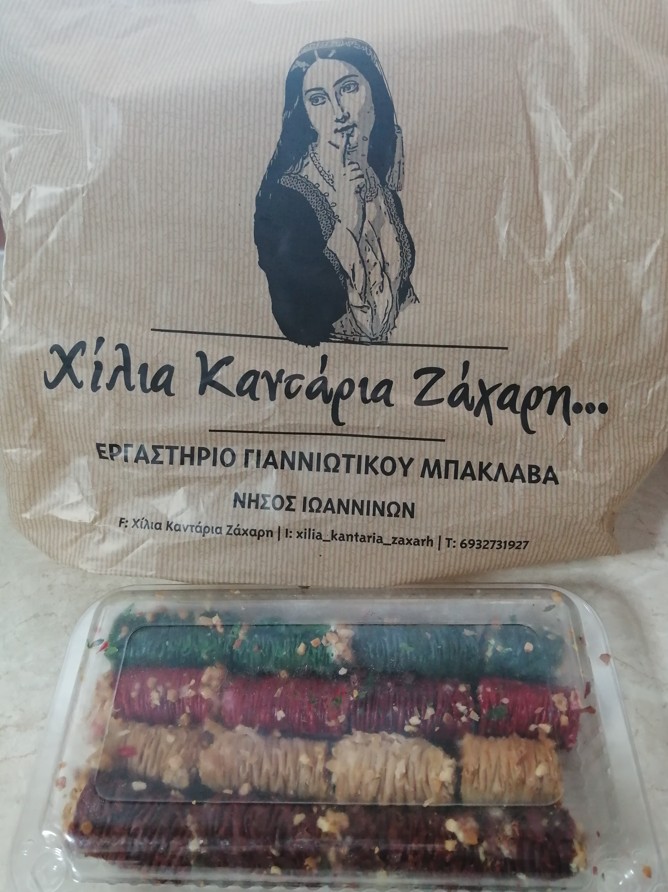
The shop is called A Thousand Quintals of Sugar (In Greek, Χιλια Κανταρια Ζαχαρη) and the logo is a drawing of Kyra Frosini (I told you she’s everywhere!)

The man stands at the shop entrance giving people little treats to entice them to buy while making funny faces, calling the strangers funny names and saying the most hilarious things. I had a little taste of the guy’s humor and I soon was in stitches just like everybody else.

He called me ‘bourbourini mou’ and I have no idea what that means LOL! And he called all the men ‘Pashako mou’ which means ‘My little Pasha).

There are some absolutely hilarious clips of him on Tik Tok (hashtag #γαργαλιαρης), if you’re interested in seeing him firing on all cylinders with a big crowd. You can watch the short video I took of him to get an idea. You’ll hear me giggling away 🙂

He didn’t stop speaking both times I passed by and while I shopped inside the store, and people kept laughing. He is like the Duracell bunny champion of salesmen, what a guy!

Well worth visiting the island just to meet him! Chances are, he’ll see you and call you over before you even spot him LOL!

I don’t know if he’d be interested in a career as a comedian, but he definitely has the talent!

After purchasing a selection of his delicious desserts we also got some souvenirs from the many Greek art stores. If you’re ever in Ioannina do check out their silverware on display. The silver craftsmen of Ioannina are famous, and you’ll find something to take away with you at a low price to cherish forever, that’s for sure.

I have uploaded my photos from the island on Facebook. Go here to check them out! You will see more artefacts at the museum, the caves with the WWII display, and also the glass tanks full of live eels and frogs at the tavernas on the dock.

Oh yes! Eels and frog legs are on the menu over there, but, of course, I shied away, LOL!

You can also visit the museum website to see more photographs.


Before I end this post, I’d like to share a quick recipe with you.

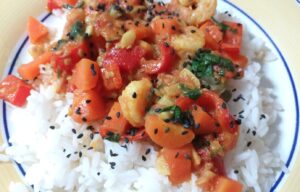
This quick and easy meal with fish and prawns is best served on a bed of rice or fries. I’ve also had it with boiled potatoes. That works too!

The tomato sauce is very light as the recipe uses only fresh tomato in small quantity. It’s a light but hearty meal to have for dinner.

Although it’s aestherically pleasing as it is, being so colorful, I sometimes add a final touch using the super-nutritious black sesame seed as you can see in the picture. It adds a dash of color to the boiled rice, too.

Hubby loves it!

GO HERE TO GET THE RECIPE


DID YOU ENJOY THIS POST? CHECK OUT THIS ONE ABOUT THE STUNNING FORTIFIED QUARTER OF IOANNINA THAT STANDS ON A HILLTOP AND OFFERS AMAZING VISTAS


Sharing is caring! Here’s a ready tweet for you to spread some love:

Interested in travel, food and books from Greece? Here's a blog you will love! #Greek #blogger #writer Share on X

3 FREE books for you! Sign up below to receive them instantly!

NEW! Clean Christmas romance. Single mother Cathy Roussos gave up on love long ago, and veterinarian Alex Rallis doesn’t believe in it, but one magical Christmas on a Santorini farm might just change everything…
Check it out on Amazon     Read a FREE sample!
 

A clean romantic suspense short read with an unreliable narrator that’ll keep you guessing! Vera is losing her mind over famous actor Yannnis Ksenos, except, she isn’t just a fan… Now, she plucks up the courage to ring his doorbell… Visit Amazon


For my delicious Greek recipes, go here
 
Planning to visit Greece? Check out my  FREE guide to south Corfu!

Author, is META pirating your books to train AI? Check now and take action!

Today, I am blogging just for authors, because I found out something both incredible and infuriating and I feel compelled to share. For those of you who didn’t know either: There is a database of authored works called LibGen and it is used by META to train AI. I searched with my name today, and, to my horror, found one of my books is pirated on there. You can search for your author name here and I hope you find none:

https://www.theatlantic.com/technology/archive/2025/03/search-libgen-data-set/682094/

If you have found your books on there don’t worry. There are ways to take action, and you are not alone.

The Authors Guild provides a ready template for authors to send an email to META and complain. I have done that, and now I am spreading the word. If you find your books on META’s pirated books database you can go here to use the Authors Guild’s letter template. It takes seconds to put in your details and send the email from the same page:

https://actionnetwork.org/letters/authors-guild-author-letters-to-ai-companies?source=email&

See also this post if you wish to take more action:

https://societyofauthors.org/2025/03/21/the-libgen-data-set-what-authors-can-do/

Please spread the word so that more authors find out about this! The more of us put pressure on META the better! To save you time, feel free to copy this post and use it as is or edit it as you wish. You don’t need to credit me by name. I give you full permission.

Please consider putting this infomation all over your social media and in your newsletter too. Authors often subscribe to multiple newsletters so you’ll give them a good chance to see this and protect their works.

They will be greatful to you for sharing. I know I am grateful to my author friends Theresa Snyder and Jenny Burke who posted about this on Facebook!

If you have liked this post, see also:

Concerns about AI-written books. What are the implications for authors and readers?


Sharing is caring! Here’s a ready tweet for you to spread some love:

Author, is META pirating your books to train AI? Find out here #authors #indieauthors #writers Share on X


Are you an author needing help with promotion? Check out my FREE, cracking good tips and resources: http://effrosyniwrites.com/for-authors/


3 FREE books for you! Sign up below to receive them instantly!

NEW! Clean Christmas romance. Single mother Cathy Roussos gave up on love long ago, and veterinarian Alex Rallis doesn’t believe in it, but one magical Christmas on a Santorini farm might just change everything…
Check it out on Amazon     Read a FREE sample!
 

A clean romantic suspense short read with an unreliable narrator that’ll keep you guessing! Vera is losing her mind over famous actor Yannnis Ksenos, except, she isn’t just a fan… Now, she plucks up the courage to ring his doorbell… Visit Amazon


For my delicious Greek recipes, go here
 
Planning to visit Greece? Check out my  FREE guide to south Corfu!


A new audiobook set in Corfu, Greece

Hello, All! Thrilled to announce I published my very first audio book this month!

My Corfu Love Story is a clean romance short read with a paranormal twist. The audio book’s duration is under 2 hours.

Spyri never forgot that old summer in Corfu when she met Markos…

Spyri is haunted by precious old memories from her summers in Moraitika, Corfu. This summer, she returns there and meets Markos, the one she never forgot since they were kids.

Sparks fly when they meet, but each one has their own hurts of the past to deal with.

Can two old childhood friends find happiness together with a little help from their loved ones beyond the veil?

🎧 Listen to the sample on Amazon US or Audible

Also available on kindle and paperback! Visit your Amazon store here


Sharing is caring! Here’s a ready tweet for you to spread some love:

#newaudiobook A new audio book set in Corfu, Greece #audibles #newrelease Share on X


Limited time offer! Sign up below and get these books for FREE!

 
New! Clean Christmas romance. Two broken hearts. One magical holiday. A Santorini farm where anything can happen. Check it out on preorder! Launches December 4, 2025
 
For my delicious Greek recipes, go here
 
Planning to visit Greece? Check out my  FREE guide to south Corfu!

The stone bridge of Plaka in Epirus and Greek baked fish with onions and tomatoes

The most intrepid thing I’ve done in ages…

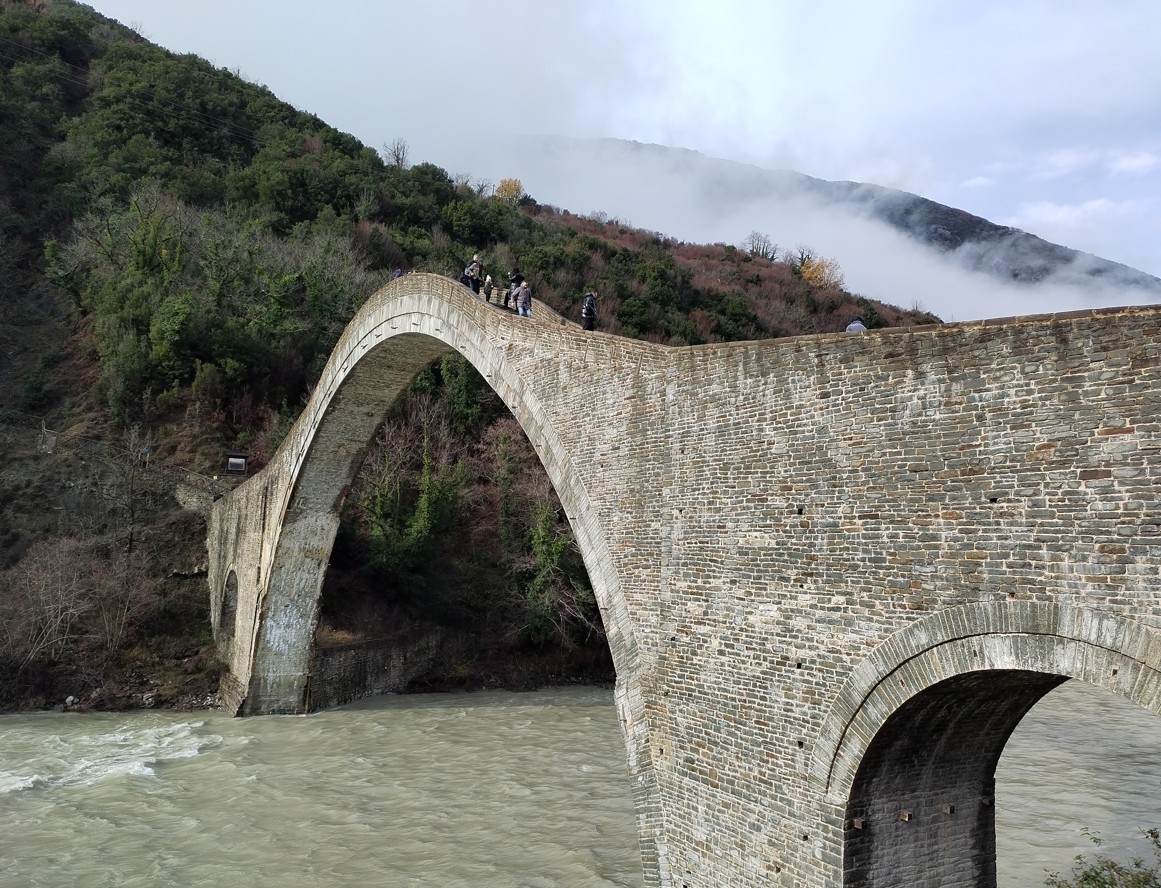
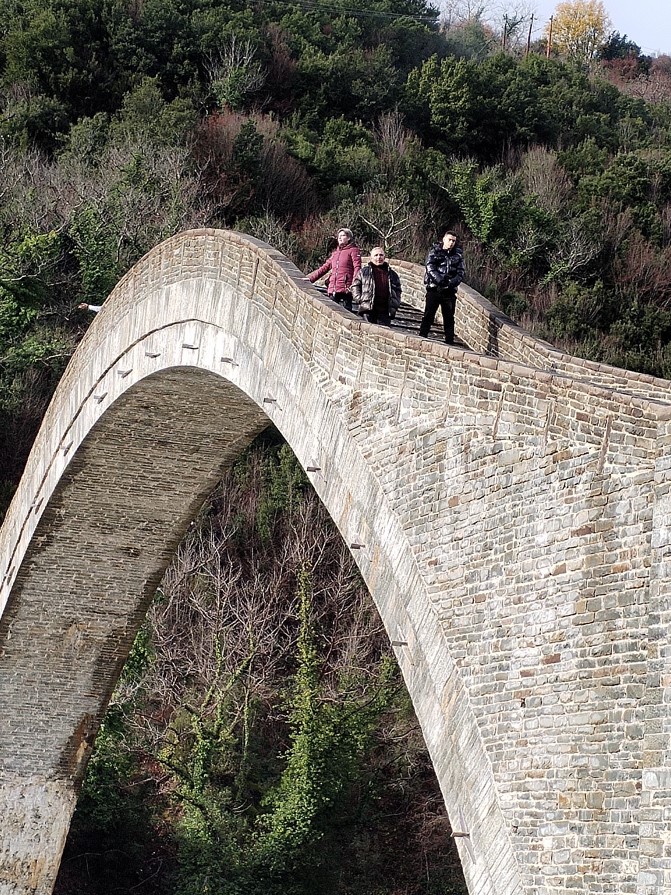
During my Christmas break in Epirus where my husband and I stayed in the historic city of Arta, we visited the mountain area of Tzoumerka for a day. Our first stop was the famous stone bridge of Plaka dating from 1866.

An earlier attempt to build it was made in 1863, but the bridge had collapsed on the day of its inauguration!

During WWII, it was bombed by the Germans near its centre but the damage was easily repaired.

This bridge is the biggest of its kind in the Balkans and the third biggest in Europe. The arch is 40 metres (130 ft) wide and 17.61 m (57 ft 9 in) high.

This marvelous single-arch stone bridge was demolished in February 1, 2015 during a flood caused by a heavy rainfall. Only a small bit on either side remained, only what touched the ground. The rest of the bridge, all parts that hovered in the air, collapsed.

It was on the news in Greece at the time, and everyone got upset about it, seeing that the stone bridges of Tzoumerka, just like those in Zagori, are legendary, unique in their mastery, and it’s not easy to replicate these nowadays.

Still, the architects and engineers at the Athens Polytechnic University stepped in, worked diligently, and were able to reconstruct this magnificent bridge, while trying their best to make it look as similar as possible to the original one.

The undertaking was huge. The university team comprised of 30 professors and 40 researchers. Committed to reconstructing the bridge just as it was originally, they used no modern technology, no hidden supports, and not a single kilo of metal.

As I admired it during my visit, I was particularly impressed by the coloring of the stone. It doesn’t look at all brand new, as one would expect. In fact, if one looks at pictures before and after the collapse, the sight is identical!

The bridge was given back to the public in 2020, a little over five years since its destruction.

I was thrilled on the day of my visit to find out that I was actually traveling on the coach with one of the people who had made the reconstruction of the bridge possible! That person was a reporter who works in one of the major Athens newspapers. She read a published article of hers to everyone on the coach, which she’d written about the bridge of Plaka, as we made our way there on the mountains.

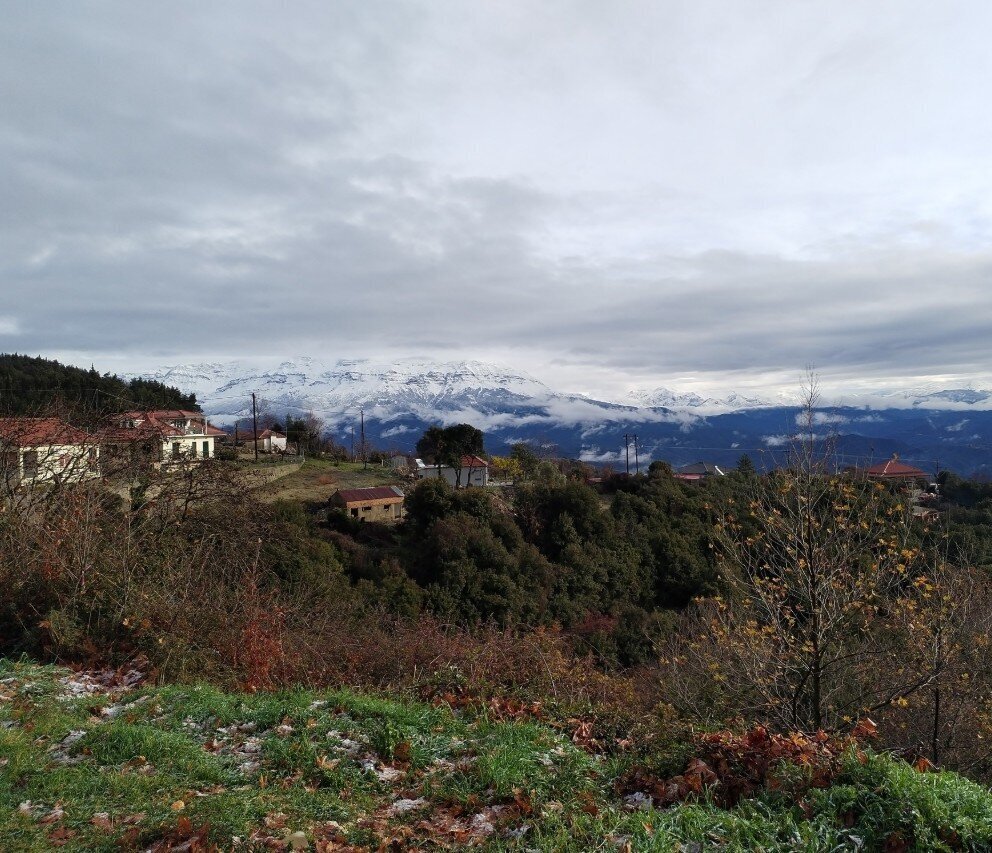
It was a treat for everyone to listen to her article as we traveled up and down on windy mountain roads, amidst a lush landscape that was crowned with heavily snowcapped mountains and thick cloud formations.

At the end of her beautiful and highly descriptive article, the lady reporter informed us that she had last visited the bridge a few days before it collapsed. She had taken several photographs that day, and, would you believe, those wound up playing an integral part in the reconstruction of the bridge!

This is because when the professors at the Athens Polytechnic University heard about her article they contacted her, hoping to acquire photographs of the bridge, so they could reconstruct it as closely as possible to its original design.

It turned out she had a wealth of photographs from all possible angles from surface level to give them, and these photographs made up the model they managed to recreate.

Sadly, I do not know the name of the reporter to give her credit here, but I am sure those who used her photos have already honored her by name for her contribution to this amazing reconstruction. I cannot help but think it was fate she had visited just a few days before the catastrophe to take all these photos.


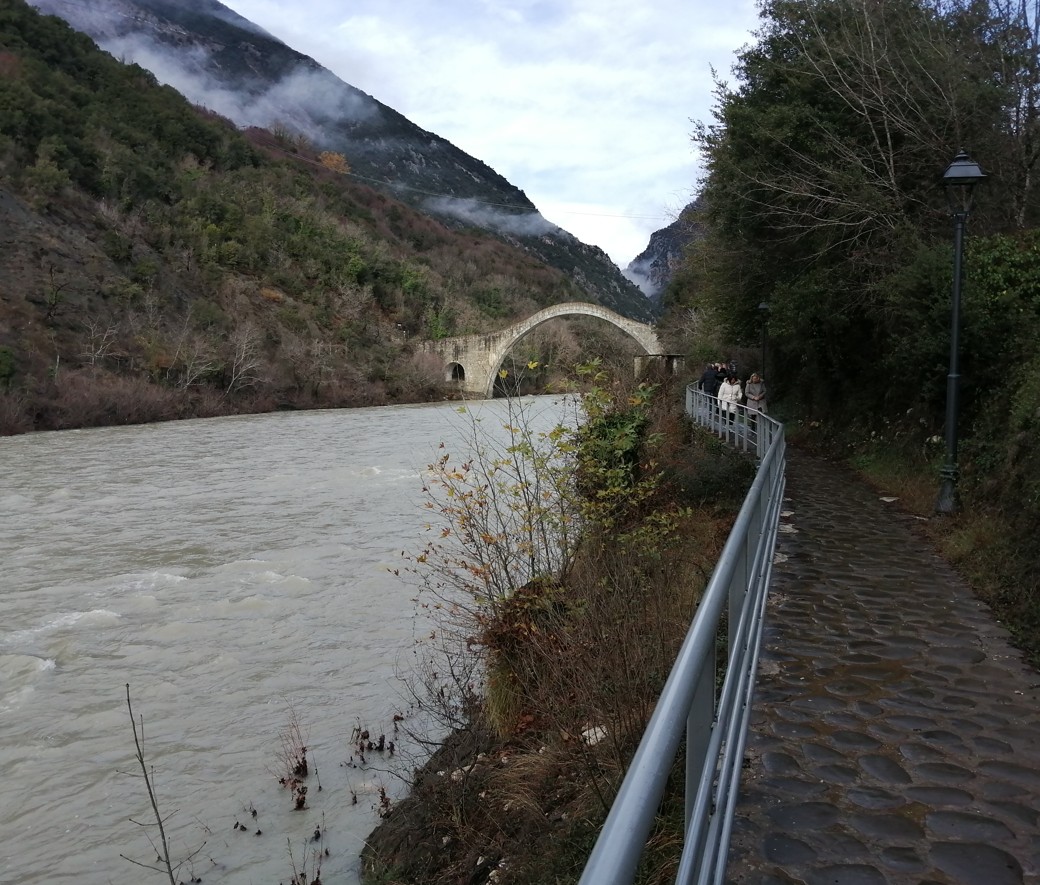
As we took the beautiful paved path alongside the river Arachthos from the large parking area to the bridge, we couldn’t help but marvel at both its size and its beauty.

The lush mountains crowned by the fog that quiet Christmas eve morning when we visited served as the ideal backdrop that encouraged everyone to keep taking photographs and made the atmosphere even more enchanting.

Walking on this bridge remains to this day an unforgettable experience for me. I have walked on several stone bridges in Zagori, but the incline on this one towards the center was that something else. The top of the arch is on a much higher level than one would expect, because of the steep incline leading up to it near the center from both sides.

I found walking on the bridge very difficult near the top, especially coming down from it.

Plus, seeing that the ledge was low, there was nothing to hold on to up there. Therefore, I wouldn’t recommend walking on this bridge near the top unless you are confident on your feet, or, at least, without having someone strong to hold on to.


Just look at me on this photo. It may not show, but I was getting ready to faint😵‍💫hehe

No, seriously now, it was a wonderful experience. The view from up there was fantastic.

Go here for a super-short video that shows a 360-degree view from the top of the bridge.

But getting up there wasn’t the only reason why I used the word ‘intrepid’ on the heading earlier!

The more important reason is related to a sign that stands at the entrance of the bridge. According to it, the architects who rebuilt it in the recent years did not apply any modern reinforcement techniques whatsoever. This was so they could maintain the exact look that the stone bridge had always had.

Thus, they simply couldn’t vouch that it was safe! As a result, the sign warns visitors that by walking on the bridge they do so at their own risk!

I tell you, I haven’t taken that many risks in one day since I was a reckless teen 😂

GO HERE for all my photographs from the bridge as well as for beautiful vistas along the mountain roads.

My travel report from Epirus isn’t finished yet, by the way. See you in the next newsletters for the final two parts!


The secret of “Psari Plaki” is in the layers…

In Greek cuisine, “Plaki” is a type of cooking that involves either fish (psari plaki) or lentils, like broad beans (fasolia plaki).

Today, I am pleased to share my family recipe for ‘psari plaki’, meaning ‘fish plaki’. The word ‘plaki’ is probably derived from ancient Greek, as ‘plakion’ was the name of a marble or iron slab used for baking, a tradition that still survives today in some parts of Greece where housewives still use iron pans to bake breads or savory pancakes that they call ‘plakopitta.’

In the Greek language today, the word ‘plaka’ means a marble slab or a tile, and thus, in my understanding, ‘plaki’ means baking that requires some kind of laying, as in setting the food in layers.

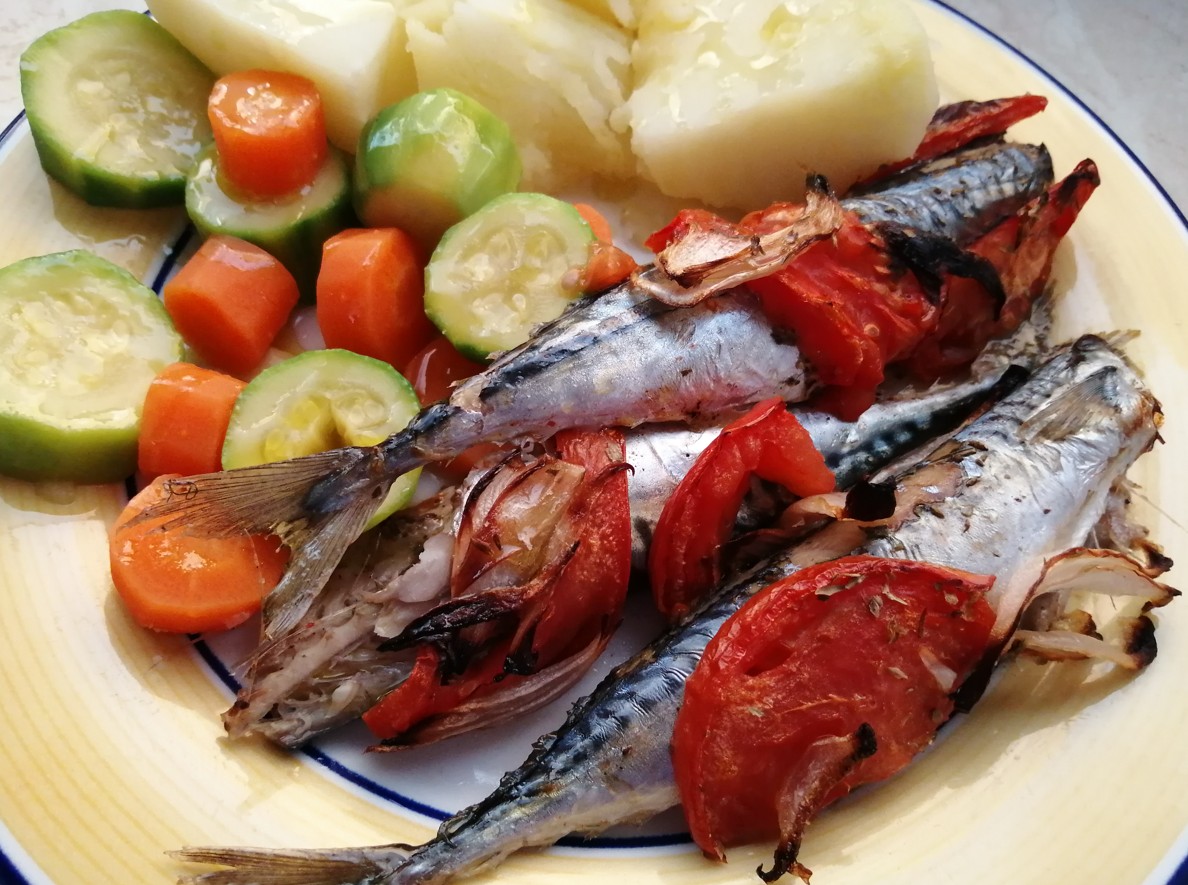
Such is the case in my recipe, where the fish is cooked whole, covered with thick slices of tomato and onion, in this particular order. Under this covering, the fish absorbs the aromas and the juices of these vegetables and, thus, is kept soft during baking. The result is a succulent fish that tastes phenomenal, especially as this recipe also involves the rich aromas of dried oregano and garlic.

Please note that there isn’t one standard recipe of plaki, and that there are infinite varieties from all around Greece. Some recipes involve a rich tomato sauce and no vegetable covering for the fish, and others include potato and carrot chunks in the pan. My recipe is basic, and, thus, quicker to rustle up.

This is the classic ‘psari plaki’ recipe. My mother and her own mother never made it any other way.

The fish should be baked whole and thus only small to medium-sized fish must be used. I use mackerel in this recipe, but you can also try scorpaena, plaice, haddock, swordfish, sea bream etc. Basically, any fish with white flesh that comes from the sea will do.

So, what do you say? Will you try it?

GO HERE to get the recipe and enjoy!


Sharing is caring! Here’s a ready tweet for you to spread some love:

Interested in travel, food and books from Greece? Here's a blog you will love! #Greek #blogger #writer Share on X

3 FREE books for you! Sign up below to receive them instantly!

NEW! Clean Christmas romance. Single mother Cathy Roussos gave up on love long ago, and veterinarian Alex Rallis doesn’t believe in it, but one magical Christmas on a Santorini farm might just change everything…
Check it out on Amazon     Read a FREE sample!
 

A clean romantic suspense short read with an unreliable narrator that’ll keep you guessing! Vera is losing her mind over famous actor Yannnis Ksenos, except, she isn’t just a fan… Now, she plucks up the courage to ring his doorbell… Visit Amazon


For my delicious Greek recipes, go here
 
Planning to visit Greece? Check out my  FREE guide to south Corfu!

The alluring sea lake of Messolonghi and a family recipe for squid stew

I visited Messolonghi by coach during my Christmas break in Epirus where I stayed in the historical city of Arta.

On our way back to Athens, the driver took us for a ride around the sea lake of Messolonghi, a historical town that is famous for an amazing feat of bravery during the Greek war of Independence.

The town was under siege by Turkish forces for many months, and the people had suffered for a long time with hunger and thirst. Seeing that their demise was certain, instead of surrendering to the Turks, they decided upon a heroic exodus from within the city walls, attacking the enemy with what little strength they had left. It was the night between the 10th and the 11th of April, 1826, and their heroism is still remembered today, as one of the most humbling acts of bravery the Greeks have ever known.

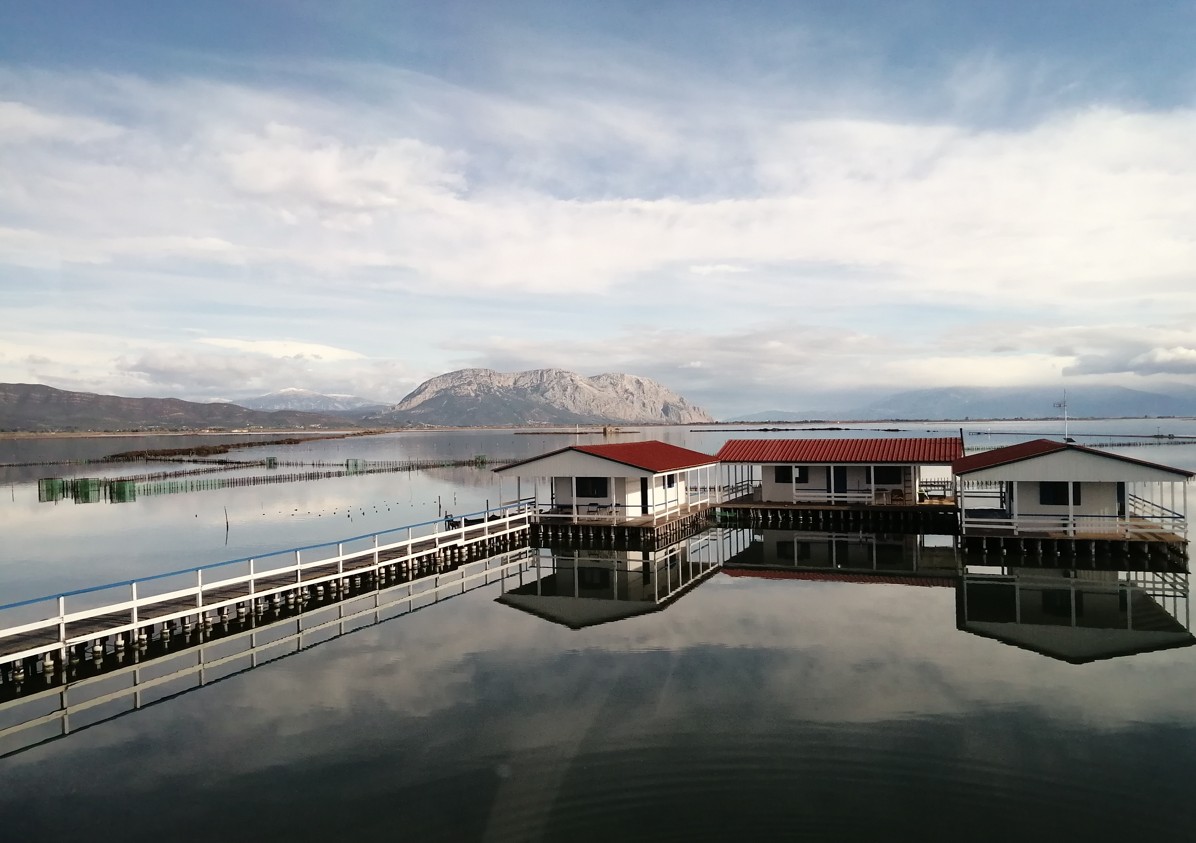
Today, Messolonghi is a stunning bustling town, graced by its beautiful sea lake (lagoon) that offers a treasure of gifts to both locals and tourists.

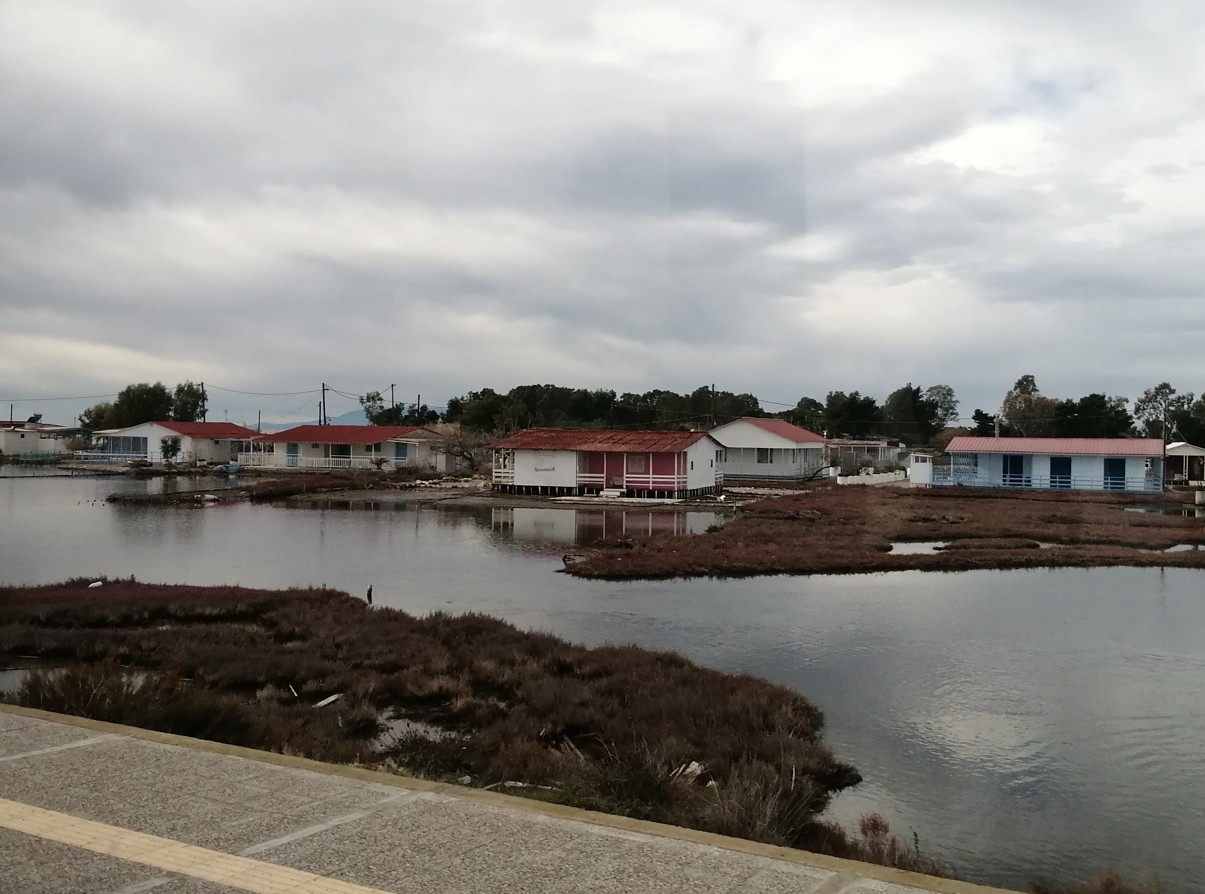
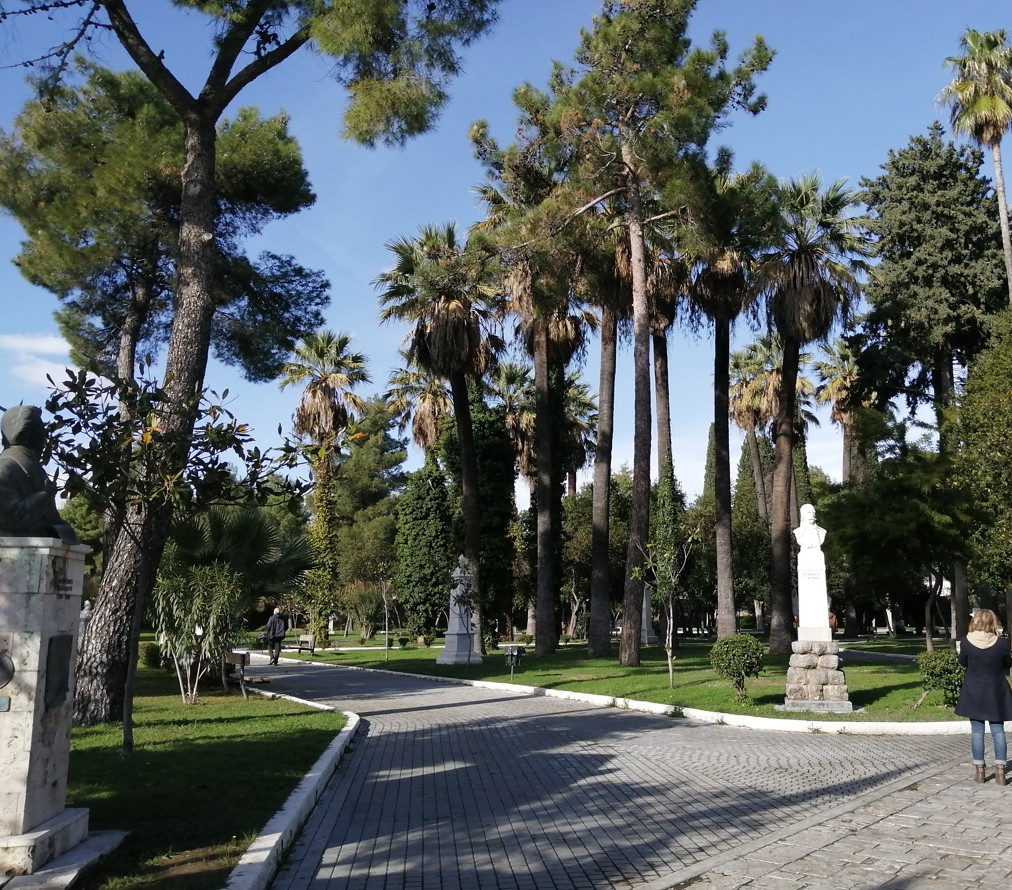
In the quaint residential areas of Kleisova and Tourlida, where I took the photos you can see above, the landscape is dotted with colorful and charming stilt houses on the sea lake that the locals call “pelades.”

The salt produce of Messolonghi, which comes in various types, is famous and highly sought after all over Greece as it contains high nutritional value (92 different metals and other nutrients).

On the quiet beach where we made a short stop a little further away from Tourlida there is a small museum dedicated to salt. There, at the little shop, people can buy various types of salt.

Messolonghi is also famous for its fish produce, including sea bass, eel, and tarama (i.e. bottarga – a mediterranean kind of caviar). At the many exquisite tavernas in town cooks prepare fish dishes with flair, confident about the freshness and high quality of the fish on offer that the sea lake provides in abundance.

One of the resident birds at the sea lake is the colorful Akyoni bird with its mournful song that resembles a kingfisher.

According to the ancient Greek legend, Alkyoni used to be a princess… She and her husband Ceyx were boastful and blesphemous towards Zeus and Hera. To punish them, Zeus killed Ceyx with a thunderbolt. When Alkyoni found out she threw herself into the sea. Then, the gods took pity on them both and turned them into Alkyoni birds.

On top of that, and as the Alkyoni birds made their nests on the rocks by the sea, the gods decreed that in the middle of winter there should be about 14 days of calm weather so that the alkyoni eggs can hatch safely.

Hence, the term the “Days of Alkyoni” (“Halkyone Days” aka “Alkyonides” in Greek) that traditionally come around the middle to the end of January in Greece every year, when it’s sunny and generally mild.

On our way out of the town of Messolonghi we stopped at the “Garden of the Heroes,” a grassy park of about 14 acres with tall palm trees, eucalyptus trees and pines that is dotted with 69 beautiful monuments, and even some tombs of local heroes, from various wars.

Some of the monuments were donated by armies of other countries that were allies or enemies to Greece in its many wars, such as Russia, Italy, Germany and France.

The buried remains here include those of the hero of the Greek war of Independence Markos Botsaris. In 1858, King Otto and Queen Amalia of Greece financed the planting of trees and donated a marble lion for the park.

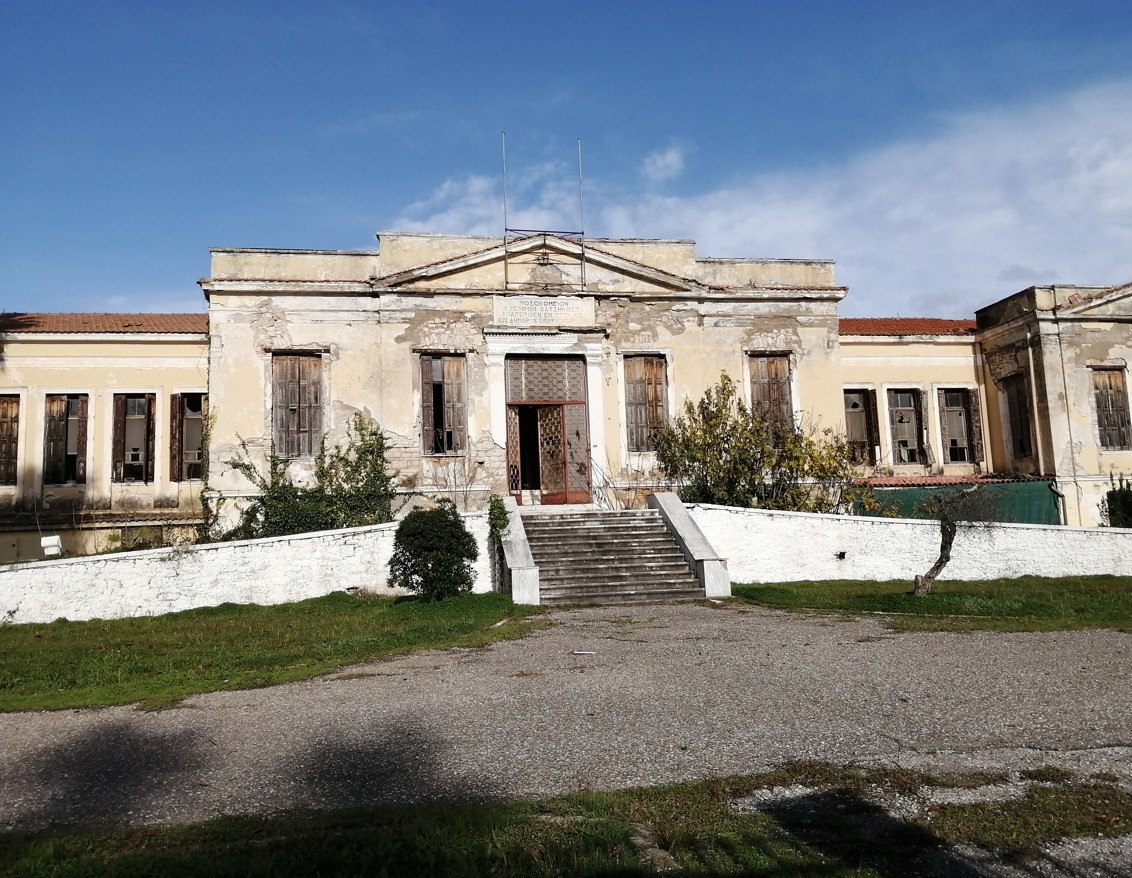
I loved strolling around this beautiful park on a sunny day with the sound of birdsong delightful in my ears. However, my experience was considerably enriched, albeit with a great measure of sadness, to see the decrepit building of the town’s old hospital barely standing erect right beside the park.

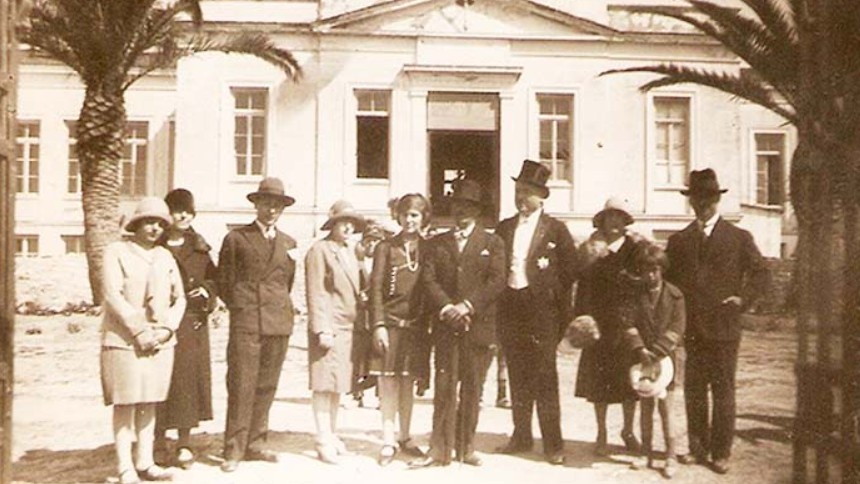
Old image credit: Fourtounis.gr

Messolonghi’s old hospital was built in 1906 and was in operation until 1999. It is such a pity that it was abandoned and turned derelict to this tremendous extent in just over a couple of decades, having been totally left to its fate to battle the elements.

The marble plaque above the entrance reads: “Chatzikosta Brothers Hospital, founded 1906, during the years of the Mayor Sokratis…” (the surname is illegible).

Indeed, a bit of research confirmed the hospital was built and financed by brothers Georgios and Anastasios Chatzikostas. This is one of the oldest hospitals of Greece.

As I looked at it from behind the fence, unable to get closer, I tried to imagine its heyday, when it was busy with staff, visitors and patients coming and going in haste, the latter arriving by foot on stretchers, and others in army vehicles, during the many dark years of wars that my country has known since 1906. That’s two world wars, and the bloodiest one of all for my country, i.e. the civil war that followed WWII.

I look at the old photograph above which provides such a depressing contrast to the forlorn look of the hospital today and can only shake my head ruefully.

Still, I always aspire to a future in my country where gems of the past such as this one will be cherished and protected, instead of being left to go to ruin by neglect.

On a cheerful note, GO HERE to see all my photos from Messolonghi.

It was a swift visit, so I feel I need to go back there and stay awhile. For one, to absorb the beauty of the place and to walk along the seafront road that stretches for miles, the lake stunning, a splendid silver mirror under the blue sky.

I can see why Lord Byron loved Messolonghi so much… The great romantic poet was forever inspired by the brave Greeks, who fought for their freedom. He died in his cherished Messolonghi on April 19, 1824, at the age of 36, having been defeated by a high fever.

His body was embalmed to be sent for burial back to England, but the people of Messolonghi, who loved him just as much as he loved them, asked that part of him stays there. According to some sources, Byron’s heart remained in Messolonghi…

I don’t know about you, but all this talk about the sea lake of Messolonghi and its produce made me think ‘seafood’ LOL! So, I thought it would be apt to share one of my seafood recipes here with you.

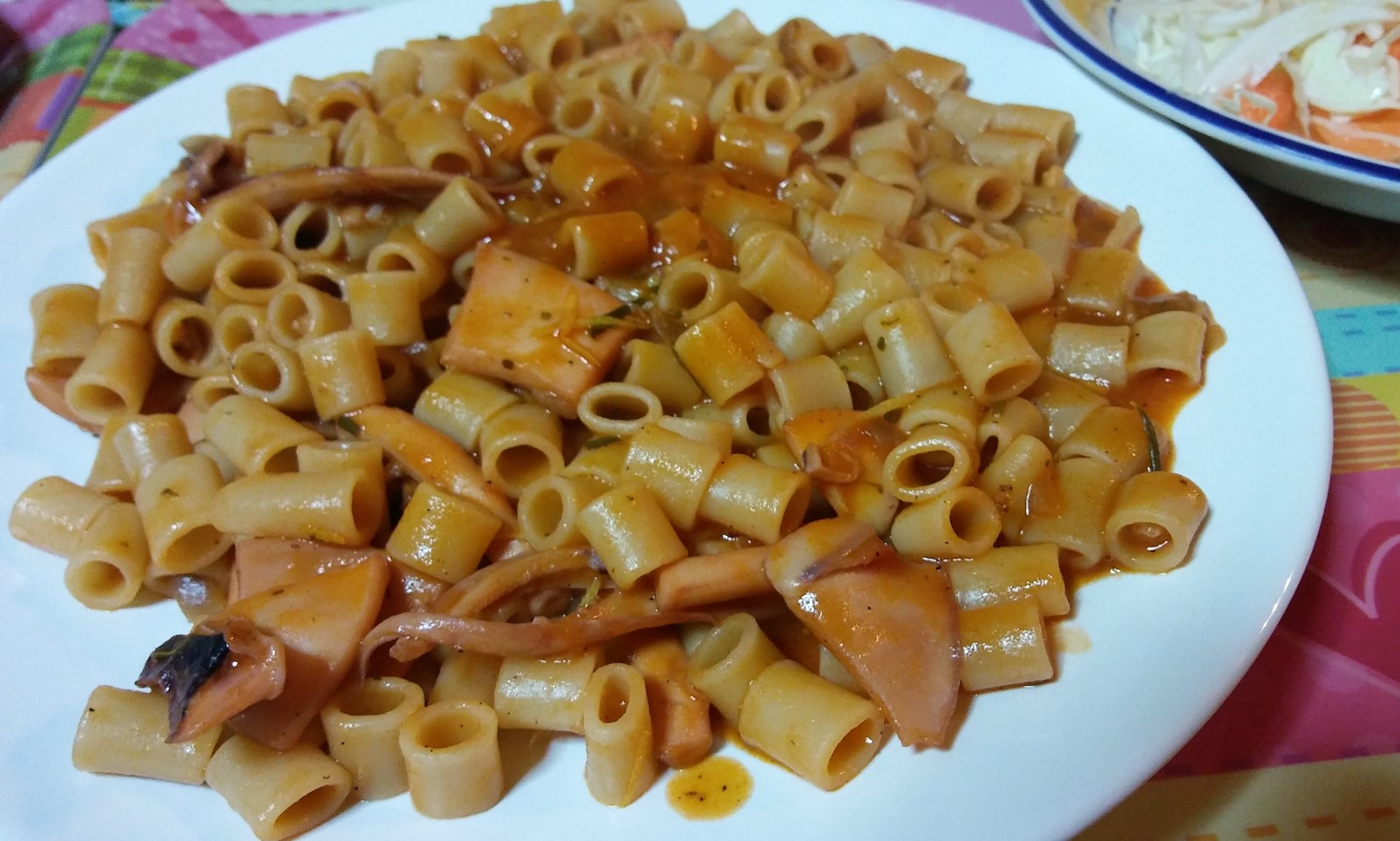
It is my father’s recipe for cuttlefish (‘soupia’, in Greek)  in tomato sauce, but squid (‘calamari’), which is smaller, can also be used. This meal can be equally enjoyed with rice, potato or pasta.

GO HERE TO GET THE RECIPE

Enjoy!


Sharing is caring! Here’s a ready tweet for you to spread some love:

Interested in travel, food and books from Greece? Here's a blog you will love! #Greek #blogger #writer Share on X


3 FREE books for you! Sign up below to receive them instantly!

NEW! Clean Christmas romance. Single mother Cathy Roussos gave up on love long ago, and veterinarian Alex Rallis doesn’t believe in it, but one magical Christmas on a Santorini farm might just change everything…
Check it out on Amazon     Read a FREE sample!
 

A clean romantic suspense short read with an unreliable narrator that’ll keep you guessing! Vera is losing her mind over famous actor Yannnis Ksenos, except, she isn’t just a fan… Now, she plucks up the courage to ring his doorbell… Visit Amazon
 

For my delicious Greek recipes, go here
 
Planning to visit Greece? Check out my  FREE guide to south Corfu!