Shortly after publishing my article about The British Cemetery in Corfu town I received an email from Royal Navy Veteran Frank Carrick from Ayrshire, Scotland. Frank read my article and wanted to share with me his own experience as well as an article of his own. I found it very moving and highly informative, a true gem. With his kind permission, I am delighted to share it with you all today.
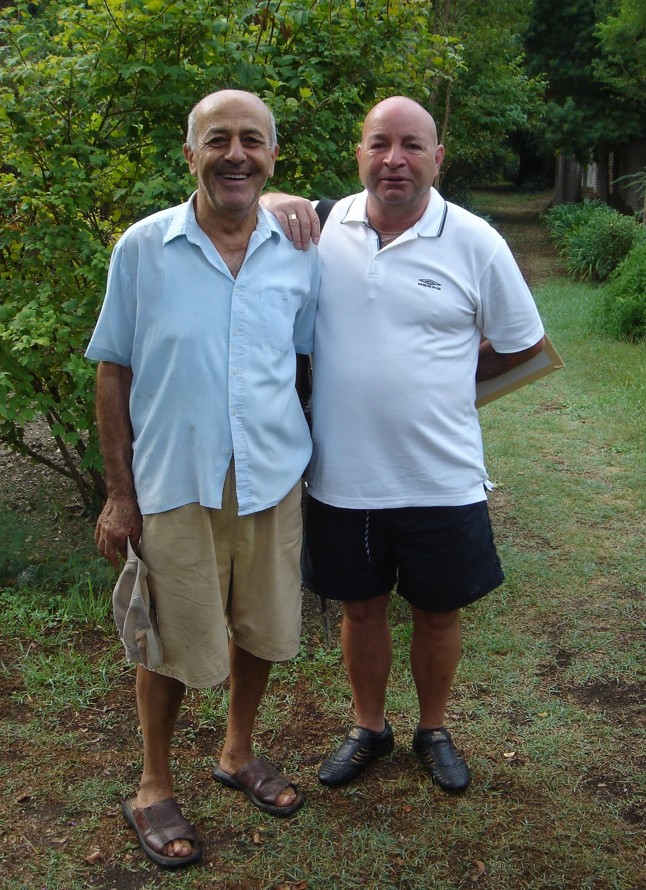
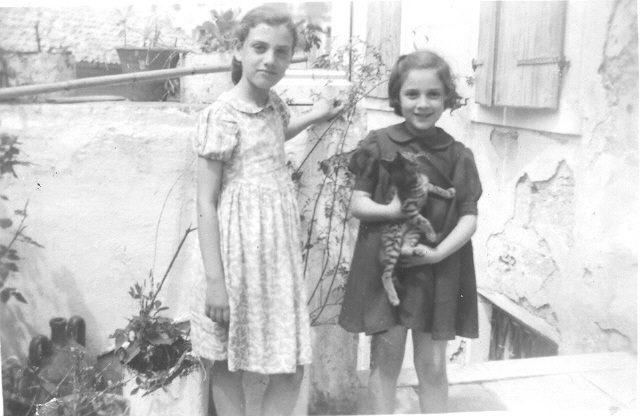
George Psailas (pictured left), and Frank Carrick during the latter’s first visit to the cemetery.
Frank told me the kindest things about George Psailas, the caretaker of the cemetery for many years, whom he once was fortunate enough to meet in person. George Psailas gave him a copy of a booklet he had written on the orchids of the cemetery. Frank cherishes it to this day.
George Psailas was a bit of an expert on orchids and also took care of a multitude of tortoises that lived in the cemetery when he was there. The whole place was thriving at the time, and he lived his whole life in this quiet corner of Corfu town.
From the little I’ve heard, it seems to me that the whole Psailas family were honorable people, who did a remarkable job with the cemetery while it was in their care. During the German Occupation, they hid a Jewish family at the house where they lived, inside the cemetery. What a brave act that was, saving the lives of these innocents from certain torment and annihilation.
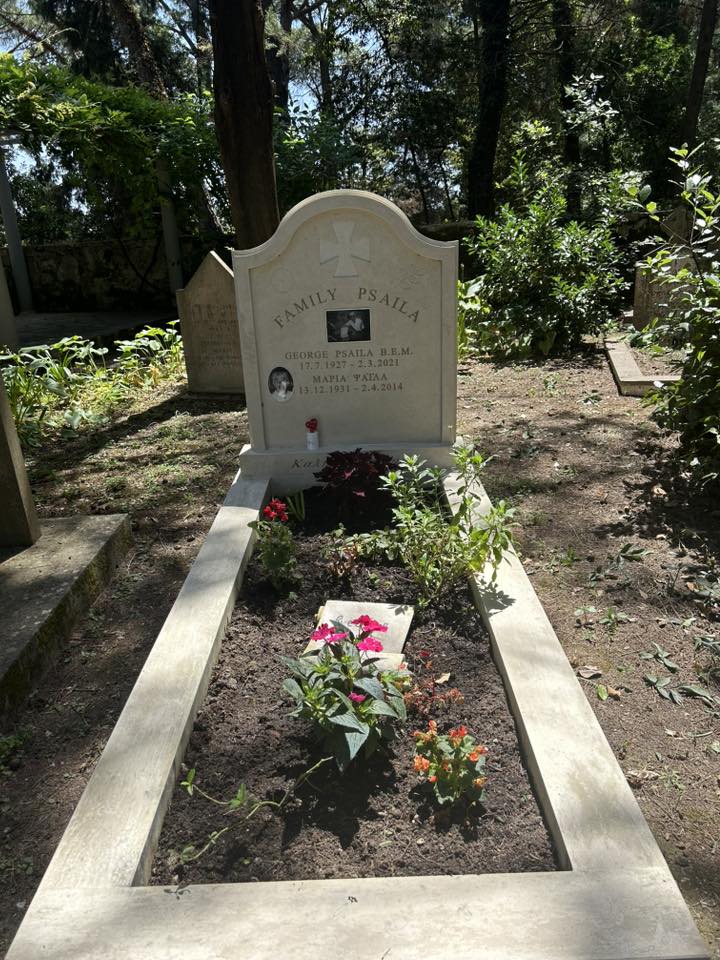
George Psailas is buried with his wife Marie right at the top of the main path of the cemetery (photo credit: Kevin Atkinson)
Frank Carrick, who has been visiting Dassia, Corfu for his summer holidays with his family for many years, visits the cemetery whenever he is on the island. Sometimes, he leaves wreaths on the graves of the heroes and, other times, leaves memorial poppies.
Without further ado, here’s Frank’s original article about the British Cemetery, George Psailas, and the Corfu Incident, as he wrote it back in 2007 when George Psailas (who died in 2021) was still with us.
The British Cemetery and The Corfu Channel Incident – by Frank Carrick
As a regular visitor to Corfu I thought I had seen most of the island and places of interest.
However, back in 2004, one of my Greek friends asked if I had ever paid a visit to the British Cemetery in Corfu Town.
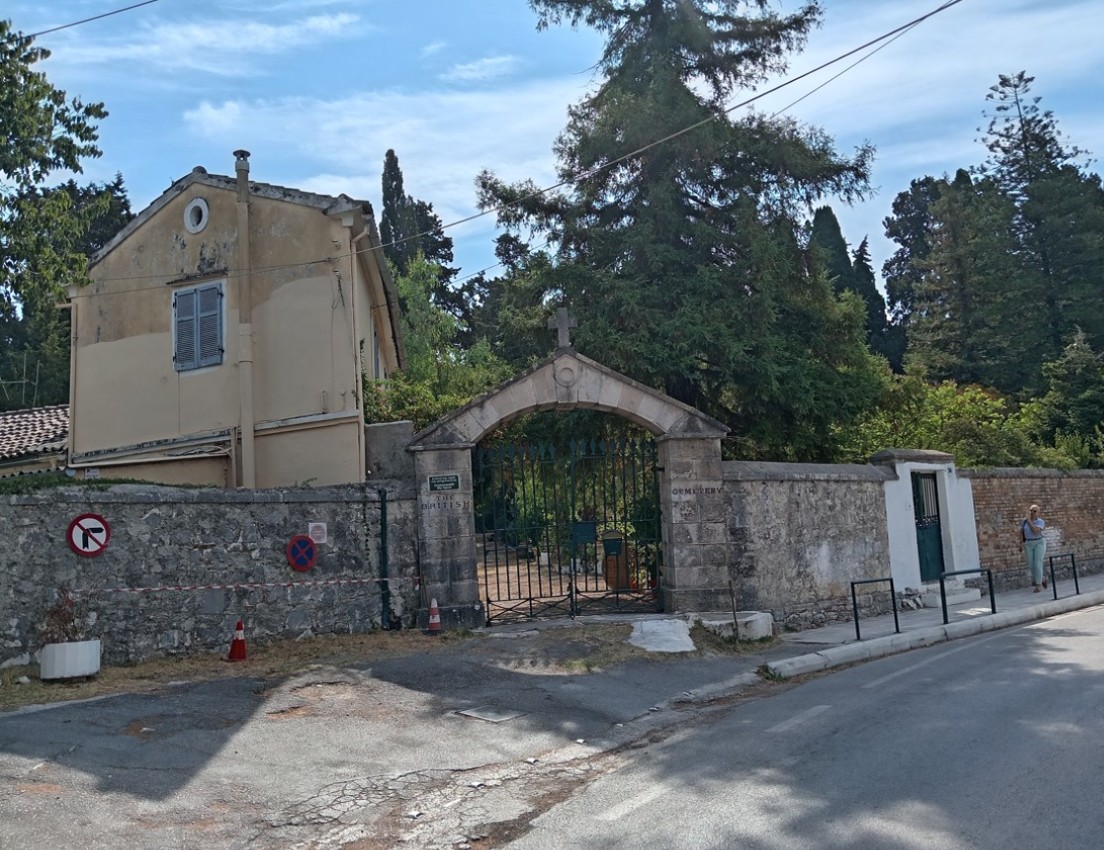
To my shame, I had never even heard of it! The very next morning, I set off for the Town and the Cemetery thinking it would be difficult to find as I had never seen it in all my visits to Corfu, but my fears were unfounded; just crossed San Rocco Square to the Airport Road, walked about a hundred yards and there it was, the gate to the British Cemetery.
As I opened the gate, it was like entering another world. It was so quiet, tranquil, and after the traffic noise and the hustle and bustle of the dusty town centre it was like heaven, unbelievably peaceful and quiet. A little bell disturbs the peace for a second as the gate is opened, and almost instantly, the figure of the caretaker appears before you.
He enquires as to your preferred language, introduces himself and then proceeds to give the visitor the history of the cemetery, locations of certain memorials and a bit of his own life story, and offers a guided tour.
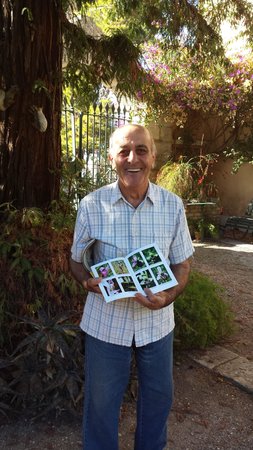
George Psailas and his booklet, ‘The Orchid House’. George is buried with his wife Marie right at the top of the main path of the cemetery.
The caretaker is called George Psailas and he was born in 1927 in the cemetery. He was married in the cemetery and he will show you where he will be buried when his time comes. George took over the duties of caretaker in 1944 on the death of his father, who had looked after the Cemetery since 1924.
The British Cemetery in Corfu town is also famous worldwide for the orchids that grow in the gardens. Some, so I’ve been told, grow nowhere else. Visitors from all around the world come to see them bloom in I believe March/April/May.
In addition to the supervision of the cemetery, George is also responsible for the orchids and is a bit of an expert. On my first visit, George accompanied me around the cemetery gardens pointing out interesting monuments and telling me of some of the people buried there.
The cemetery is the last resting place for British soldiers, sailors and members of their families since 1814 when Corfu was under British Protection (1814-1864). However, there is a section dedicated to Germans killed during their occupation of the island (1943-44) and even some from the Kaiser’s time (his personal boat crew). Most of the German remains have been returned to Germany although the monuments remain.
One interesting German grave is of Erich Kerizen (09.10.1944), murdered by his own men after he prevented the destruction of the harbour in Corfu Town by cutting connections to the explosives as the Germans were leaving at the end of the occupation.
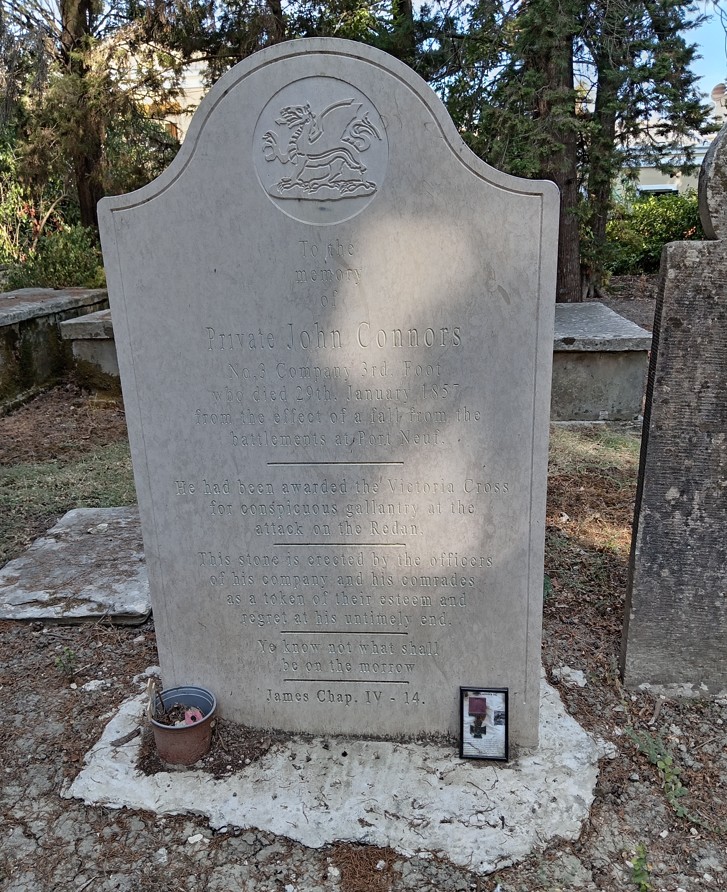
The cemetery also contains the remains and memorial to British VC holder John Connors (1830-1857). He was about 24 years old, and a private in the 3rd Regiment (later, The East Kent Regiment – The Buffs), in the British Army during the Crimean War when the following deed took place for which he was awarded the VC:
On 8 September 1855 at Sebastopol in the Crimea, Private Connors showed conspicuous gallantry at the assault on the Redan in personal conflict with the enemy. He rescued an officer of the 30th Regiment who was surrounded by Russians, by shooting one and bayoneting another, and then for some time carried on a hand-to-hand encounter against great odds until support arrived. He survived the war and died in Corfu 29th Jan 1857.
There are a few more interesting monuments all around these quiet gardens, with their own captivating tales, but the area I personally found to be most intriguing was the memorial and graves of British sailors killed during what became known as ‘The Corfu Incident’.
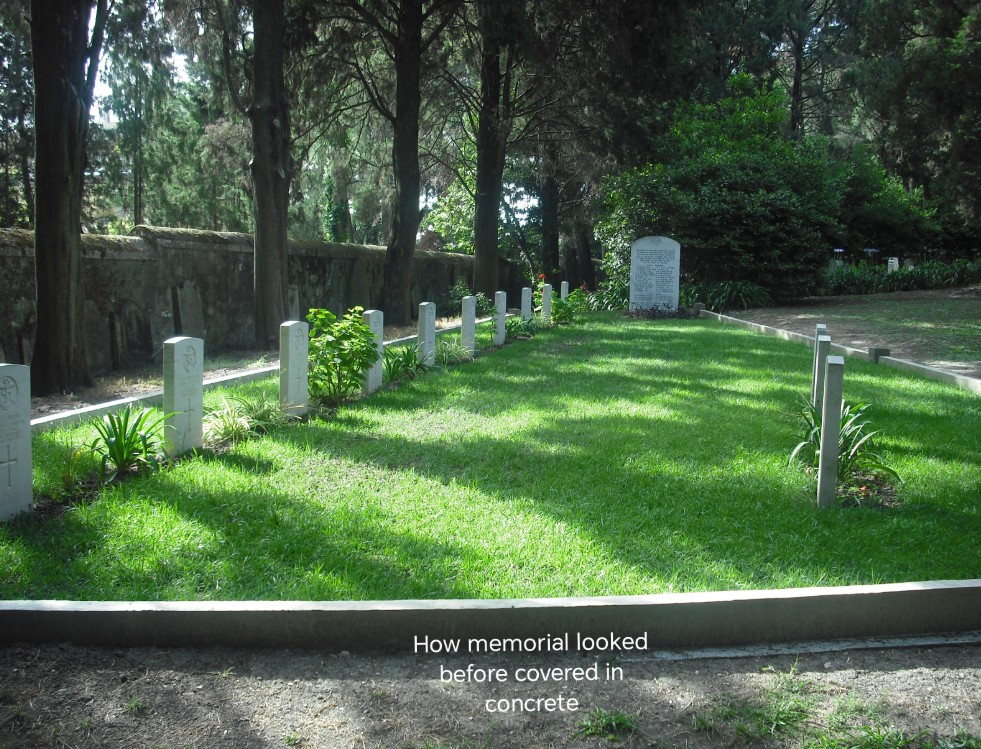
In the far left-hand side of the cemetery, deep in the shade, stands a large white stone, with the names of 32 Royal Navy personnel from the ships HMS Volage and HMS Saumarez, who were killed by Albanian mines in 1946. Their bodies were never recovered. In a neat line leading away from the main memorial lie another 13 smaller white stones.
These mark the remains of those 12 sailors recovered from the ships, plus the remains of a young midshipman (18 years old) from HMS Forth, who died in Gibraltar in 1951 and was transferred to Corfu. Being ex-RN I became intrigued by these graves and the story surrounding them.
I had never heard of the ‘Corfu Incident’, and yet, here lay the remains of 44 British Seaman killed by mines one year after the war had ended. Why and how? I decided to find out not only for myself, but to keep the story alive in the hope that these sailors would not be forgotten.
Here is what I’ve found out so far. In May of 1946, Albanian shore batteries fired upon two British cruisers, HMS Orion and HMS Superb. As Britain had just won the war and supposedly ruled the seas, they could not ignore this episode had to make the point that the straits between Corfu and Albania could and should be used freely by ships going about their lawful and peaceful business. In a show of force designed to demonstrate who was boss (my opinion), in October 1946, four British ships led by the cruiser HMS Mauritius sailed through the narrow channel, which were at the time recognised International Waters.
HMS Saumarez, a destroyer, was in second in line, with the cruiser HMS Leander and destroyer HMS Volage, following behind. Just off Saranda, HMS Saumarez struck a mine. It was a massive explosion just below her bridge on the starboard side. HMS Volage was ordered to aid the crippled ship and, if possible, take her under tow.
The Volage managed to secure a tow rope, (despite the surrounding sea burning with oil) and start the tow. Tragically, as she moved off, she herself hit a mine which blew off her bow, the tow, and instantly killed eight men.
Despite the damage and loss of life to HMS Volage her crew courageously manoeuvred her back to a position where she could recover the tow. She accomplished this but had to tow the Saumarez astern; that is both ships sailing stern first. What a feat of seamanship and real bravery.
It took thirteen hours to travel the sixteen miles to Corfu. It must have been a terrifying experience for all the surviving seamen living through the horror of the explosion and the loss of their shipmates and friends. For every minute that passed of those long hours at sea, the thought in the back of their own minds must have been, ‘Are there any more mines?’ Thirteen hours of expecting another explosion, of ‘Is this my last moment?’
The channel had been swept clear of mines after the war. The straits had also been used recently without incident, so there was no way of knowing if the rest of the passage through the straits would be safe. Terrifying indeed.
They must also have been very brave. A total of 44 men were killed. There were also another 50 men who suffered serious injuries. Albania denied laying the mines and any knowledge of them. However, the Royal Navy swept the Straits and found that, in all, there had been a total of 25 brand new mines in the channel. This proved they were not rogue mines left over from the war.
The League of Nations proved that the mines could not have been put in position without the knowledge of Albania, who had manned look-out points and shore batteries all along the coast. Albania counter-charged Britain for trespassing in Albanian waters without permission and sweeping for mines. Britain was found guilty of this charge! Albania was found guilty of laying the mines or having knowledge of them and fined about £830,000. The fine was never paid nor an apology ever received for the murder of those sailors, for that was what it was. Murder!
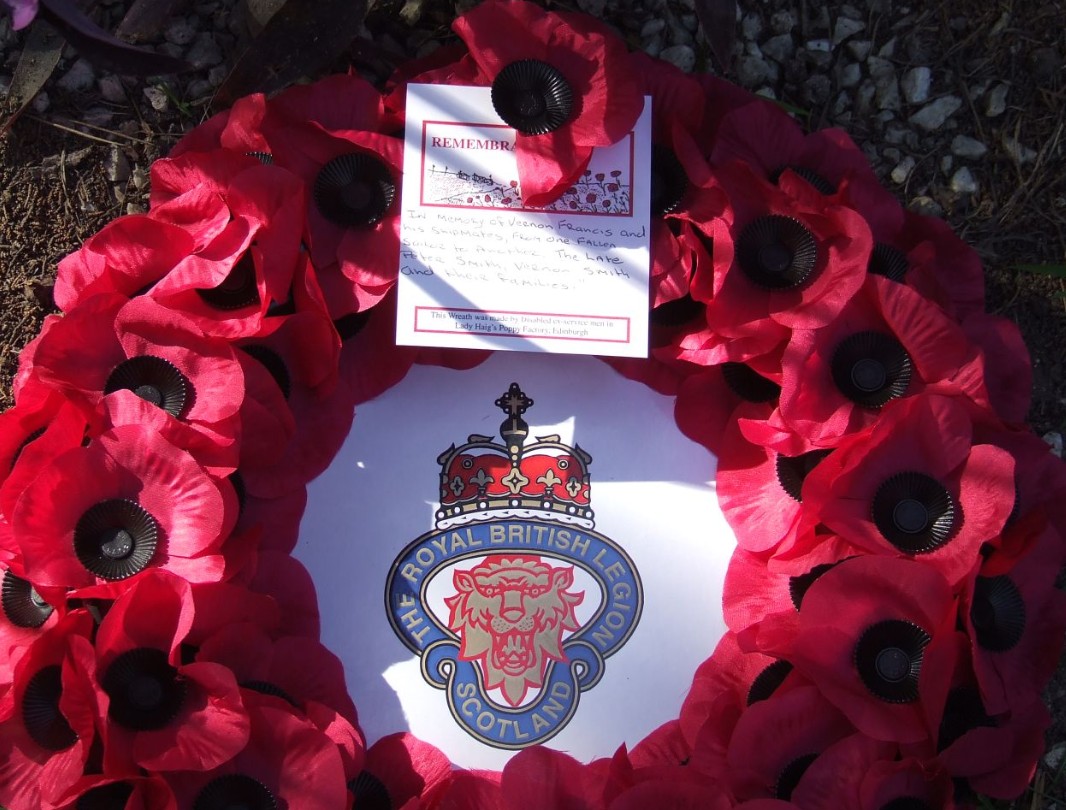
In June of this year 2007, I returned to Corfu with a wreath from the RBLS Irvine Branch and placed it at the memorial to the men killed in the Corfu Incident. I was accompanied by a friend–Dave Hughes. (ex-Para). It was Dave’s first visit and he was quite moved, not only by the incident, but also by the British Cemetery and the dedication of George Psailas to his task of looking after the gardens. I say ‘gardens’, for that is what they are.
Every grave has wild flowers growing on them, and although it is a cemetery it is still a delightful place to have a stroll or even spend some time watching the resident tortoises wander around (George puts out fresh fruit and veg for them) in the shade.
It must be really beautiful when the orchids are in bloom. On leaving the cemetery, there is a visitors’ book and many messages in many languages appear here. You can also leave a small donation to help with the upkeep. You don’t have to and no offence is taken if you refrain.
The wreath laid this year was dedicated not only to those men lost during ‘The Incident’ but to the Late Peter Smith who served on HMS Saumarez and survived the mine. He died on the 28th April this year. Peter’s best friend or ‘Oppoe’ was AB Vernon Francis who was killed by the mine and his body was never recovered. Peter named his son after his pal, and that son, Vernon Smith, asked me to say a few words on his behalf at the memorial.
Vernon also told me his father was always troubled by the fact that he never knew if his friend Vernon’s body was ever recovered. It is to my regret that I could not give a definite answer to him before he passed away.
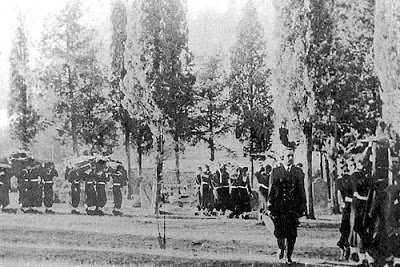
The old photograph of the funeral in the British Cemetery is by kind permission of George Psailas, the caretaker of the British Cemetery, and it is featured in a little booklet he wrote called ‘The Orchid House’.
All the heroes buried at the British cemetery shall grow not old, as we that are left grow old: Age shall not weary them, nor the years contemn. At the going down of the sun and in the morning We will remember them.
The words written in this article are my own, as are the opinions. The whole incident has been covered by better and more informed people than me. There has been a book written on the subject, which I have been unable to acquire at this time.
The title is ‘The Corfu Incident” by Eric Leggett. New English Library: 1976 ISBN-13: 9780450024740 ISBN: 0450024741
George Psailas attended the funerals of the sailors killed by the mines in his second year as Supervisor.
The Commonwealth War Graves Commission awarded him a prize of honour in 1977.
It reads: ‘Certificate Presented by the Commonwealth War Graves Commission to George Psailas In Recognition of Long and Devoted Service’.
Directions to the British Cemetery:
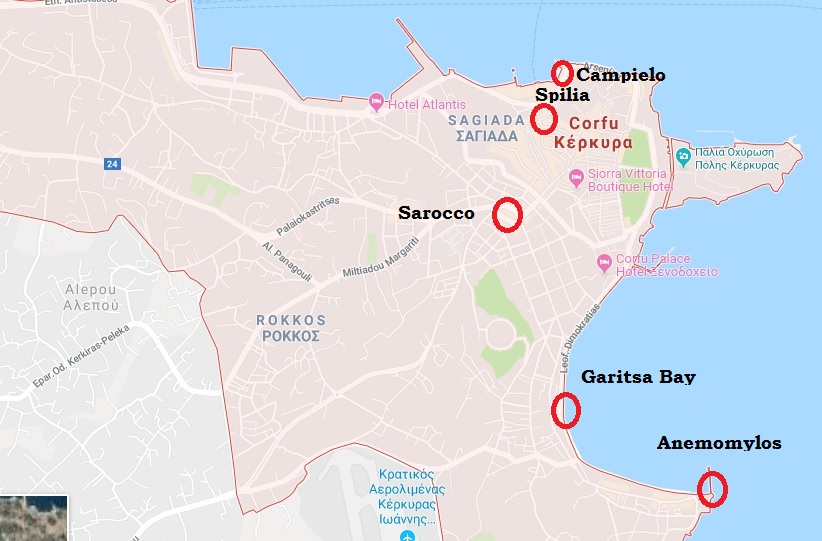
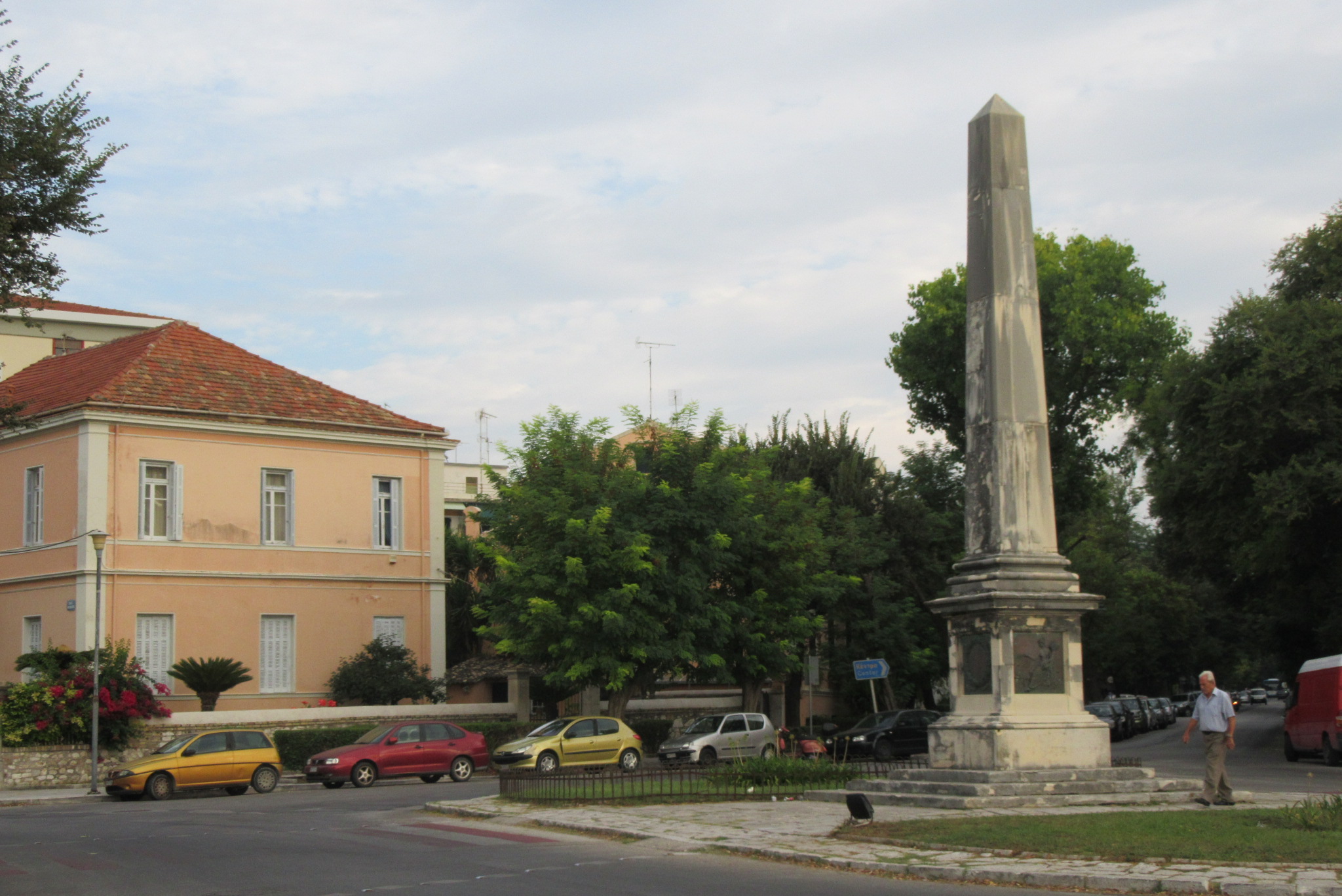
From Corfu seafront to south of the old town and turn inland onto Alexandras Avenue, which is a big tree-lined avenue. At the top of this is Sarocco Square which contains a huge roundabout.
From this roundabout, if you’re driving, follow the signs for the hospital and the British Cemetery down Polichronis Konstanta. The cemetery is to the left and very close to the prison.
If on foot, when you reach Sarocco Square from Alexandras Avenue go left into Methodiou street, a busy road lined with shops. Just before the T-junction, you’ll see a street corner on your left (Kolokotronis Streeet). The cemetery is a few meters down that street. You will see it shortly after you turn the corner.
I offer my heartfelt thanks to Frank Carrick for sending me his beautiful and highly informative article. His love and respect for our military men to whom we all owe our freedom today, shines through.
I will end this article in a similar fashion, with the timeless poem, The Soldier, by Robert Brooke to pay my own respects to the heroes buried in the cemetery:
‘If I should die, think only this of me: That there’s some corner of a foreign field that is for ever England. There shall be in that rich earth a richer dust concealed; a dust whom England bore, shaped, made aware, gave, once, her flowers to love, her ways to roam; A body of England’s, breathing English air, washed by the rivers, blest by suns of home.
And think, this heart, all evil shed away, a pulse in the eternal mind, no less gives somewhere back the thoughts by England given; her sights and sounds; dreams happy as her day; and laughter, learnt of friends; and gentleness, in hearts at peace, under an English heaven.’
THANK YOU FOR READING! MAKE SURE TO DOWNLOAD MY 3 FREE BOOKS BELOW 🙂 YOU WILL RECEIVE THEM INSTANTLY WITH YOUR SUBSCRIPTION TO MY FUTURE POSTS.
Sharing is caring! Here’s a ready tweet for you to spread some love:
Interested in FREE books, Greek travel and easy recipes? Here's a blog you will love! #Greek #blogger #writer Share on X
3 FREE books for you! Sign up below to receive them instantly!
Clean Christmas romance. Single mother Cathy Roussos gave up on love long ago, and veterinarian Alex Rallis doesn’t believe in it, but one magical Christmas on a Santorini farm might just change everything…
Check it out on Amazon Read a FREE sample!
A clean romantic suspense short read that’ll keep you guessing! Vera is losing her mind over famous actor Yannnis Ksenos, except, she isn’t just a fan. Now, she plucks up the courage to ring his doorbell… Visit Amazon
For my delicious Greek recipes, go here.
Planning to visit Greece? Check out my FREE guide to south Corfu!
Clean romance short read, FREE with Kindle Unlimited. It’ll transport you straight to Corfu to experience summer in an idyllic Greek seaside village. The story is inspired from the author’s love for Moraitika and its people. Now, also available as an audio book! Visit Amazon